Stock Analysis · Bread Financial Holdings Inc (BFH)
Overview
Bread Financial Holdings Inc. is a consumer finance company focused on private-label and co-brand credit cards, installment lending, and related payment products. In simple terms, it helps retailers and other partners offer financing to customers at the checkout, both in stores and online. The company earns money mainly by lending to consumers and by providing card and payment services to merchant partners.
Its business is centered on credit services, so revenue is driven primarily by finance charges and fees generated from customer loans and credit card balances. Based on recent company reporting, the mix is heavily tilted toward interest-based income, with smaller contributions from service and interchange-related activity.
- Interest and fees on credit card and loan receivables: approximately 80% to 90% of total revenue. This includes finance charges, late fees, and other charges tied to private-label cards, co-brand cards, and installment loans.
- Interchange and merchant-related revenue: approximately 5% to 10%. This comes from payment activity on cards and arrangements with retail and brand partners.
- Other revenue: generally below 10%. This can include servicing-related items, gains or adjustments connected to the loan portfolio, and other smaller operating streams.
Bread Financial is not a diversified bank or a broad payments network. It is a more specialized lender and card platform operator, which makes the company easier to understand but also more exposed to the health of U.S. consumers, retailer partnerships, and credit performance.
The business has shown that revenue can recover and expand over time, but profit conversion has been uneven. Revenue moved from roughly $3.3 billion in 2021 to about $4.7 billion in 2025, while net income swung much more sharply from year to year. That pattern matters because it shows Bread Financial can grow receivables and sales, but earnings remain sensitive to funding costs, credit trends, and operating efficiency.
Key Figures
| Metric | Value | Sector ⓘ |
|---|---|---|
| Date | Oct 03, 2026 | |
| Context | ||
| Sector | Financial Services | |
| Industry | Credit Services | |
| Market Cap ⓘ | $3.76B | |
| Beta ⓘ | 1.13 | |
Value (Cheapness) | ||
| P/E Ratio ⓘ | 7.58 | 12.60 |
| P/B Ratio ⓘ | 1.17 | 1.23 |
| FCF Yield ⓘ | 58.18% | 10.16% |
| Dividend Yield ⓘ | 0.90% | 2.96% |
| EBIT / EV ⓘ | N/A | 7.77% |
| PEG ⓘ | 2.16 | |
Growth (Business expansion) | ||
| Revenue Growth ⓘ | 3.80% | 9.50% |
| RPS Growth (5Y CAGR) ⓘ | 11.79% | 12.10% |
| EPS Growth (5Y CAGR) ⓘ | 13.68% | -9.45% |
| BVPS Growth (5Y CAGR) ⓘ | 14.75% | 5.01% |
| Margin Growth (5Y Trend) ⓘ | -18.86% | -4.07% |
| FCF Growth (5Y CAGR) ⓘ | 9.43% | 4.96% |
| DPS Growth (5Y CAGR) ⓘ | 2.11% | 8.79% |
Quality (Business durability) | ||
| ROIC (Latest) ⓘ | N/A | 9.60% |
| ROE (Latest) ⓘ | 17.00% | 13.84% |
| ROA (Latest) ⓘ | 2.57% | 1.53% |
| ROIC (5Y Median) ⓘ | 7.20% | 7.86% |
| ROE (5Y Median) ⓘ | 16.24% | 12.20% |
| ROA (5Y Median) ⓘ | 2.27% | 1.29% |
| Net Debt / EBIT (Latest) ⓘ | N/A | 0.91 |
| Net Debt / EBIT (5Y Median) ⓘ | 1.91 | 0.74 |
| Net Debt / EBITDA (Latest) ⓘ | -0.54 | 0.97 |
| Operating Margin (Latest) ⓘ | N/A | 22.12% |
| Operating Margin (5Y Median) ⓘ | 22.57% | 24.39% |
| Debt to Equity (Latest) ⓘ | 97.62% | 60.37% |
| Profit Margin (Latest) ⓘ | 21.36% | 26.62% |
| Free Cash Flow (Latest) ⓘ | $2.19B | |
Momentum (Price trend) | ||
| 3Y Return ⓘ | +203.87% | +89.23% |
| 12M Return (excl. last month) ⓘ | +55.93% | +17.35% |
| 6M Return ⓘ | +32.40% | +10.00% |
| Price vs. 200-Day MA ⓘ | +9.26% | +3.73% |
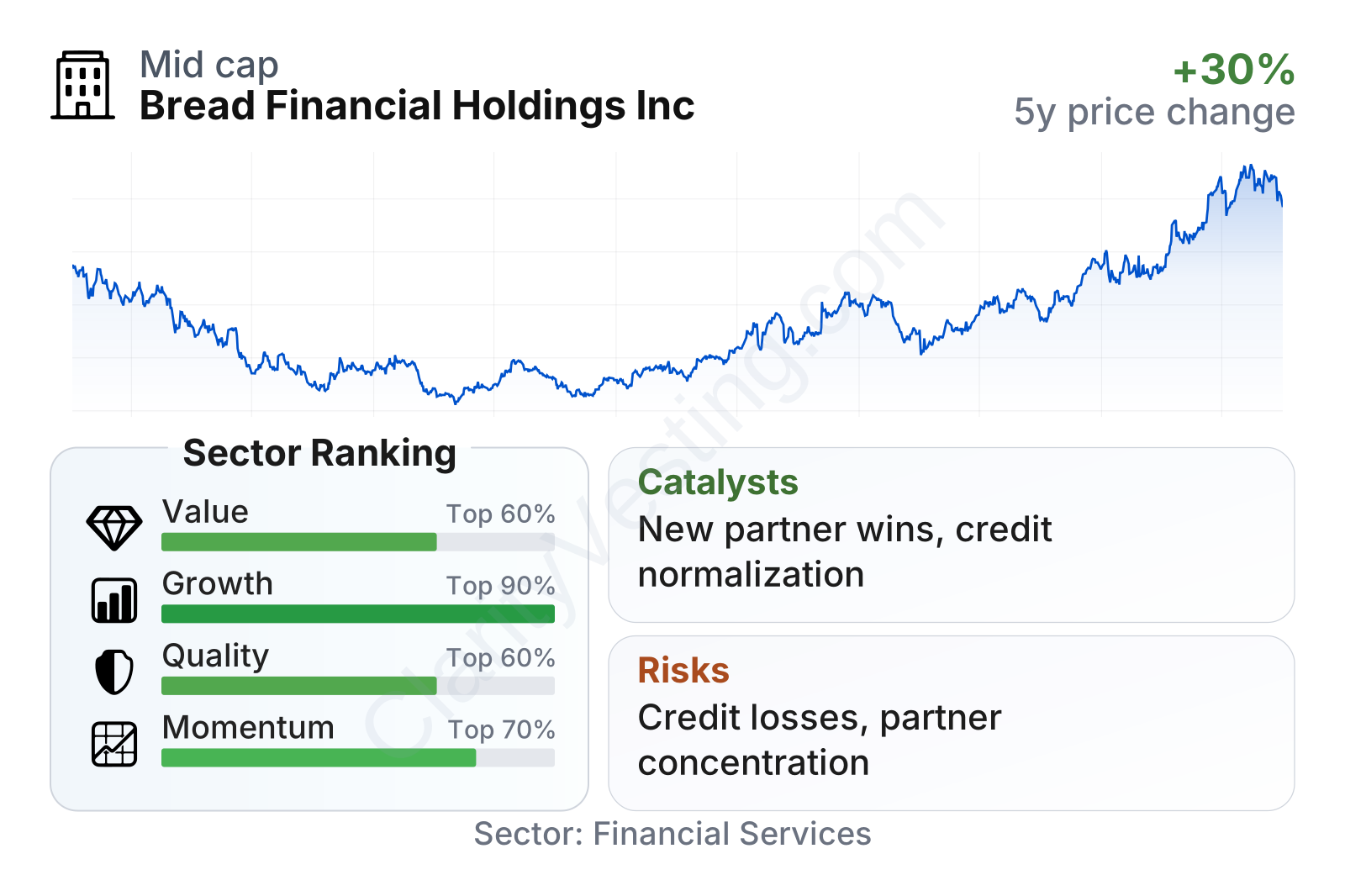
Bread Financial sits in the mid-cap range, with a stock that has been more volatile than the broader market. The latest factor profile looks mixed but not weak: valuation appears moderate on earnings, growth metrics are strong over a multi-year period, and profitability is above many sector peers on return measures. At the same time, revenue growth is not especially fast right now, leverage is higher than the sector median, and the dividend yield is low at under 1%.
The stock chart highlights how dramatic sentiment shifts can be for this company. Shares fell hard in 2022 and 2023, then rebounded strongly through 2025 and into 2026. That kind of move usually reflects how closely the market ties Bread Financial’s value to credit conditions, loan losses, and funding expectations rather than to steady, utility-like growth.
Growth
Bread Financial operates in a sector with long-term relevance. Consumer credit, digital checkout financing, and loyalty-linked payment products remain important for retailers trying to drive repeat spending. The broader opportunity is supported by the ongoing shift toward digital commerce and embedded finance, where financing is offered directly inside the shopping experience.
The company’s strategy is logical for that environment. Instead of competing as a mass-market card issuer with the largest banks on every front, Bread Financial focuses on branded partnerships and retailer-linked programs. That can create a more tailored product offering and make the company valuable to merchants that want data, customer engagement, and financing tools in one platform.
A major catalyst is the company’s ability to deepen existing partner relationships and sign new ones, especially in digital and omnichannel retail. Another is portfolio discipline: if underwriting remains sound while receivables expand, earnings can rise quickly because fixed platform costs do not need to grow at the same pace as loan balances.
Earnings per share have been volatile rather than smooth, but the multi-year pattern is still stronger than much of the sector. Five-year EPS growth has outpaced the median financial services peer group, even though individual years have varied sharply. That suggests the underlying earnings power is real, but it comes with a cyclical profile.
Book value per share has climbed substantially over the last five years, from the low $40s to above $70 by 2025. For a lender, that is an important sign because book value reflects the capital base supporting the credit business. This trend indicates Bread Financial has been building shareholder equity even while navigating uneven profit cycles.
Recent company updates have also emphasized capital returns, funding management, and portfolio execution. In a lender like Bread Financial, these are not secondary details: they directly affect confidence in earnings durability. If funding costs stabilize and credit performance remains manageable, the company has a clearer path to translating receivable growth into stronger net income.
Risks
This article is for informational purposes only and does not constitute financial advice. Some content is AI-generated. See Disclaimer