Stock Analysis · Bank First National Corp (BFC)
Overview
Bank First National Corp is a regional bank based in Wisconsin. Through its main banking subsidiary, Bank First, it provides traditional community banking services to businesses, professionals, and consumers. Its activities include commercial lending, commercial real estate lending, agricultural lending, residential mortgages, consumer loans, deposit gathering, treasury management, and wealth-related services. In simple terms, the company makes money largely by taking deposits, lending those funds at higher rates, and earning fees from banking services.
For a regional bank like Bank First, revenue is usually driven by a few core streams. Based on the company’s business model and disclosures, the main sources are approximately the following:
- Net interest income: about 80% to 90% — the spread between interest earned on loans and securities and interest paid on deposits and borrowings. This is the engine of the business.
- Service charges and deposit-related fees: about 4% to 8% — account fees, treasury management charges, debit-card related income, and other everyday banking fees.
- Loan-related and mortgage banking income: about 2% to 6% — gains on loan sales, mortgage origination-related activity, and certain lending fees.
- Wealth management, trust, and other noninterest income: about 2% to 5% — advisory, fiduciary, and miscellaneous customer-service revenue.
What stands out is that Bank First remains a plain-vanilla bank rather than a diversified financial conglomerate. That can be a strength for readability and control, but it also means results are closely tied to loan growth, deposit costs, and credit quality. Over the last several years, total revenue has expanded sharply, while net income has also trended higher despite periods of pressure from rising funding costs.
The business has clearly grown in scale since 2021, with revenue roughly doubling by 2025. However, the path has not been perfectly smooth: interest expense climbed materially as rates moved up, and operating costs also increased, showing that part of the growth has come with higher funding and staffing costs.
Key Figures
| Metric | Value | Sector ⓘ |
|---|---|---|
| Date | Oct 24, 2026 | |
| Context | ||
| Sector | Financial Services | |
| Industry | Banks - Regional | |
| Market Cap ⓘ | $1.57B | |
| Beta ⓘ | 0.41 | |
Value (Cheapness) | ||
| P/E Ratio ⓘ | 19.33 | 12.46 |
| P/B Ratio ⓘ | 1.95 | 1.25 |
| FCF Yield ⓘ | 2.70% | 9.82% |
| Dividend Yield ⓘ | 0.30% | 2.94% |
| EBIT / EV ⓘ | 6.91% | 8.11% |
| PEG ⓘ | 0.10 | |
Growth (Business expansion) | ||
| Revenue Growth ⓘ | 48.30% | 9.10% |
| RPS Growth (5Y CAGR) ⓘ | 12.47% | 12.31% |
| EPS Growth (5Y CAGR) ⓘ | 4.50% | -6.97% |
| BVPS Growth (5Y CAGR) ⓘ | -35.62% | 5.02% |
| Margin Growth (5Y Trend) ⓘ | -14.68% | -4.00% |
| FCF Growth (5Y CAGR) ⓘ | 12.76% | 4.71% |
| DPS Growth (5Y CAGR) ⓘ | 47.02% | 8.92% |
Quality (Business durability) | ||
| ROIC (Latest) ⓘ | 9.30% | 9.18% |
| ROE (Latest) ⓘ | 11.82% | 13.93% |
| ROA (Latest) ⓘ | 1.66% | 1.57% |
| ROIC (5Y Median) ⓘ | 10.94% | 7.80% |
| ROE (5Y Median) ⓘ | 10.41% | 12.15% |
| ROA (5Y Median) ⓘ | 1.59% | 1.28% |
| Net Debt / EBIT (Latest) ⓘ | -1.61 | 1.02 |
| Net Debt / EBIT (5Y Median) ⓘ | -1.43 | 0.72 |
| Net Debt / EBITDA (Latest) ⓘ | -1.16 | 0.88 |
| Operating Margin (Latest) ⓘ | 34.54% | 22.30% |
| Operating Margin (5Y Median) ⓘ | 45.60% | 24.50% |
| Debt to Equity (Latest) ⓘ | 9.66% | 59.34% |
| Profit Margin (Latest) ⓘ | 36.46% | 26.42% |
| Free Cash Flow (Latest) ⓘ | $42.58M | |
Momentum (Price trend) | ||
| 3Y Return ⓘ | +109.60% | +95.73% |
| 12M Return (excl. last month) ⓘ | +21.03% | +17.30% |
| 6M Return ⓘ | +5.40% | +6.07% |
| Price vs. 200-Day MA ⓘ | +1.35% | +5.36% |
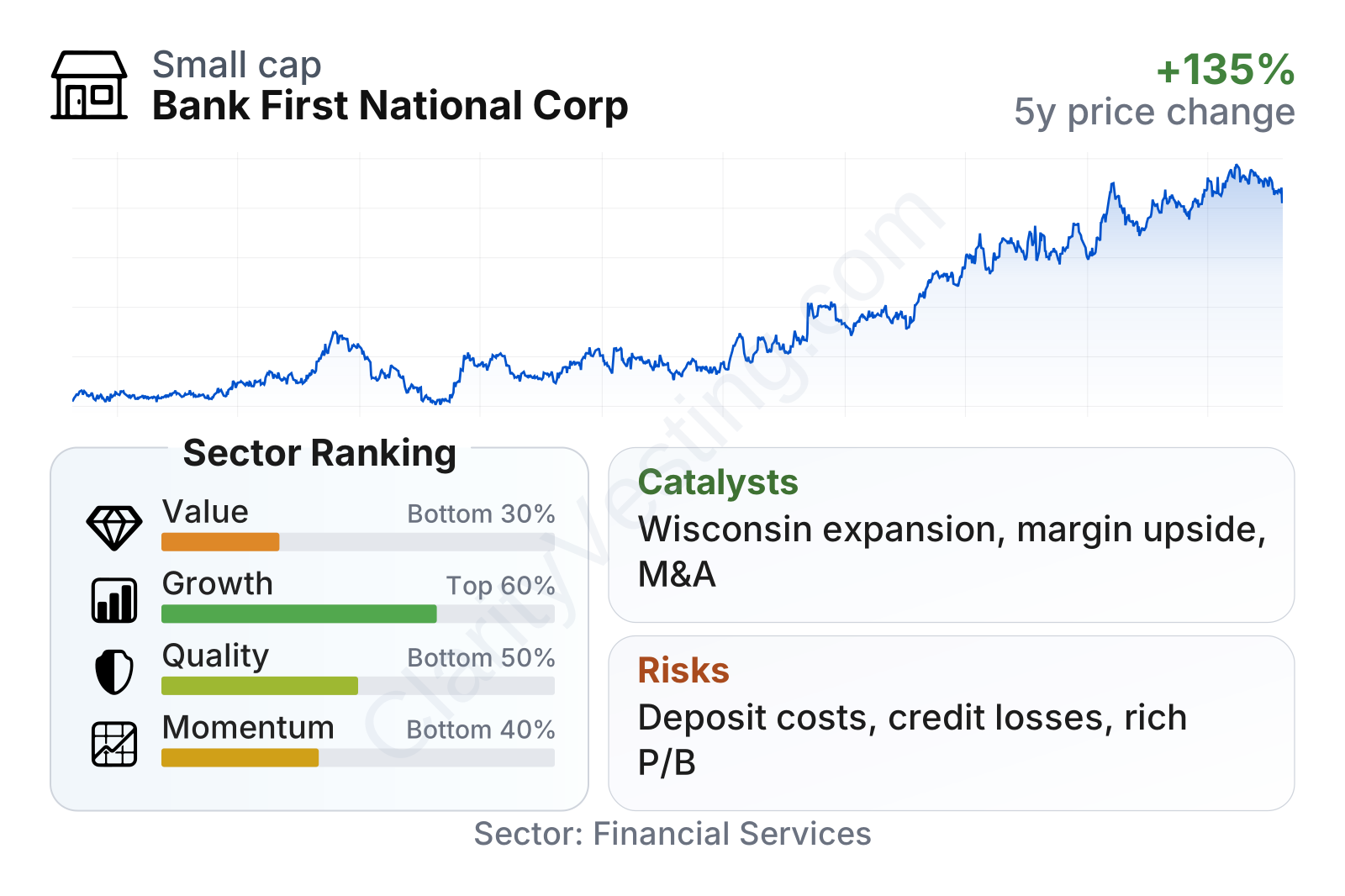
Bank First is a small-cap regional bank with relatively low share-price volatility, as shown by its low beta. The broad picture from the metrics is mixed. Profitability remains solid, with a strong profit margin and asset returns that are around sector norms or slightly better over time. Balance-sheet leverage also looks conservative compared with many regional peers. On the other hand, the stock trades at a noticeable premium to the sector on earnings and book value, which places its value factor ranking in the weaker part of the group. Growth metrics are uneven as well: recent revenue growth has been strong, but longer-term earnings and book value trends are less clean than the headline revenue increase suggests.
The share price has risen strongly over the past several years, especially from 2024 into 2026. That move helps explain why valuation multiples now sit above many regional-bank peers and why the dividend yield looks modest relative to the sector median.
Growth
Bank First operates in regional banking, a mature sector rather than a high-growth one. That said, mature does not mean stagnant. Community and regional banks can still grow by gaining local market share, expanding commercial relationships, acquiring smaller institutions, and deepening services with existing customers. Bank First’s strategy appears consistent with that model: build scale in Wisconsin and nearby markets, keep a business-focused loan book, and use local relationships as a competitive edge.
Recent growth has been helped by both organic expansion and acquisitions completed in recent years. The company has shown a meaningful increase in revenue, and its longer-term revenue-per-share growth is close to the sector norm. That indicates growth has not been purely cosmetic. At the same time, the path for per-share value creation needs a careful reading because earnings and book value trends have been more volatile than revenue alone would suggest.
Earnings per share dipped from 2021 through 2023, then recovered in 2024 and improved again in 2025. That pattern matters because it suggests the bank was able to work through a tougher rate environment and rebuild profitability rather than simply post one-off results. The partial 2026 reading implies profitability is still holding up, although a full-year view is needed before drawing strong conclusions.
Book value per share appears much more stable after the unusual 2021 starting point and has generally moved upward from 2022 through 2025. For a bank, book value is an important anchor because it reflects the capital base supporting future lending. A rising book value over several years, even at a moderate pace, usually points to retained earnings and balance-sheet resilience.
As for future catalysts, the most important ones are straightforward. If interest rates stabilize or move in a way that eases deposit-cost pressure, net interest margin could improve. Continued loan growth in commercial, agricultural, and real estate lending would also help. In addition, Bank First has historically used acquisitions to expand its footprint; if management continues to integrate deals well, that can provide another leg of growth beyond the bank’s existing branch network.
There is also a practical industry tailwind: many smaller community banks face rising compliance and technology costs, which can make consolidation attractive. A well-run regional bank with solid capital can benefit from that environment by picking up customers, lenders, or even entire institutions in adjacent markets.
Risks
This article is for informational purposes only and does not constitute financial advice. Some content is AI-generated. See Disclaimer


