Stock Analysis · Brookfield Renewable Partners LP (BEP)
Overview
Brookfield Renewable Partners LP is a global renewable power and energy transition company. In simple terms, it owns, operates, and develops assets that produce electricity from renewable sources such as hydroelectric, wind, solar, and energy storage. It also invests in related businesses that support decarbonization, including distributed generation, carbon capture, renewable natural gas, recycling, and nuclear services through its broader transition platform. The partnership is part of the Brookfield group, which gives it access to large pools of capital, operating expertise, and deal flow across many regions.
The business model is built around long-life infrastructure. Brookfield Renewable develops or acquires power assets, signs contracts to sell electricity, and then collects recurring cash flow over long periods. This tends to make revenue more predictable than in many other industries, although results can still move with power prices, hydrology, currency swings, and financing costs.
Based on company reporting, revenue is diversified by technology rather than concentrated in one single source. The largest categories are generally:
- Hydroelectric: approximately 40% to 45% of generating capacity. This includes dams and water-powered generation assets, which are important because they often have long useful lives and operational flexibility.
- Wind: approximately 25% to 30% of generating capacity. This includes onshore wind farms across North America, South America, Europe, and Asia.
- Solar and distributed generation: approximately 20% to 25%. This covers utility-scale solar, rooftop systems, and localized energy solutions for commercial and industrial customers.
- Storage and other transition businesses: approximately 5% to 10%. This includes battery storage and certain decarbonization-related operations that are becoming more relevant to future growth.
Geographically, Brookfield Renewable is also diversified across North America, South America, Europe, and Asia-Pacific. That reduces dependence on any one electricity market, but it also adds currency and regulatory complexity.
Over the last several years, the business has expanded meaningfully. Revenue rose from roughly $4.1 billion in 2021 to about $6.5 billion in 2025. At the same time, interest expense climbed sharply, which helps explain why accounting earnings have remained thin even as the asset base and operating scale increased.
The broad pattern is clear: Brookfield Renewable has been growing revenue and operating income, but a larger share of that operating progress has been absorbed by financing costs. That is a central theme for understanding the company.
Key Figures
| Metric | Value | Sector ⓘ |
|---|---|---|
| Date | Oct 17, 2026 | |
| Context | ||
| Sector | Utilities | |
| Industry | Utilities - Renewable | |
| Market Cap ⓘ | $13.93B | |
| Beta ⓘ | 0.98 | |
Value (Cheapness) | ||
| P/E Ratio ⓘ | N/A | 17.28 |
| P/B Ratio ⓘ | 1.94 | 1.51 |
| FCF Yield ⓘ | -33.88% | 0.65% |
| Dividend Yield ⓘ | 5.47% | 3.77% |
| EBIT / EV ⓘ | 5.10% | 5.01% |
| PEG ⓘ | 3.51 | |
Growth (Business expansion) | ||
| Revenue Growth ⓘ | 1.10% | 6.10% |
| RPS Growth (5Y CAGR) ⓘ | 11.14% | 3.87% |
| EPS Growth (5Y CAGR) ⓘ | N/A | -11.30% |
| BVPS Growth (5Y CAGR) ⓘ | -34.54% | 4.23% |
| Margin Growth (5Y Trend) ⓘ | 17.20% | 3.57% |
| FCF Growth (5Y CAGR) ⓘ | N/A | -8.84% |
| DPS Growth (5Y CAGR) ⓘ | 6.82% | 4.84% |
Quality (Business durability) | ||
| ROIC (Latest) ⓘ | 6.56% | 6.53% |
| ROA (Latest) ⓘ | 0.15% | 3.20% |
| ROIC (5Y Median) ⓘ | 4.88% | 5.95% |
| ROA (5Y Median) ⓘ | -0.20% | 2.75% |
| Net Debt / EBIT (Latest) ⓘ | 15.68 | 7.13 |
| Net Debt / EBIT (5Y Median) ⓘ | 18.19 | 7.23 |
| Net Debt / EBITDA (Latest) ⓘ | 7.64 | 4.31 |
| Net Debt / Assets ⓘ | 35.91% | 38.42% |
| EBITDA / Interest ⓘ | 1.81 | 4.58 |
| Operating Margin (Latest) ⓘ | 34.91% | 20.83% |
| Operating Margin (5Y Median) ⓘ | 30.43% | 20.08% |
| Debt to Equity (Latest) ⓘ | 843.14% | 137.69% |
| Profit Margin (Latest) ⓘ | -1.26% | 11.37% |
| Free Cash Flow (Latest) ⓘ | -$4.72B | |
Momentum (Price trend) | ||
| 3Y Return ⓘ | +56.81% | +52.37% |
| 12M Return (excl. last month) ⓘ | +22.00% | +8.84% |
| 6M Return ⓘ | -18.06% | -3.95% |
| Price vs. 200-Day MA ⓘ | -11.22% | -0.79% |
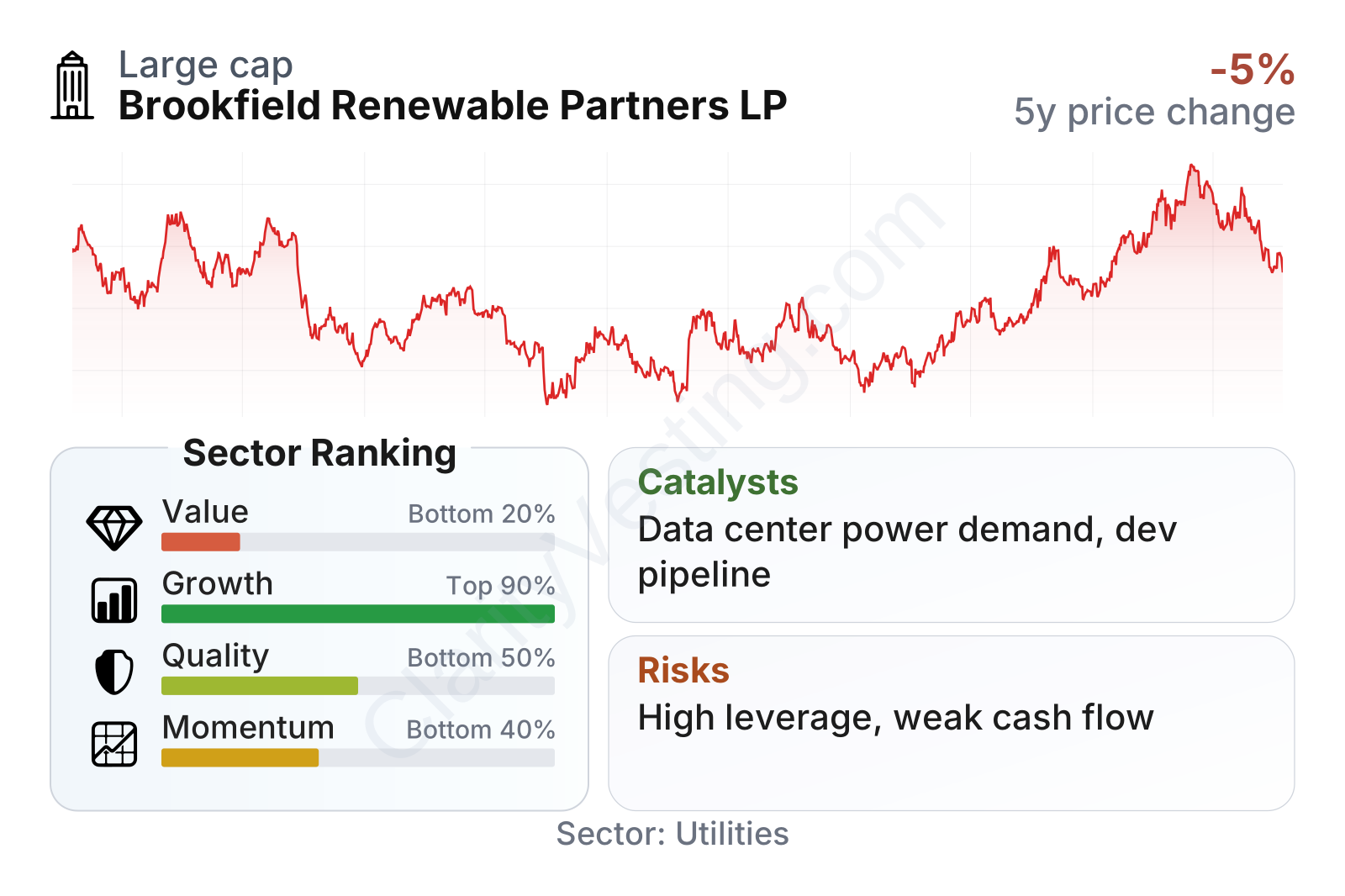
Brookfield Renewable is a large listed renewable infrastructure owner with market capitalization in the large-cap range for the sector and a share price volatility close to the broader market. The factor profile is mixed. Growth measures are strong versus the utility peer group, helped by solid five-year revenue-per-share and dividend-per-share expansion, while value metrics screen weak because earnings-based multiples are elevated and free cash flow is currently negative. Quality is also pressured by leverage and low interest coverage, even though operating margins are better than the sector median.
The stock’s longer-term share performance has recovered well from the 2023 trough, but the path has been uneven. That pattern fits a rate-sensitive infrastructure business: sentiment tends to improve when investors become more comfortable with borrowing costs and future project returns.
Growth
Brookfield Renewable operates in a sector with a strong long-term backdrop. Electricity demand is growing as more of the economy shifts toward electrification, while governments and corporations continue to push for cleaner power supply. Renewable generation is one of the main ways to meet that demand, especially in regions where new hydro, wind, solar, and storage can be developed at competitive cost.
The company’s strategy is built around three growth engines: developing new projects, acquiring assets at scale, and recycling capital by selling mature assets and reinvesting the proceeds. That approach makes sense for a business that needs continuous investment but also wants to avoid relying only on issuing new equity. Brookfield’s global platform matters here because it can source deals and operating opportunities in many markets, not just one country.
Revenue per share has shown a steady upward trend over the last five years, which is an encouraging sign because it suggests expansion has not come only from financial engineering. Even though recent year-over-year revenue growth has been modest, the longer-term trend is stronger than the sector median.
One of the biggest growth catalysts is the company’s development pipeline. Brookfield Renewable has regularly highlighted a very large pipeline of renewable and transition projects, including solar, storage, carbon capture, and distributed energy. Another important catalyst is corporate demand for clean power. Large industrial and technology customers increasingly want long-duration renewable supply contracts, which can support new project economics.
There is also a structural opportunity from power demand linked to data centers and artificial intelligence infrastructure. These customers need large amounts of electricity, often with clean-energy targets attached. A company with a global portfolio, operating expertise, and contracting experience is in a good position to participate if this demand remains strong.
The main limitation in the near term is cash generation. Free cash flow has remained deeply negative as Brookfield Renewable continues to invest heavily. For a developer-owner of infrastructure, that does not automatically signal operational weakness, but it does mean growth is capital-intensive and dependent on continued access to financing, asset sales, and disciplined project execution.
Risks
This article is for informational purposes only and does not constitute financial advice. Some content is AI-generated. See Disclaimer


