Stock Analysis · Bellevue Gold Limited (BELGF)
Overview
Bellevue Gold Limited is an Australian gold producer and mine developer focused on the Bellevue Gold Project in Western Australia. The company spent years advancing the asset from exploration into production, and it is now primarily a single-mine gold business. In simple terms, Bellevue digs gold-bearing ore, processes it into gold doré, and sells that output into the gold market.
That business model makes revenue relatively easy to understand: the company mainly earns money from selling gold, while its longer-term value depends on how much gold it can produce, what it costs to mine, and whether it can extend the life of its deposit through drilling and development.
Based on recent annual reporting, Bellevue’s revenue mix is highly concentrated.
- Gold sales: approximately 100% of revenue. This includes doré produced from the Bellevue operation and sold under offtake arrangements.
- Other revenue: immaterial in normal periods. Any secondary income, if present, is not a meaningful driver compared with gold production and sales.
This concentration means the company is straightforward to analyze, but it also means its results are closely tied to one commodity, one core operation, and the ramp-up performance of that mine.
The income flow over the last few years shows a business that shifted quickly from pre-production losses to commercial sales, with revenue climbing sharply as the mine came online. At the same time, costs and interest expense also rose, so the key issue is no longer whether Bellevue can sell gold, but whether it can translate rising production into consistently stronger margins and cash generation.
Key Figures
| Metric | Value | Sector ⓘ |
|---|---|---|
| Date | Oct 17, 2026 | |
| Context | ||
| Sector | Basic Materials | |
| Industry | Gold | |
| Market Cap ⓘ | $1.56B | |
| Beta ⓘ | 1.52 | |
Value (Cheapness) | ||
| P/E Ratio ⓘ | N/A | 16.90 |
| P/B Ratio ⓘ | 1.77 | 1.65 |
| FCF Yield ⓘ | 0.93% | 5.76% |
| Dividend Yield ⓘ | N/A | 2.13% |
| EBIT / EV ⓘ | N/A | 6.30% |
| PEG ⓘ | N/A | |
Growth (Business expansion) | ||
| Revenue Growth ⓘ | 8.50% | 11.10% |
| RPS Growth (5Y CAGR) ⓘ | N/A | 4.49% |
| EPS Growth (5Y CAGR) ⓘ | -3.61% | -13.47% |
| BVPS Growth (5Y CAGR) ⓘ | 11.79% | 5.51% |
| Margin Growth (5Y Trend) ⓘ | -21.24% | -1.54% |
| FCF Growth (5Y CAGR) ⓘ | N/A | 0.37% |
| DPS Growth (5Y CAGR) ⓘ | N/A | 6.08% |
Quality (Business durability) | ||
| ROIC (Latest) ⓘ | N/A | 9.26% |
| ROA (Latest) ⓘ | -3.10% | 4.91% |
| ROIC (5Y Median) ⓘ | -3.87% | 7.70% |
| ROA (5Y Median) ⓘ | -4.21% | 3.86% |
| Net Debt / EBIT (Latest) ⓘ | N/A | 1.40 |
| Net Debt / EBIT (5Y Median) ⓘ | N/A | 1.70 |
| Net Debt / EBITDA (Latest) ⓘ | 0.41 | 0.95 |
| Net Debt / Assets ⓘ | 9.57% | 13.69% |
| EBITDA / Interest ⓘ | 5.90 | 12.34 |
| Operating Margin (Latest) ⓘ | -0.01% | 13.20% |
| Operating Margin (5Y Median) ⓘ | 5.45% | 11.80% |
| Debt to Equity (Latest) ⓘ | 40.30% | 40.56% |
| Profit Margin (Latest) ⓘ | 1.23% | 6.43% |
| Free Cash Flow (Latest) ⓘ | $14.52M | |
Momentum (Price trend) | ||
| 3Y Return ⓘ | +11.56% | +68.89% |
| 12M Return (excl. last month) ⓘ | +75.38% | +30.21% |
| 6M Return ⓘ | -18.70% | -4.16% |
| Price vs. 200-Day MA ⓘ | -8.96% | -1.27% |
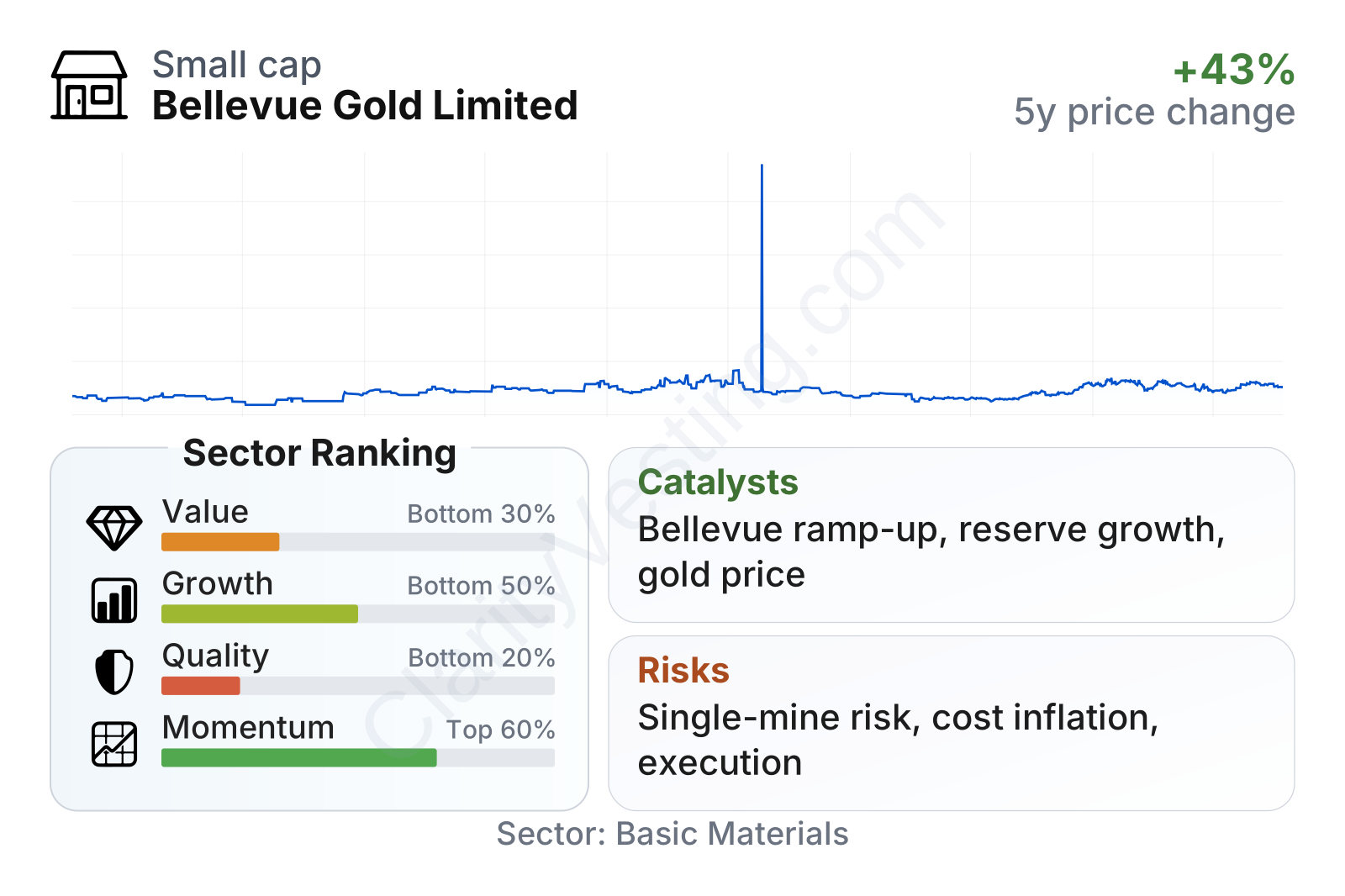
Bellevue is now a mid-sized gold company by market value, and its share price has been volatile, which is not unusual for a relatively young producer. The stock has recovered strongly over parts of the last year, and recent price momentum has been better than much of the sector, but the longer multi-year record still reflects sharp swings as the market reacted to development milestones, operating performance, and changes in gold sentiment.
The operating profile is more mixed than the recent revenue growth suggests. Sales expanded very quickly as production scaled, with year-over-year revenue growth far above the sector median. However, profitability and capital efficiency still rank weakly against peers. Return on assets is negative, operating margin is around break-even on a trailing basis, and free cash flow yield remains low compared with the broader gold group.
Balance sheet risk looks more manageable than some early-stage miners. Net debt relative to EBITDA and assets is below sector medians, which suggests leverage is present but not excessive. Even so, interest coverage is softer than many peers, so the company still needs stronger operating consistency to make the financial profile look more resilient.
Growth
Gold mining remains a relevant long-term sector because gold plays two roles at once: it is both a commodity and a financial hedge. Demand is influenced by jewelry, central bank purchases, investment flows, and macro uncertainty. That does not create steady growth in the same way as software or health care, but it does support a large and durable global market. For a producer like Bellevue, growth depends less on overall gold demand and more on mine performance, reserve expansion, and the gold price.
Bellevue’s strategy is logical for this stage of its life cycle. The company has moved from explorer and developer to producer, and the next step is to stabilize operations, improve recoveries and unit costs, and prove that the mine can deliver at scale. If that happens, the business can improve faster than revenue alone would suggest, because even moderate operational gains can have a meaningful effect on earnings in mining.
A major catalyst is the size and quality potential of the Bellevue asset itself. The project has been marketed around a high-grade underground gold system in a tier-one mining jurisdiction, and ongoing drilling has aimed to add mine life beyond the initial plan. For long-term analysis, that matters because a mine with a longer reserve life can support more stable planning, more efficient use of infrastructure, and a stronger valuation framework than a short-life asset.
Another important support comes from the broader gold price environment. When gold prices remain elevated, producers can generate stronger margins, improve debt metrics, and accelerate payback on development spending. Bellevue’s recent revenue progression reflects both increasing production and a supportive commodity backdrop. If both continue together, operating leverage could remain significant.
Recent company updates have centered on production ramp-up, operational delivery, and ongoing mine development. For Bellevue, these are not routine details; they are the main link between the development case and the investment case. Evidence that the operation is becoming steadier, with fewer cost pressures and better throughput, would be a meaningful sign of opportunity because the market has often been cautious with newer miners until reliability is demonstrated over time.
Risks
This article is for informational purposes only and does not constitute financial advice. Some content is AI-generated. See Disclaimer


