Stock Analysis · NV Bekaert SA (BEKSF)
Overview
NV Bekaert SA is a Belgian industrial company that makes advanced steel wire products, coatings, and related solutions used in construction, automotive, energy, agriculture, consumer goods, and industrial equipment. In simple terms, Bekaert takes wire rod and turns it into higher-value products such as reinforcement fibers for concrete, steel cord for tires, specialty wire for many industrial uses, and technologies that improve durability, efficiency, or performance.
The group reports its business through four main segments. Based on the latest annual reporting, revenue is spread across several end markets rather than depending on one single activity, which gives some diversification but also ties results to global manufacturing and construction cycles.
- Rubber Reinforcement: about 34% of revenue. This includes steel cord and bead wire mainly used in tires for cars, trucks, and off-road vehicles.
- Steel Wire Solutions: about 31% of revenue. This covers a broad range of industrial wire products for agriculture, mining, material handling, filtration, and general manufacturing.
- Specialty Businesses: about 19% of revenue. This includes higher-value activities such as combustion technology, synthetic ropes, and fiber technologies for selected industrial niches.
- Bridon-Bekaert Ropes Group: about 16% of revenue. This business focuses on advanced ropes and mooring solutions used in offshore energy, cranes, mining, and infrastructure.
Geographically, Bekaert is a global operator with manufacturing and sales exposure across Europe, North America, Latin America, and Asia. That international footprint is useful because demand conditions vary by region, but it also means the company is exposed to currency swings, trade rules, and uneven industrial activity.
Over the last several years, the business mix shows a familiar industrial pattern: revenue has been under pressure since the 2022 peak, while profitability narrowed more sharply than sales. That suggests pricing, volumes, or product mix became less favorable, especially in 2025. The positive point is that Bekaert still converts a meaningful part of its business into cash and has kept research spending and operating discipline in place even during a weaker period.
Key Figures
| Metric | Value | Sector ⓘ |
|---|---|---|
| Date | Nov 05, 2026 | |
| Context | ||
| Sector | Industrials | |
| Industry | Metal Fabrication | |
| Market Cap ⓘ | $2.17B | |
| Beta ⓘ | 1.11 | |
Value (Cheapness) | ||
| P/E Ratio ⓘ | 23.59 | 21.91 |
| P/B Ratio ⓘ | 1.08 | 2.02 |
| FCF Yield ⓘ | 24.01% | 6.25% |
| Dividend Yield ⓘ | 4.28% | 1.88% |
| EBIT / EV ⓘ | N/A | 4.74% |
| PEG ⓘ | N/A | |
Growth (Business expansion) | ||
| Revenue Growth ⓘ | -4.60% | 9.40% |
| RPS Growth (5Y CAGR) ⓘ | -3.47% | 7.69% |
| EPS Growth (5Y CAGR) ⓘ | -7.44% | -8.58% |
| BVPS Growth (5Y CAGR) ⓘ | 3.94% | 6.13% |
| Margin Growth (5Y Trend) ⓘ | -7.24% | 0.74% |
| FCF Growth (5Y CAGR) ⓘ | 10.86% | 10.86% |
| DPS Growth (5Y CAGR) ⓘ | 18.72% | 9.40% |
Quality (Business durability) | ||
| ROIC (Latest) ⓘ | 14.26% | 10.39% |
| ROA (Latest) ⓘ | 6.26% | 5.44% |
| ROIC (5Y Median) ⓘ | 9.43% | 9.39% |
| ROA (5Y Median) ⓘ | 5.72% | 4.94% |
| Net Debt / EBIT (Latest) ⓘ | 0.90 | 2.13 |
| Net Debt / EBIT (5Y Median) ⓘ | 1.15 | 2.28 |
| Net Debt / EBITDA (Latest) ⓘ | 0.44 | 1.40 |
| Net Debt / Assets ⓘ | 9.59% | 19.16% |
| EBITDA / Interest ⓘ | 20.87 | 9.93 |
| Operating Margin (Latest) ⓘ | 5.64% | 10.23% |
| Operating Margin (5Y Median) ⓘ | 7.47% | 10.29% |
| Debt to Equity (Latest) ⓘ | 38.95% | 64.90% |
| Profit Margin (Latest) ⓘ | 2.21% | 6.61% |
| Free Cash Flow (Latest) ⓘ | $519.96M | |
Momentum (Price trend) | ||
| 3Y Return ⓘ | +39.06% | +69.58% |
| 12M Return (excl. last month) ⓘ | 0.00% | +10.82% |
| 6M Return ⓘ | +18.79% | +1.32% |
| Price vs. 200-Day MA ⓘ | N/A | +1.91% |
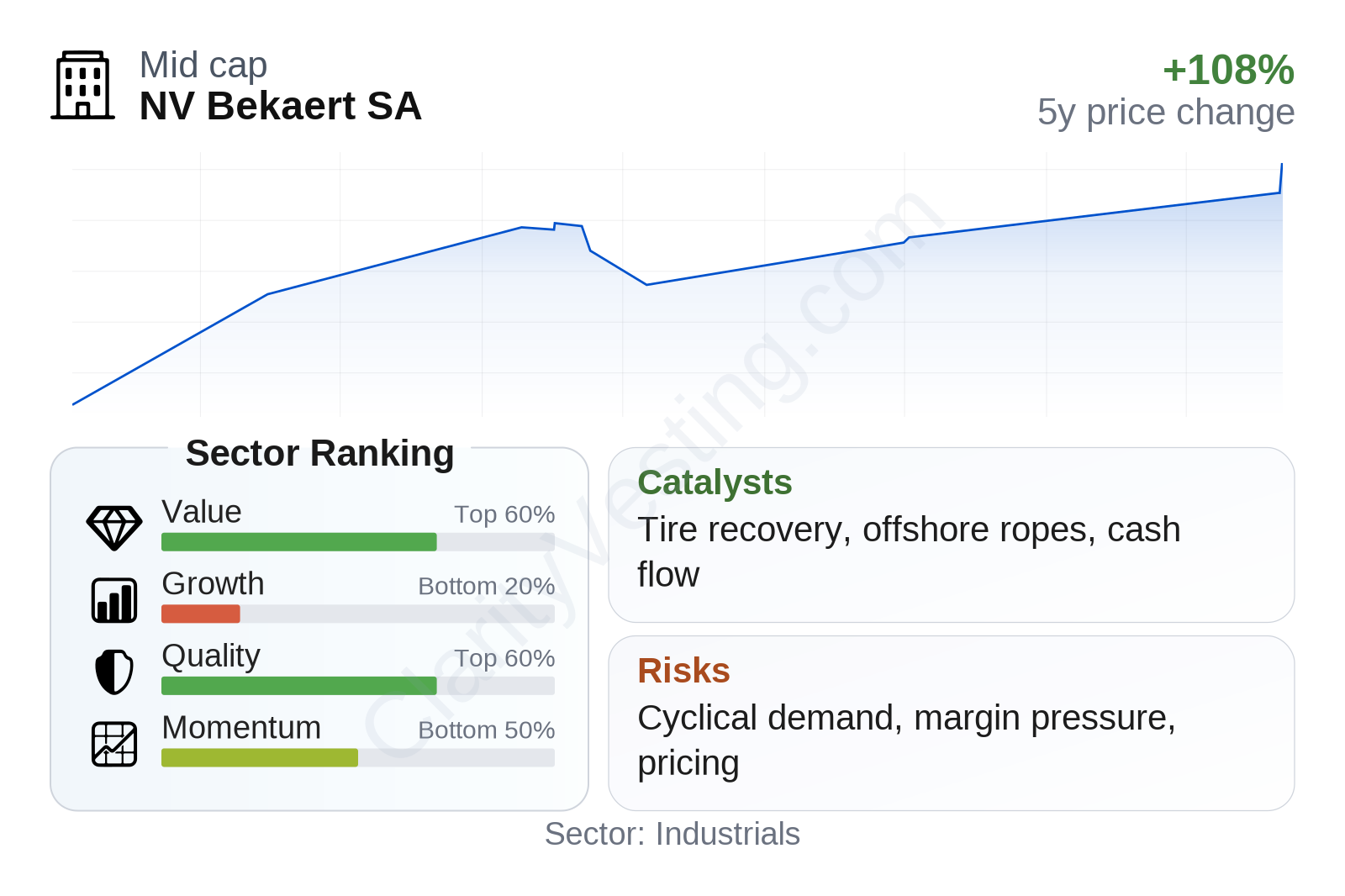
Bekaert sits in the mid-cap range and shows a mixed profile. On one hand, balance sheet quality looks solid: leverage is clearly below many industrial peers, interest coverage is strong, and returns on capital are somewhat above the sector median. Free cash flow generation also stands out, with cash flow yield well above the sector median and a dividend yield around 4%.
On the other hand, recent operating performance has been softer. Revenue has declined year over year, long-term revenue per share has trended down, and operating margins are below the sector median. Momentum is also mixed: the share price has improved over the last six months, but longer-term stock performance still trails much of the broader industrial universe.
Growth
Bekaert operates in sectors that are not pure high-growth markets, but parts of its portfolio do benefit from durable long-term themes. Tire reinforcement follows global mobility and freight demand. Infrastructure and construction support demand for concrete reinforcement products. Offshore energy, lifting, and mooring solutions can benefit from investment in energy projects, including offshore wind and other marine infrastructure. Specialty industrial applications may also grow faster than standard wire products because they carry more technical content and often face less direct price competition.
The company’s strategy has generally been to shift its portfolio toward more specialized and higher-value applications rather than relying only on commodity-like wire volumes. That direction makes strategic sense. In basic steel-related manufacturing, margins are often vulnerable to raw material costs and price competition. Moving into engineered ropes, advanced reinforcement, and specialty technologies can improve resilience if execution is good.
A notable catalyst is the potential recovery in end markets after a weak industrial phase. Because Bekaert serves multiple cyclical industries, even a moderate rebound in tire production, construction activity, or industrial capital spending could have a visible effect on profits. Another potential support is offshore and energy infrastructure demand through Bridon-Bekaert Ropes Group, where technical know-how and certification requirements can create better positioning than in standard wire products.
Recent company communication has also emphasized portfolio optimization, productivity measures, and disciplined capital allocation. For a business with already moderate leverage, these actions matter because they can protect cash generation during downturns and leave room for selective investment or shareholder distributions when markets improve.
Risks
This article is for informational purposes only and does not constitute financial advice. Some content is AI-generated. See Disclaimer