Stock Analysis · NV Bekaert SA (BEKAY)
Overview
NV Bekaert SA is a Belgian industrial company that makes advanced steel wire products, coatings, and related materials technologies. Its products are used in construction, infrastructure, energy, automotive, agriculture, industrial equipment, and consumer applications. In simple terms, Bekaert sells highly engineered wire and reinforcement solutions that help make tires, concrete, cables, filtration systems, and industrial components stronger, lighter, or more durable.
The business is global, with manufacturing and commercial operations across Europe, the Americas, and Asia. That broad footprint matters because Bekaert serves end markets that are closely tied to industrial production, building activity, and infrastructure spending. It also means results can move with regional economic cycles, raw material costs, and currency swings.
Based on the company’s recent annual reporting, revenue comes mainly from four operating segments.
- Rubber Reinforcement: approximately 35% to 40% of revenue. This segment mainly includes steel cord and bead wire used in tires, making it closely linked to automotive production and replacement tire demand.
- Steel Wire Solutions: approximately 30% to 35% of revenue. This covers a broad range of wire products for construction, agriculture, industrial uses, and general manufacturing.
- Specialty Businesses: approximately 15% to 20% of revenue. This includes higher-value niche activities such as fiber technologies, combustion technologies, and other engineered solutions.
- Bridon-Bekaert Ropes Group: approximately 10% to 15% of revenue. This business supplies advanced ropes and mooring solutions for offshore energy, mining, cranes, and industrial applications.
The broad mix is useful because it reduces reliance on one single product line, but Bekaert remains an industrial materials company at its core, so demand still depends heavily on manufacturing and construction activity. Over the last few years, the business has also been shifting toward more specialized applications where pricing and margins can be more resilient than in standard steel products.
The longer-term picture shows a business with shrinking revenue since the 2022 peak, but one that has kept operating income positive and maintained meaningful spending on innovation and commercial capabilities. That suggests Bekaert has been managing through a weaker cycle rather than facing a breakdown of its core business model.
Key Figures
| Metric | Value | Sector ⓘ |
|---|---|---|
| Date | Oct 17, 2026 | |
| Context | ||
| Sector | Industrials | |
| Industry | Metal Fabrication | |
| Market Cap ⓘ | $2.15B | |
| Beta ⓘ | 1.12 | |
Value (Cheapness) | ||
| P/E Ratio ⓘ | 23.68 | 22.10 |
| P/B Ratio ⓘ | 10.65 | 1.97 |
| FCF Yield ⓘ | 22.08% | 6.38% |
| Dividend Yield ⓘ | 5.02% | 1.94% |
| EBIT / EV ⓘ | N/A | 4.79% |
| PEG ⓘ | N/A | |
Growth (Business expansion) | ||
| Revenue Growth ⓘ | -4.60% | 9.30% |
| RPS Growth (5Y CAGR) ⓘ | -45.71% | 7.81% |
| EPS Growth (5Y CAGR) ⓘ | N/A | -13.06% |
| BVPS Growth (5Y CAGR) ⓘ | -41.53% | 6.14% |
| Margin Growth (5Y Trend) ⓘ | -3.28% | 0.88% |
| FCF Growth (5Y CAGR) ⓘ | 10.60% | 11.01% |
| DPS Growth (5Y CAGR) ⓘ | -33.90% | 9.48% |
Quality (Business durability) | ||
| ROIC (Latest) ⓘ | N/A | 10.84% |
| ROA (Latest) ⓘ | 5.22% | 5.41% |
| ROIC (5Y Median) ⓘ | N/A | 9.38% |
| ROA (5Y Median) ⓘ | 5.70% | 4.95% |
| Net Debt / EBIT (Latest) ⓘ | 0.90 | 2.08 |
| Net Debt / EBIT (5Y Median) ⓘ | N/A | 2.27 |
| Net Debt / EBITDA (Latest) ⓘ | 0.48 | 1.39 |
| Net Debt / Assets ⓘ | 9.59% | 19.28% |
| EBITDA / Interest ⓘ | N/A | 9.58 |
| Operating Margin (Latest) ⓘ | 6.41% | 10.50% |
| Operating Margin (5Y Median) ⓘ | 7.47% | 10.29% |
| Debt to Equity (Latest) ⓘ | 38.95% | 65.48% |
| Profit Margin (Latest) ⓘ | 2.21% | 6.67% |
| Free Cash Flow (Latest) ⓘ | $474.03M | |
Momentum (Price trend) | ||
| 3Y Return ⓘ | +6.08% | +61.68% |
| 12M Return (excl. last month) ⓘ | +5.88% | +12.58% |
| 6M Return ⓘ | -7.53% | 0.00% |
| Price vs. 200-Day MA ⓘ | N/A | +0.02% |
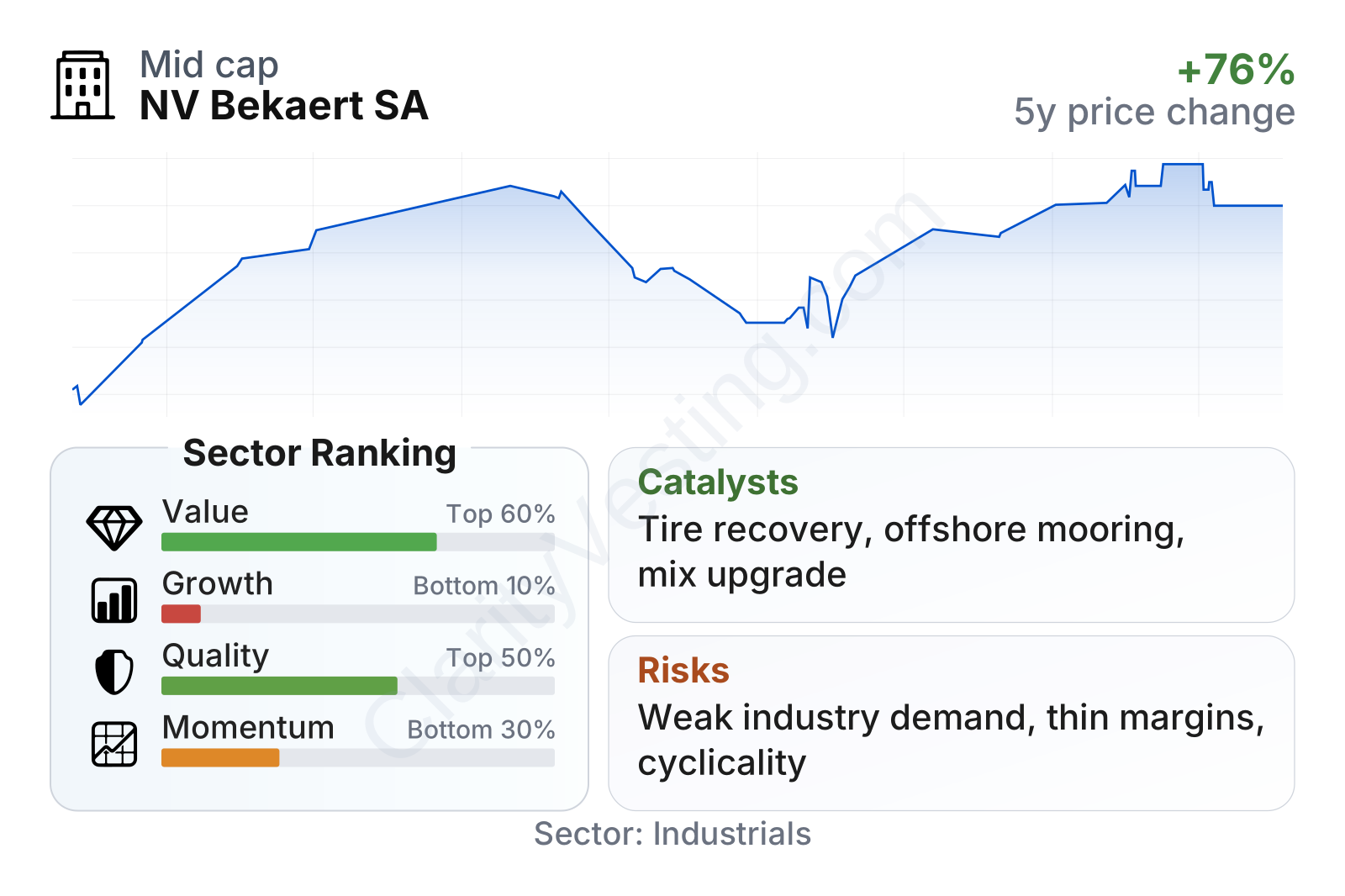
Bekaert sits in the middle of the pack on valuation and quality, but the split inside the metrics is important. Cash generation looks strong, leverage looks conservative, and the dividend yield stands above the sector median. On the other hand, growth metrics are notably weak, profitability is below many industrial peers, and share-price momentum has lagged the sector. In other words, the company currently looks more like a cash-generating cyclical manufacturer than a fast-growing industrial compounder.
The stock has risen meaningfully from its 2022 level, but recent performance has been softer. That is consistent with a business that has improved from earlier lows without yet convincing the market that a stronger growth phase is underway.
Growth
Bekaert operates in end markets that have credible long-term demand drivers, even if near-term conditions remain uneven. Tire reinforcement benefits from global vehicle parc growth and replacement demand. Construction and infrastructure can benefit from public investment and urbanization. Energy-related activities, especially offshore and selected industrial applications, support demand for advanced ropes, mooring systems, and specialized materials. Sustainability trends also matter: lighter vehicles, more durable infrastructure, and lower-material-intensity designs all support the need for engineered reinforcement solutions.
The company’s strategy also makes industrial sense. Management has been emphasizing portfolio discipline, cost control, and a shift toward more specialized and value-added products rather than chasing volume in lower-margin commodity categories. For a company like Bekaert, that is usually the right path because it can improve resilience even when total sales are not expanding quickly.
Recent revenue trends still show pressure rather than acceleration. Sales have been declining year over year, although the pace of decline appears less severe than during the earlier part of the downturn. That can indicate the business is moving closer to stabilization, but it does not yet show a clear return to broad-based growth.
Cash generation is a more encouraging part of the picture. Even with softer sales, free cash flow has remained substantial by the standards of the company’s size. That matters for long-term analysis because it gives Bekaert room to maintain operations, fund targeted investment, reduce debt, and continue shareholder distributions without depending too heavily on external financing.
Potential catalysts over the next few years include a recovery in industrial production, stronger replacement tire demand, increased infrastructure spending, and a better mix toward specialty products. Offshore energy and mooring solutions are another area to watch, as they can provide exposure to structurally important projects rather than only short-cycle demand. Recent company communication has also highlighted transformation efforts and portfolio optimization, which could support margins if execution remains steady.
Risks
This article is for informational purposes only and does not constitute financial advice. Some content is AI-generated. See Disclaimer


