Stock Analysis · Beam Therapeutics Inc (BEAM)
Overview
Beam Therapeutics is a clinical-stage biotechnology company focused on base editing, a form of gene editing designed to make precise single-letter changes in DNA or RNA. The goal is to correct disease-causing mutations without cutting both strands of DNA in the way older CRISPR approaches often do. Beam is developing treatments in areas such as blood disorders, cancer, and rare genetic diseases, while also building delivery technologies that could broaden the range of diseases its platform can address.
Because Beam is still in the development stage, it does not yet generate recurring revenue from approved medicines. Its revenue mainly comes from collaboration agreements, licensing, and research arrangements with larger pharmaceutical partners. This makes revenue uneven from year to year, depending on milestone timing, accounting recognition, and partner activity rather than product sales.
The main revenue sources are currently:
- Collaboration and license revenue: approximately the vast majority of total revenue. This includes upfront payments, research support, option payments, and development milestones from strategic partnerships.
- Other research-related revenue: a small remainder, mainly linked to services or reimbursements under collaboration arrangements when applicable.
- Product revenue: 0% at this stage, since Beam does not yet have a commercialized therapy.
Over the last several years, Beam’s income profile has been driven much more by partner payments than by any stable operating business. That is normal for an early-stage biotech, but it also means the company’s reported sales can swing sharply without necessarily reflecting progress or weakness in the underlying science.
The broader financial pattern shows a company spending heavily on research and development while revenue moves in bursts. R&D has consistently been the dominant use of cash, which fits Beam’s platform-building strategy. The noticeable rise in revenue in some years appears tied to collaboration accounting rather than a durable shift to self-sustaining operations.
Key Figures
| Metric | Value | Sector ⓘ |
|---|---|---|
| Date | Oct 24, 2026 | |
| Context | ||
| Sector | Healthcare | |
| Industry | Biotechnology | |
| Market Cap ⓘ | $2.57B | |
| Beta ⓘ | 2.20 | |
Value (Cheapness) | ||
| P/E Ratio ⓘ | N/A | 25.42 |
| P/B Ratio ⓘ | 2.40 | 3.08 |
| FCF Yield ⓘ | -14.53% | 3.12% |
| Dividend Yield ⓘ | N/A | 1.85% |
| EBIT / EV ⓘ | -5.30% | 0.56% |
| PEG ⓘ | N/A | |
Growth (Business expansion) | ||
| Revenue Growth ⓘ | -94.20% | 7.50% |
| RPS Growth (5Y CAGR) ⓘ | 15.02% | 8.60% |
| EPS Growth (5Y CAGR) ⓘ | -16.62% | -17.73% |
| BVPS Growth (5Y CAGR) ⓘ | -0.69% | 3.72% |
| Margin Growth (5Y Trend) ⓘ | N/A | -0.57% |
| FCF Growth (5Y CAGR) ⓘ | N/A | 0.96% |
| DPS Growth (5Y CAGR) ⓘ | N/A | 6.69% |
Quality (Business durability) | ||
| ROIC (Latest) ⓘ | -5.75% | 3.17% |
| ROA (Latest) ⓘ | -6.33% | 2.98% |
| ROIC (5Y Median) ⓘ | -20.20% | 4.56% |
| ROA (5Y Median) ⓘ | -20.53% | 1.87% |
| Net Debt / EBIT (Latest) ⓘ | N/A | 1.34 |
| Net Debt / EBIT (5Y Median) ⓘ | N/A | 1.86 |
| Net Debt / EBITDA (Latest) ⓘ | N/A | 1.00 |
| Net Debt / Assets ⓘ | 1.99% | 5.06% |
| EBITDA / Interest ⓘ | N/A | 9.55 |
| Operating Margin (Latest) ⓘ | -54.75% | 9.25% |
| Operating Margin (5Y Median) ⓘ | -458.13% | 7.33% |
| Debt to Equity (Latest) ⓘ | 23.17% | 26.68% |
| Profit Margin (Latest) ⓘ | -55.45% | 3.34% |
| Free Cash Flow (Latest) ⓘ | -$372.77M | |
Momentum (Price trend) | ||
| 3Y Return ⓘ | +28.59% | +51.61% |
| 12M Return (excl. last month) ⓘ | +6.23% | +19.90% |
| 6M Return ⓘ | -22.50% | +10.10% |
| Price vs. 200-Day MA ⓘ | -13.19% | +6.44% |
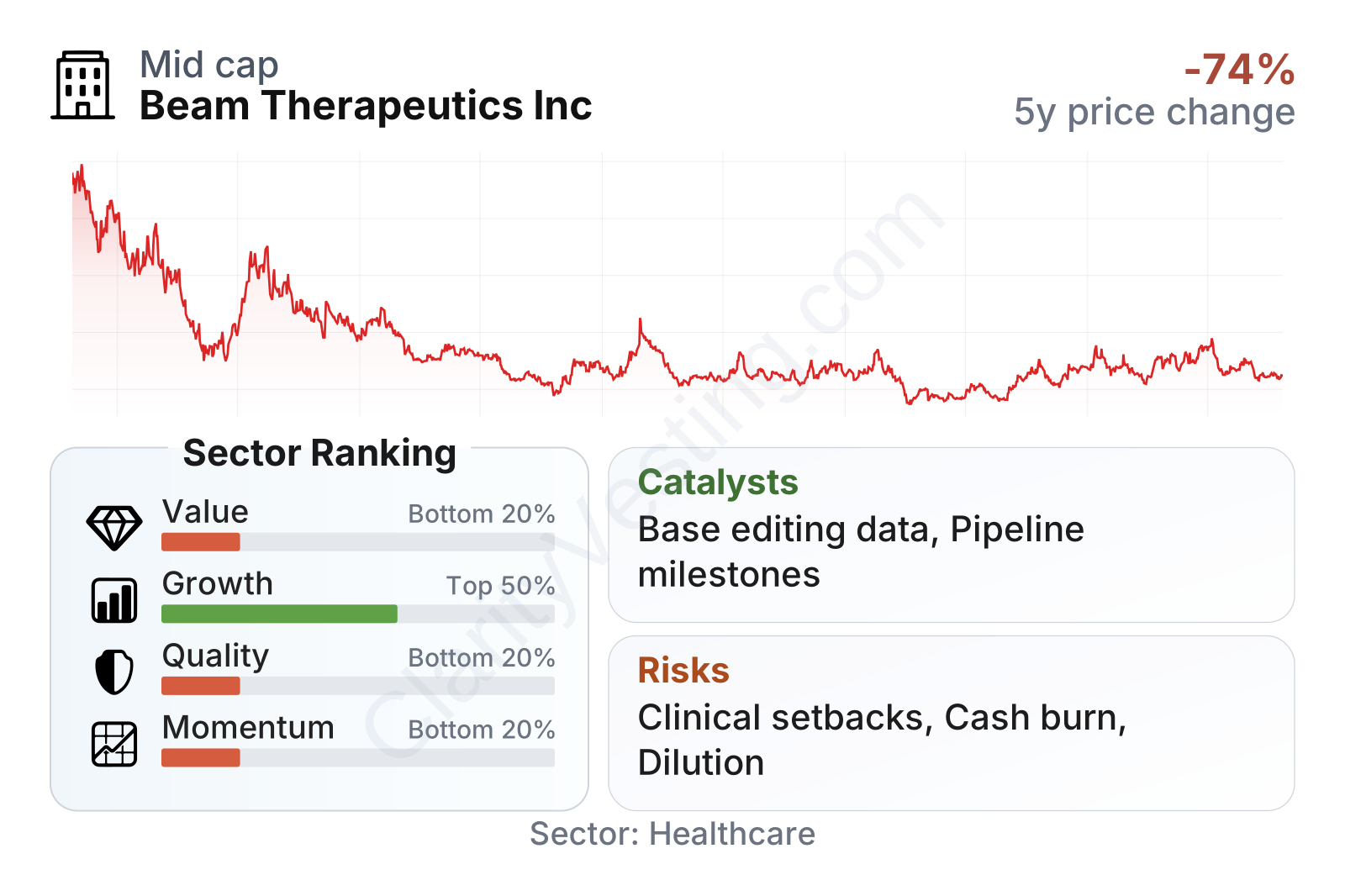
Beam is still best understood as a development-stage biotech rather than a conventional operating company. The market value places it in the mid-sized range for an early clinical biotech, and the stock has been very volatile, with a beta above 2. That fits a business whose outlook depends heavily on trial outcomes, regulatory milestones, and partnership developments.
The factor picture is mixed. Growth metrics look better than many biotech peers over a multiyear view, largely because partnership revenue has expanded over time from a small base, but current profitability and cash generation remain weak. Value screens also look unattractive in a traditional sense because the company has negative earnings and negative free cash flow, so common valuation ratios are of limited use. Balance-sheet leverage is not the central issue here; operating execution and clinical conversion are.
Growth
Beam operates in one of the most promising areas of biotechnology. Gene editing remains a growing field because it aims to address the root genetic cause of disease rather than only managing symptoms. Within that field, base editing is especially interesting because it is intended to make more targeted changes, which could potentially improve precision and reduce some of the challenges associated with double-strand DNA breaks. If the technology works consistently in humans, it could support multiple medicines across several disease areas.
Beam’s strategy for future growth is logical for a platform company. It is pursuing internal clinical programs while also using partnerships to bring in funding, validate its technology, and spread development risk. That approach can be powerful if the platform proves versatile, because one successful program may increase confidence in several others at the same time.
Revenue growth has been highly irregular, with very strong spikes followed by steep declines. That pattern is typical when revenue depends on milestone recognition rather than product demand. For long-term analysis, the more important point is not the latest year-over-year swing, but whether Beam continues to convert its science into clinical milestones and partner-backed economics.
Several potential catalysts could matter over the next few years. The first is continued clinical progress in Beam’s lead programs, especially in genetically defined diseases where clear biological endpoints can help show whether the editing approach is working. The second is expansion of the company’s delivery capabilities, which could open larger disease markets beyond the most accessible blood-related uses. The third is additional collaboration value creation, whether through milestone achievements, new partnerships, or broader use of its platform by established drugmakers.
Recent company updates have also kept attention on Beam’s pipeline refinement and capital allocation. In a sector where many firms have been forced to slow spending, Beam’s ability to continue advancing programs while maintaining strategic flexibility stands out as an important opportunity. If clinical data improve confidence in safety, editing efficiency, and durability, the company’s platform could gain much broader relevance than any single asset alone.
Free cash flow remains deeply negative, which is normal for a clinical-stage biotechnology company but still important. Beam is funding research today in the hope of future commercial therapies. That means future growth depends not only on scientific progress, but also on how long existing cash and partnership funding can support development before more capital is needed.
Risks
This article is for informational purposes only and does not constitute financial advice. Some content is AI-generated. See Disclaimer


