Stock Analysis · Becton Dickinson and Company (BDX)
Overview
Becton, Dickinson and Company, usually called BD, is a large medical technology company that sells tools, devices, and systems used every day in hospitals, laboratories, clinics, pharmacies, and research settings. Its products are often essential rather than optional: syringes, infusion systems, specimen collection products, diagnostic instruments, and medication management solutions. That makes BD less dependent on one single blockbuster product than many healthcare companies.
BD’s revenue base is spread across three major business segments. Based on the company’s latest annual reporting structure, the mix is approximately:
- BD Medical: about 45% of revenue — includes medication delivery products such as syringes, pen needles, IV catheters, infusion therapy products, and advanced patient monitoring technologies.
- BD Life Sciences: about 31% of revenue — includes specimen collection, microbiology, molecular diagnostics, flow cytometry, and tools used in research and biopharma production.
- BD Interventional: about 24% of revenue — includes products used in vascular care, urology, critical care, surgery, and peripheral intervention procedures.
This diversification matters. It means BD is not tied only to one treatment area or one type of healthcare customer. It also gives the company a broad installed base inside hospitals and laboratories, where switching suppliers can be disruptive because staff training, workflow integration, and regulatory requirements all matter.
Over the last several years, revenue has trended upward from roughly $19 billion to nearly $22 billion, while gross profit has also expanded. Operating income has improved versus 2023, although net income has not kept pace to the same degree because interest expense and other costs remain meaningful. In simple terms, the business is still growing, but not every dollar of additional sales is flowing cleanly to the bottom line.
Key Figures
| Metric | Value | Sector ⓘ |
|---|---|---|
| Date | Oct 24, 2026 | |
| Context | ||
| Sector | Healthcare | |
| Industry | Medical Instruments & Supplies | |
| Market Cap ⓘ | $52.94B | |
| Beta ⓘ | 0.28 | |
Value (Cheapness) | ||
| P/E Ratio ⓘ | 45.09 | 25.42 |
| P/B Ratio ⓘ | 2.26 | 3.08 |
| FCF Yield ⓘ | 4.92% | 3.12% |
| Dividend Yield ⓘ | 2.16% | 1.85% |
| EBIT / EV ⓘ | 3.24% | 0.56% |
| PEG ⓘ | 1.11 | |
Growth (Business expansion) | ||
| Revenue Growth ⓘ | 5.40% | 7.50% |
| RPS Growth (5Y CAGR) ⓘ | 3.81% | 8.60% |
| EPS Growth (5Y CAGR) ⓘ | -7.28% | -17.73% |
| BVPS Growth (5Y CAGR) ⓘ | 2.20% | 3.72% |
| Margin Growth (5Y Trend) ⓘ | 0.13% | -0.57% |
| FCF Growth (5Y CAGR) ⓘ | -5.97% | 0.96% |
| DPS Growth (5Y CAGR) ⓘ | 3.80% | 6.69% |
Quality (Business durability) | ||
| ROIC (Latest) ⓘ | 3.46% | 3.17% |
| ROA (Latest) ⓘ | 1.77% | 2.98% |
| ROIC (5Y Median) ⓘ | 6.96% | 4.56% |
| ROA (5Y Median) ⓘ | 3.10% | 1.87% |
| Net Debt / EBIT (Latest) ⓘ | 7.54 | 1.34 |
| Net Debt / EBIT (5Y Median) ⓘ | 7.35 | 1.86 |
| Net Debt / EBITDA (Latest) ⓘ | 3.61 | 1.00 |
| Net Debt / Assets ⓘ | 31.74% | 5.06% |
| EBITDA / Interest ⓘ | 8.21 | 9.55 |
| Operating Margin (Latest) ⓘ | 10.24% | 9.25% |
| Operating Margin (5Y Median) ⓘ | 11.42% | 7.33% |
| Debt to Equity (Latest) ⓘ | 68.84% | 26.68% |
| Profit Margin (Latest) ⓘ | 4.19% | 3.34% |
| Free Cash Flow (Latest) ⓘ | $2.61B | |
Momentum (Price trend) | ||
| 3Y Return ⓘ | +5.94% | +51.61% |
| 12M Return (excl. last month) ⓘ | +27.90% | +19.90% |
| 6M Return ⓘ | +30.44% | +10.10% |
| Price vs. 200-Day MA ⓘ | +22.74% | +6.44% |
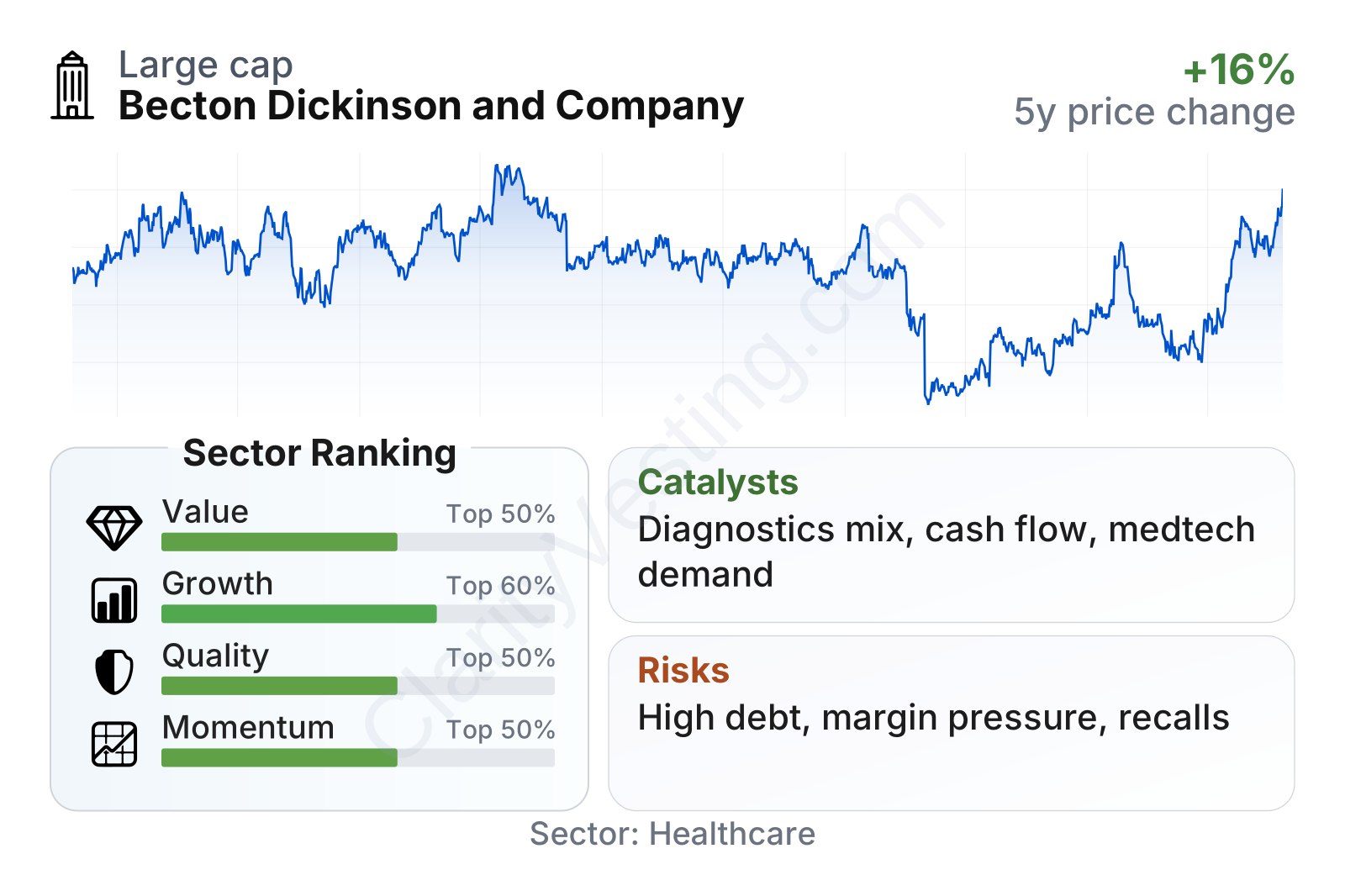
BD is a very large healthcare equipment company with unusually low share-price volatility, as shown by its beta well below 1. On valuation, the picture is mixed: the earnings multiple sits above the healthcare sector median, but the free cash flow yield and dividend yield are somewhat better than the typical peer. Quality metrics are also mixed. Long-term returns on invested capital and operating margins look solid, yet leverage is clearly higher than sector norms. Growth has been positive but not especially fast relative to the broader healthcare group, while recent share-price momentum has improved after a weak multi-year stock performance.
Growth
BD operates in a sector with durable long-term demand drivers. Aging populations, rising chronic disease, expanding surgical volumes, greater diagnostic testing, and the steady need for safer medication delivery all support demand over time. Unlike trend-driven industries, medical supplies and diagnostic systems are tied closely to recurring clinical activity, which tends to be resilient.
The company’s strategy is also logical for future expansion. Management has been focusing on higher-value categories such as medication management, automation, advanced diagnostics, and interventional products, while using BD’s scale in manufacturing and hospital relationships to cross-sell more solutions. That is generally more attractive than relying only on commoditized disposables, because software-connected systems and workflow tools can deepen customer relationships and support pricing.
Revenue growth has been positive more often than not in recent years, but it has not been smooth. There was a clear acceleration through much of 2024 and 2025, followed by weaker year-over-year comparisons in early 2026. For a company like BD, that kind of unevenness does not automatically signal structural weakness; it can reflect tougher comparisons, product timing, currency effects, or changes in procedure and testing volumes. The broader pattern still points to a business that has expanded its sales base over a multi-year period.
Cash generation is one of the more encouraging parts of the profile. Free cash flow has recovered well from the softer level seen in 2023 and has moved back above $3 billion at its recent peak. That matters because cash is what supports debt reduction, acquisitions, dividends, and internal investment. Even though the five-year cash flow trend is not particularly strong, the latest level suggests the company still has meaningful financial capacity.
One notable growth catalyst is BD’s push into smarter, workflow-oriented products rather than basic supplies alone. Hospitals and labs increasingly value systems that help reduce errors, improve efficiency, and support compliance. BD’s broad installed base gives it a platform to benefit if customers continue standardizing around integrated solutions. Recent company communications have also highlighted product launches, regulatory progress, and portfolio simplification efforts, which can create room for steadier margin improvement over time.
Risks
This article is for informational purposes only and does not constitute financial advice. Some content is AI-generated. See Disclaimer


