Stock Analysis · Budweiser Brewing Company APAC Limited (BDWBY)
Overview
Budweiser Brewing Company APAC Limited is the Asia-Pacific brewing business controlled by AB InBev. It produces, imports, markets, distributes, and sells beer and other malt-based beverages across a wide set of markets in Asia. Its portfolio includes global premium brands such as Budweiser, Corona, and Stella Artois, as well as strong local labels including Harbin and Sedrin in China, and regional brands in markets such as South Korea and India. The business is positioned mainly around premiumization, meaning it tries to grow by selling more higher-priced brands and expanding brand mix rather than relying only on volume growth.
The company’s revenue base is largely geographic. Based on annual reporting structure, the business is mainly driven by China, with South Korea as the second pillar and a smaller but strategically important contribution from India and export markets.
- China: approximately 70% to 80% of revenue in recent years. This includes mainstream and premium beer sales, with Budweiser, Harbin, and Sedrin among the key brands.
- South Korea: approximately 15% to 25% of revenue. This business includes the Oriental Brewery operations, with Cass and premium imports playing an important role.
- India and export markets: approximately 5% to 10% of revenue. This part is smaller today but relevant for long-term expansion because of rising beer consumption and a younger legal-drinking-age population in India.
Beer is still overwhelmingly the core business. There is some contribution from non-beer and other beverage activities, but public reporting indicates that malt beverages remain the main earnings engine.
The operating picture over the last several years shows a business that still converts a good share of sales into operating profit, but with declining total revenue since the 2023 peak. Costs of goods have broadly moved down with revenue, which has helped preserve gross profitability, yet net income has been more volatile than operating income. That gap suggests taxes, one-off items, and below-the-line effects have mattered as much as pure operating execution.
Key Figures
| Metric | Value | Sector ⓘ |
|---|---|---|
| Date | Oct 17, 2026 | |
| Context | ||
| Sector | Consumer Defensive | |
| Industry | Beverages - Brewers | |
| Market Cap ⓘ | $10.01B | |
| Beta ⓘ | 0.47 | |
Value (Cheapness) | ||
| P/E Ratio ⓘ | 17.79 | 17.88 |
| P/B Ratio ⓘ | 1.00 | 1.29 |
| FCF Yield ⓘ | 17.85% | 12.39% |
| Dividend Yield ⓘ | 7.71% | 2.85% |
| EBIT / EV ⓘ | 23.04% | 6.43% |
| PEG ⓘ | 0.97 | |
Growth (Business expansion) | ||
| Revenue Growth ⓘ | 0.20% | 4.10% |
| RPS Growth (5Y CAGR) ⓘ | -4.10% | 6.18% |
| EPS Growth (5Y CAGR) ⓘ | -12.62% | -13.59% |
| BVPS Growth (5Y CAGR) ⓘ | -2.07% | 3.20% |
| Margin Growth (5Y Trend) ⓘ | -5.51% | -0.15% |
| FCF Growth (5Y CAGR) ⓘ | -16.06% | 4.10% |
| DPS Growth (5Y CAGR) ⓘ | 18.71% | 6.79% |
Quality (Business durability) | ||
| ROIC (Latest) ⓘ | N/A | 12.34% |
| ROA (Latest) ⓘ | N/A | 6.30% |
| ROIC (5Y Median) ⓘ | 8.05% | 10.49% |
| ROA (5Y Median) ⓘ | 4.68% | 5.44% |
| Net Debt / EBIT (Latest) ⓘ | -1.27 | 1.96 |
| Net Debt / EBIT (5Y Median) ⓘ | -2.08 | 2.35 |
| Net Debt / EBITDA (Latest) ⓘ | -0.82 | 1.38 |
| Net Debt / Assets ⓘ | -16.10% | 21.51% |
| EBITDA / Interest ⓘ | N/A | 9.46 |
| Operating Margin (Latest) ⓘ | 17.63% | 8.87% |
| Operating Margin (5Y Median) ⓘ | 18.42% | 9.53% |
| Debt to Equity (Latest) ⓘ | 3.13% | 72.35% |
| Profit Margin (Latest) ⓘ | 9.54% | 5.40% |
| Free Cash Flow (Latest) ⓘ | $1.79B | |
Momentum (Price trend) | ||
| 3Y Return ⓘ | -55.79% | +20.92% |
| 12M Return (excl. last month) ⓘ | -21.49% | +2.13% |
| 6M Return ⓘ | -22.75% | +1.26% |
| Price vs. 200-Day MA ⓘ | -15.41% | +1.39% |
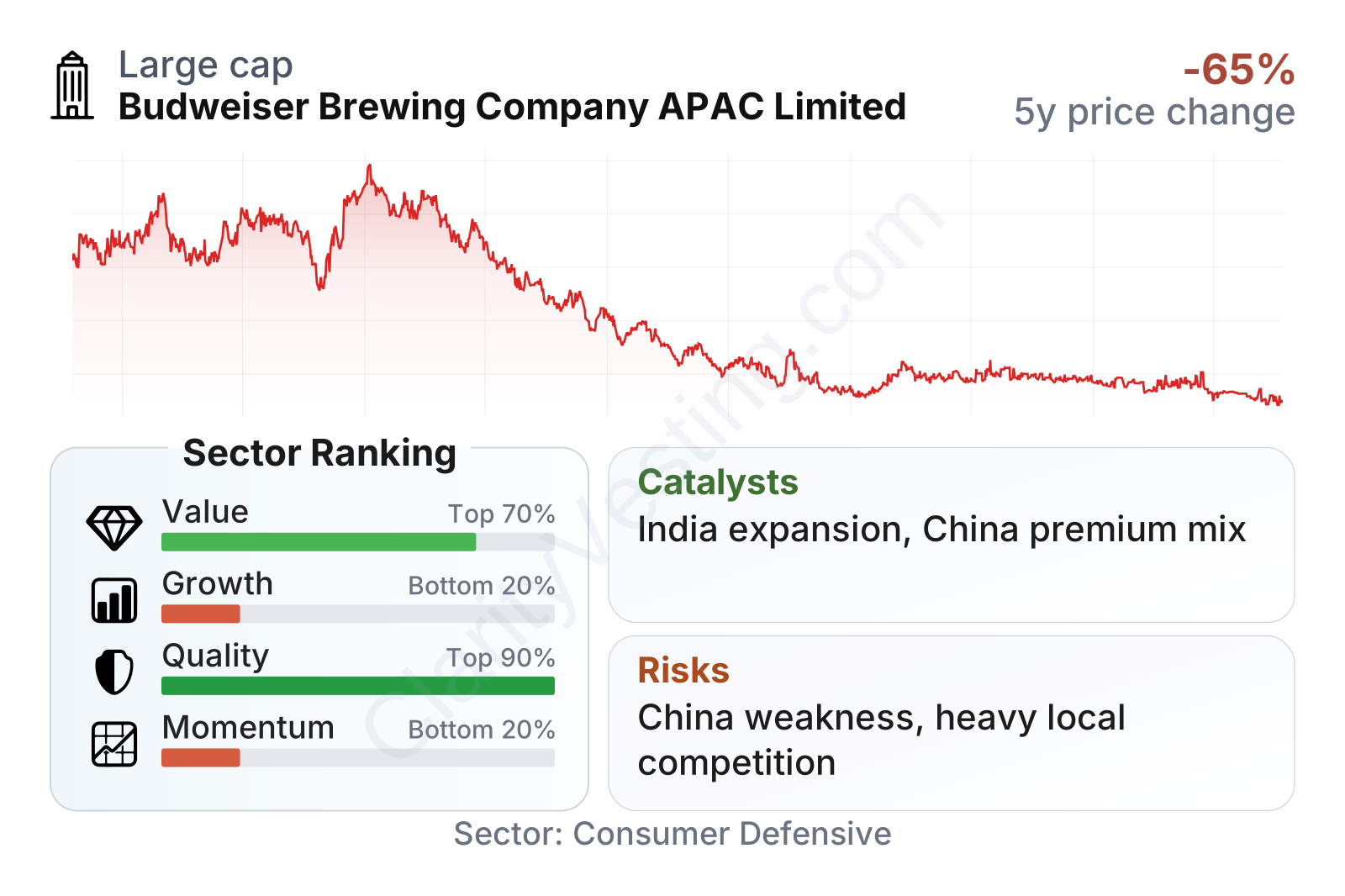
The overall profile is unusual: growth and share-price momentum are weak, while profitability, cash generation, and balance-sheet strength are much better than the sector median. The company stands out for low leverage, solid margins, and a high free-cash-flow yield, but these strengths are offset by several years of shrinking revenue per share and a sharp decline in the stock over the last three years. The market appears to be pricing Budweiser APAC as a financially solid brewer facing a difficult demand environment rather than a clear growth business.
At a broad level, this is a large regional consumer-defensive company with relatively low share-price volatility. Its beta is well below 1, which fits the profile of a staple beverage business, although the stock’s actual direction has still been weak because of company-specific and regional pressures.
Growth
The company operates in a sector that is mature in many developed markets but still offers pockets of long-term expansion in Asia. Beer itself is not a fast-growth category globally, yet premium beer, on-trade recovery, and rising consumption in selected emerging markets can still support growth. In that sense, Budweiser APAC is not exposed to a booming industry, but it does participate in attractive niches within the category.
Its strategy is logical on paper. The company has focused on premium and super-premium brands, wider distribution, and disciplined capital allocation. In markets where overall beer consumption is flat or falling, that approach can still lift revenue per hectoliter and support margins. This matters especially in China, where the long-term opportunity is less about selling more total beer and more about shifting consumers toward higher-priced brands.
India is one of the clearest long-term catalysts. The market remains underpenetrated relative to many other regions, demographics are favorable, and premium international brands have room to gain share as incomes rise and modern retail expands. Even though India is still a smaller part of the business, it offers a potential counterweight to slower conditions in China.
Another meaningful catalyst is balance-sheet flexibility. Budweiser APAC’s low net debt position gives it room to protect dividends, invest behind brands, and remain selective on commercial spending without the same financial pressure seen in more leveraged beverage companies. That does not create growth by itself, but it improves resilience while management waits for demand conditions to recover.
Recent company communications have continued to emphasize premiumization, disciplined execution, and expansion in high-potential channels and markets. The main opportunity is straightforward: if consumption in China stabilizes and premium brand mix improves while India continues to scale, earnings can recover faster than revenue because the margin base is already relatively strong.
Risks
This article is for informational purposes only and does not constitute financial advice. Some content is AI-generated. See Disclaimer


