Stock Analysis · Budweiser Brewing Company APAC Limited (BDWBF)
Overview
Budweiser Brewing Company APAC Limited is the Asia-Pacific beer business controlled by AB InBev. It produces, imports, markets, and sells beer and other malt beverages across a broad regional footprint, with a particular focus on China, South Korea, India, and Southeast Asia. Its portfolio covers global premium brands such as Budweiser, Corona, and Stella Artois, alongside strong local brands and craft labels. In simple terms, the company makes money by selling beer to wholesalers, retailers, bars, restaurants, and entertainment venues.
Its revenue mix is mainly organized by geography rather than by brand in public reporting. Based on recent annual reporting, the largest sources of revenue are approximately:
- China: about 75% to 80% of revenue. This includes mainstream, premium, and super-premium beer sold through on-trade and off-trade channels.
- South Korea: about 15% to 20% of revenue. This market includes domestic brands such as Cass and imported premium offerings.
- India and other APAC export markets: about 5% to 10% of revenue. This includes developing operations where premiumization and urban consumption are important growth themes.
The business model depends heavily on brand strength, distribution reach, and pricing power. Premium brands usually carry better margins than value products, so management has spent years pushing the portfolio toward higher-priced categories. That strategy matters because even when beer volumes are soft, revenue and profit can still be supported if consumers trade up to premium products.
Recent revenue and profit flows show a company that still generates solid gross profit and cash flow, but total revenue has trended down from the post-pandemic recovery period. Operating income remains meaningful, yet net income has been more uneven from year to year, reflecting weaker demand in key markets and some pressure on operating leverage.
The long-term pattern points to a profitable brewer with healthy gross margins, but also one facing slower sales momentum. Revenue has declined from the 2021-2023 range into 2024-2025, while operating profit and net income have narrowed, showing that brand strength has not fully offset softer regional demand.
Key Figures
| Metric | Value | Sector ⓘ |
|---|---|---|
| Date | Oct 03, 2026 | |
| Context | ||
| Sector | Consumer Defensive | |
| Industry | Beverages - Brewers | |
| Market Cap ⓘ | $10.66B | |
| Beta ⓘ | 0.47 | |
Value (Cheapness) | ||
| P/E Ratio ⓘ | 20.15 | 18.16 |
| P/B Ratio ⓘ | 1.00 | 1.27 |
| FCF Yield ⓘ | 16.75% | 12.39% |
| Dividend Yield ⓘ | 7.07% | 2.83% |
| EBIT / EV ⓘ | 23.81% | 6.45% |
| PEG ⓘ | 1.03 | |
Growth (Business expansion) | ||
| Revenue Growth ⓘ | 0.20% | 3.80% |
| RPS Growth (5Y CAGR) ⓘ | -4.06% | 6.20% |
| EPS Growth (5Y CAGR) ⓘ | -2.27% | -14.64% |
| BVPS Growth (5Y CAGR) ⓘ | -2.08% | 3.26% |
| Margin Growth (5Y Trend) ⓘ | -5.38% | -0.25% |
| FCF Growth (5Y CAGR) ⓘ | -16.03% | 4.65% |
| DPS Growth (5Y CAGR) ⓘ | 18.75% | 6.86% |
Quality (Business durability) | ||
| ROIC (Latest) ⓘ | 11.11% | 12.58% |
| ROA (Latest) ⓘ | 14.01% | 6.35% |
| ROIC (5Y Median) ⓘ | 8.02% | 10.36% |
| ROA (5Y Median) ⓘ | 4.68% | 5.44% |
| Net Debt / EBIT (Latest) ⓘ | -1.23 | 1.91 |
| Net Debt / EBIT (5Y Median) ⓘ | -2.08 | 2.32 |
| Net Debt / EBITDA (Latest) ⓘ | -0.75 | 1.36 |
| Net Debt / Assets ⓘ | -16.10% | 21.25% |
| EBITDA / Interest ⓘ | 46.14 | 9.61 |
| Operating Margin (Latest) ⓘ | 16.08% | 8.96% |
| Operating Margin (5Y Median) ⓘ | 18.37% | 9.53% |
| Debt to Equity (Latest) ⓘ | 3.13% | 71.66% |
| Profit Margin (Latest) ⓘ | 9.54% | 5.40% |
| Free Cash Flow (Latest) ⓘ | $1.79B | |
Momentum (Price trend) | ||
| 3Y Return ⓘ | -57.40% | +15.25% |
| 12M Return (excl. last month) ⓘ | -19.32% | +2.63% |
| 6M Return ⓘ | -14.69% | +2.43% |
| Price vs. 200-Day MA ⓘ | -16.23% | +0.43% |
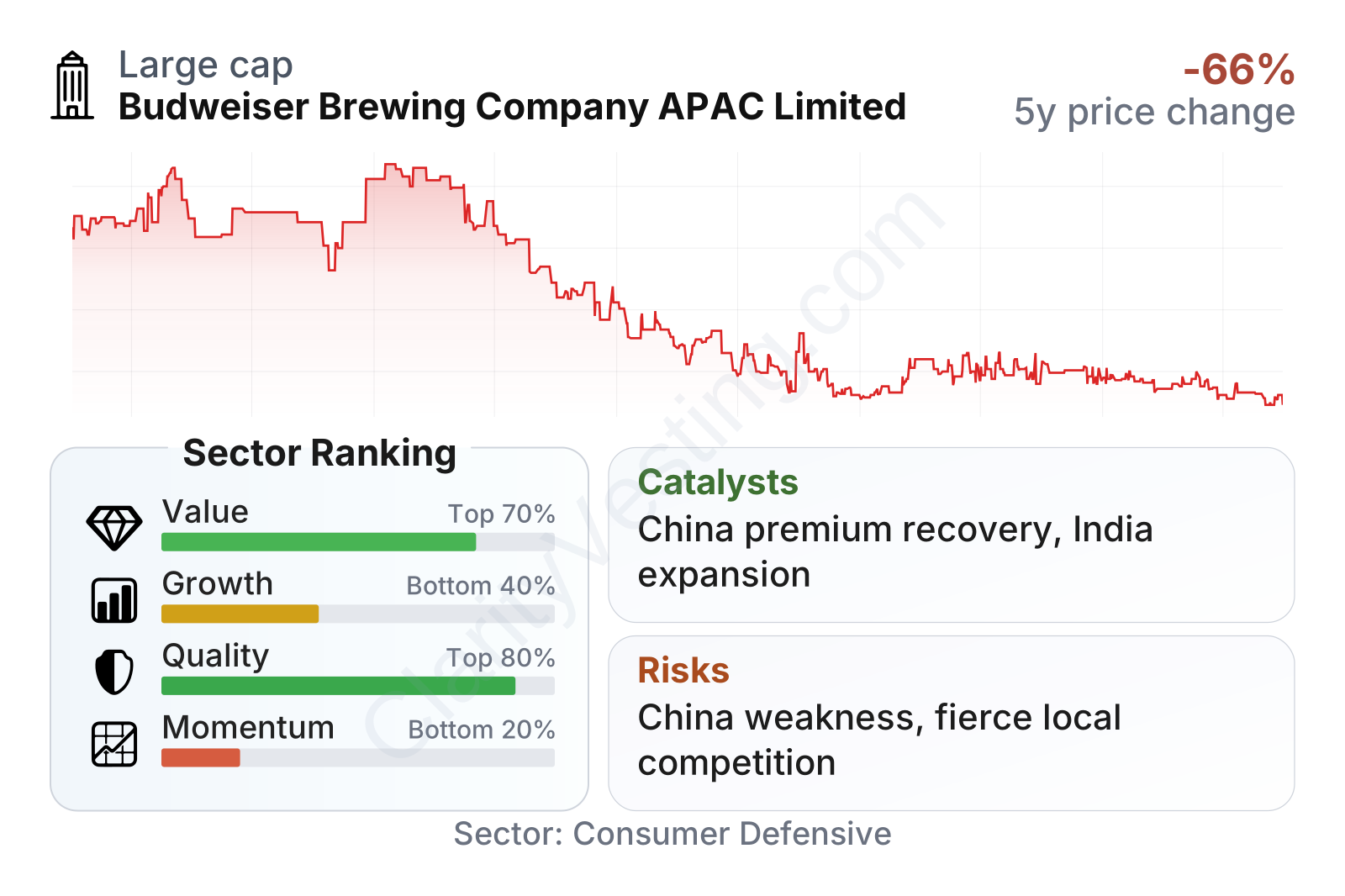
The overall picture is mixed. On one hand, business quality remains relatively strong: profitability is above many sector peers, returns on assets are solid, free cash flow is meaningful, and leverage is unusually low for a brewer. On the other hand, growth and market momentum are weak. The stock has fallen sharply over the last three years, and revenue growth has been close to flat compared with a stronger sector median. That combination often signals a company the market views as financially sound but operationally challenged.
The company is also relatively defensive from a trading-volatility standpoint, with a low beta. For a consumer staples business, that fits the profile of a mature brewer rather than a fast-expanding growth company. The dividend yield is notably above the sector median, which reflects strong cash generation but can also reflect a share price that has been under pressure.
Growth
The beer industry is generally mature, but the more attractive parts of the market are still growing. In Asia-Pacific, the biggest long-term themes are premiumization, rising urban incomes, expansion of modern retail, and higher demand for international brands in large cities and travel-related channels. That means the sector itself is not a high-growth space overall, but there are pockets of attractive demand where brand owners with premium labels can still expand revenue faster than volume.
Budweiser APAC’s strategy is logical for that environment. It is centered on premium and super-premium brands, disciplined pricing, brand marketing, and tighter execution in major cities and consumption occasions. In theory, that makes sense because premium beer tends to deliver better margins and stronger brand loyalty than value beer. The challenge is that this approach works best when consumer confidence is healthy, especially in China, which remains the company’s most important market.
The recent growth record has been subdued. Short-term revenue growth has hovered around flat to slightly negative in the reported trend, and the five-year revenue-per-share trend is negative. That does not invalidate the strategy, but it shows that the company has not yet converted its brand portfolio into consistent top-line expansion. The strongest future catalyst is a sustained recovery in Chinese consumption, especially in restaurants, nightlife, and other social drinking occasions where premium brands tend to perform best.
Another important opportunity is geographic mix. South Korea provides a meaningful second profit engine, and India remains a smaller but potentially faster-growing beer market over the long run due to low per-capita consumption and a young population. If Budweiser APAC can keep building distribution and brand awareness there without sacrificing margins, that market could become more relevant over time.
Recent company updates have also emphasized operational discipline, portfolio management, and selective investment rather than aggressive expansion at any cost. For a mature consumer business, that is often a sensible approach: protect margins, preserve cash flow, and wait for demand conditions to improve in the largest markets.
Risks
This article is for informational purposes only and does not constitute financial advice. Some content is AI-generated. See Disclaimer


