Stock Analysis · Bidvest Group Ltd (BDVSF)
Overview
Bidvest Group Ltd is a South African diversified services, trading, and distribution company. Rather than relying on one product line, it operates a collection of businesses that supply everyday goods and essential services to commercial customers, public-sector clients, and consumers. Its activities span freight and logistics, automotive retail and services, office and commercial products, financial services, travel-related services, and a range of business support operations.
This diversified structure matters for long-term analysis because Bidvest is not tied to a single economic theme. Some units are more cyclical, such as vehicle retail and freight volumes, while others are more recurring and service-led, such as facilities, security, banking-related, insurance, and office supply activities. That can smooth results, although it also makes the group more complex to evaluate than a focused industrial company.
Based on the group’s recent reporting structure, revenue is spread across several major divisions. Exact shares move from year to year, but the business mix is broadly led by distribution-heavy and trading-heavy operations, with services adding an important profit contribution.
- Automotive: approximately 25% to 30% of revenue. This includes vehicle retail, dealerships, fleet-related activity, parts, accessories, and aftersales services.
- Freight: approximately 20% to 25% of revenue. This covers port-related services, terminal operations, logistics, and handling activities linked to import-export flows.
- Commercial Products: approximately 15% to 20% of revenue. This division includes office products, print, packaging, stationery, furniture, and workplace-related supplies and equipment.
- Services International and local service businesses: roughly 10% to 15% of revenue combined, depending on period and classification. These operations typically include facilities, hygiene, security, laundry, travel, and related outsourced services.
- Branded Products, Adcock Ingram-related interests, Financial Services, and other activities: together approximately 20% to 25% of revenue. These activities include consumer and industrial products, insurance and financial offerings, and smaller group operations.
One important point for readers new to financial analysis: revenue is not the same as profit. In Bidvest’s case, trading and distribution activities can generate very large sales numbers but often on thinner margins, while service-led activities may contribute a smaller share of revenue yet carry better economics.
The long-term pattern shows a business that has been expanding its sales base steadily, with total revenue rising from around ZAR 100 billion in fiscal 2022 to more than ZAR 130 billion in fiscal 2026. Operating profit also increased over that span, although not in a straight line, which suggests growth has been real but margins remain sensitive to costs, financing charges, and the mix between lower-margin trading units and higher-margin service operations.
Key Figures
| Metric | Value | Sector ⓘ |
|---|---|---|
| Date | Oct 17, 2026 | |
| Context | ||
| Sector | Industrials | |
| Industry | Conglomerates | |
| Market Cap ⓘ | $5.21B | |
| Beta ⓘ | 0.30 | |
Value (Cheapness) | ||
| P/E Ratio ⓘ | 14.34 | 22.10 |
| P/B Ratio ⓘ | 0.12 | 1.97 |
| FCF Yield ⓘ | 301.83% | 6.38% |
| Dividend Yield ⓘ | 74.66% | 1.94% |
| EBIT / EV ⓘ | N/A | 4.79% |
| PEG ⓘ | N/A | |
Growth (Business expansion) | ||
| Revenue Growth ⓘ | 2.20% | 9.30% |
| RPS Growth (5Y CAGR) ⓘ | 6.97% | 7.81% |
| EPS Growth (5Y CAGR) ⓘ | 42.53% | -13.06% |
| BVPS Growth (5Y CAGR) ⓘ | 6.10% | 6.14% |
| Margin Growth (5Y Trend) ⓘ | -0.63% | 0.88% |
| FCF Growth (5Y CAGR) ⓘ | 41.83% | 11.01% |
| DPS Growth (5Y CAGR) ⓘ | 8.36% | 9.48% |
Quality (Business durability) | ||
| ROIC (Latest) ⓘ | 23.32% | 10.84% |
| ROA (Latest) ⓘ | 10.33% | 5.41% |
| ROIC (5Y Median) ⓘ | 12.60% | 9.38% |
| ROA (5Y Median) ⓘ | 5.56% | 4.95% |
| Net Debt / EBIT (Latest) ⓘ | 1.50 | 2.08 |
| Net Debt / EBIT (5Y Median) ⓘ | 2.57 | 2.27 |
| Net Debt / EBITDA (Latest) ⓘ | 1.08 | 1.39 |
| Net Debt / Assets ⓘ | 28.96% | 19.28% |
| EBITDA / Interest ⓘ | 5.36 | 9.58 |
| Operating Margin (Latest) ⓘ | 9.03% | 10.50% |
| Operating Margin (5Y Median) ⓘ | 9.63% | 10.29% |
| Debt to Equity (Latest) ⓘ | 104.56% | 65.48% |
| Profit Margin (Latest) ⓘ | 4.72% | 6.67% |
| Free Cash Flow (Latest) ⓘ | $15.73B | |
Momentum (Price trend) | ||
| 3Y Return ⓘ | +5.63% | +61.68% |
| 12M Return (excl. last month) ⓘ | -4.55% | +12.58% |
| 6M Return ⓘ | +2.73% | 0.00% |
| Price vs. 200-Day MA ⓘ | +19.61% | +0.02% |
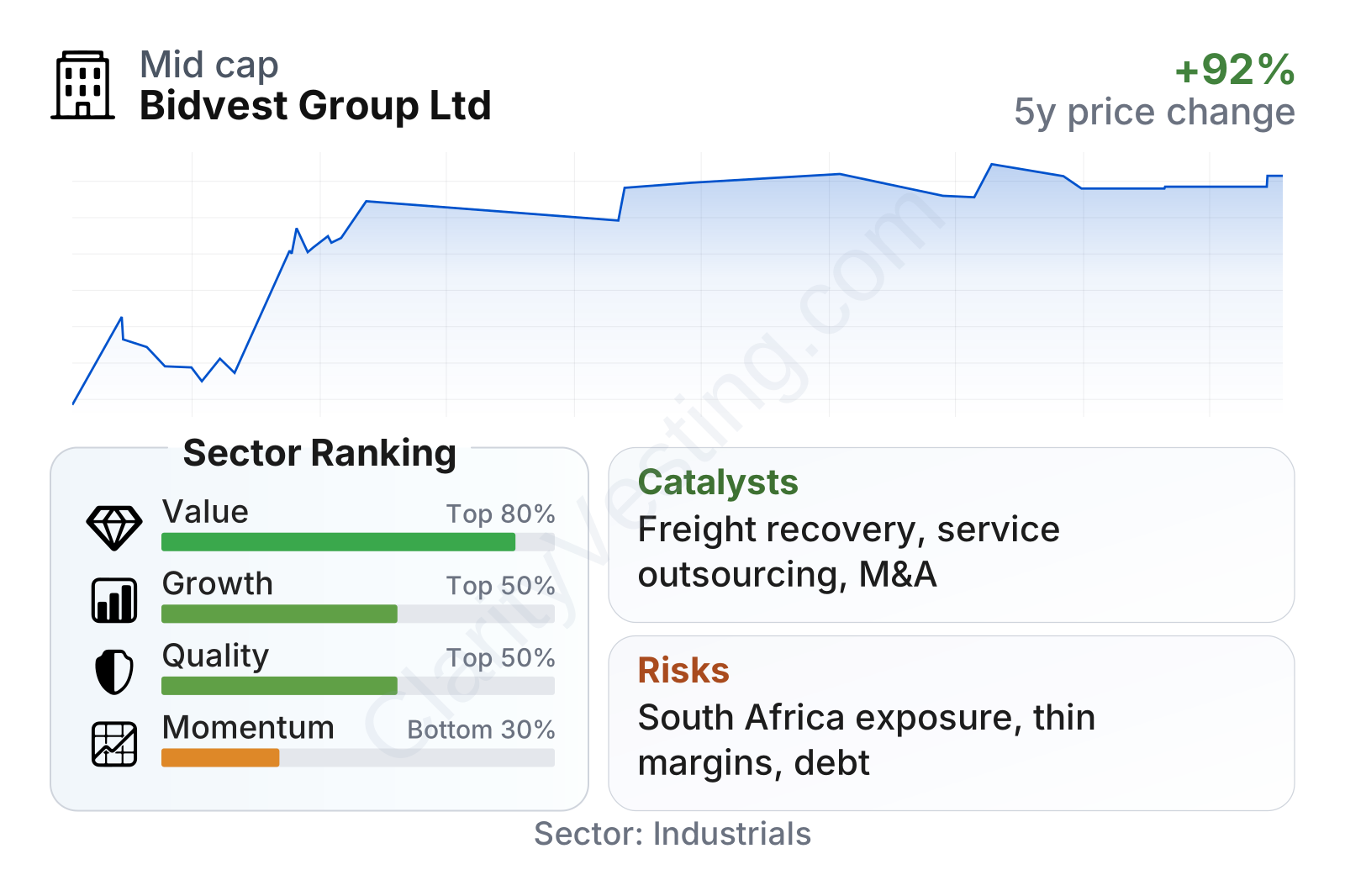
Bidvest sits in the mid-sized range by market value and its share price has shown relatively low volatility, with a beta well below 1. On valuation metrics, it screens cheaper than many industrial peers: the earnings multiple is below the sector median, while free cash flow yield and dividend yield stand out as comparatively strong. Quality is mixed but still respectable. Returns on capital and assets are comfortably above sector medians, which suggests the group’s collection of businesses can generate solid profits from the capital employed. At the same time, margins are not especially high, leverage is meaningful, and interest coverage is weaker than the typical peer. Growth is moderate rather than fast, with recent revenue expansion trailing the broader sector, but longer-term earnings and cash flow trends have been much stronger than the near-term top-line pace alone would suggest. Price momentum has been one of the weaker areas despite the stock trading above its 200-day average.
Growth
Bidvest operates in sectors that are not uniformly high-growth, but many of them are durable and economically important. Freight and logistics benefit from trade flows and infrastructure usage. Outsourced business services can grow as customers look to lower costs and simplify operations. Automotive remains cyclical, yet service and aftersales activities are generally steadier than new vehicle sales. Commercial products and workplace services are mature categories, but they can still produce incremental growth through market share gains, bolt-on acquisitions, and cross-selling.
The company’s strategy has generally focused on decentralization, operational discipline, and portfolio management. That means individual divisions are given room to run their businesses, while the parent group allocates capital, reshapes the portfolio when needed, and looks for acquisitions that fit existing capabilities. For a long-term reader, this matters because Bidvest does not need one breakthrough product to expand. Its path is more about compounding through many operating improvements across multiple businesses.
A practical growth catalyst is the continued recovery and modernization of logistics and freight-related activity in Southern Africa. If trade volumes improve, port and terminal-linked businesses can benefit. Another catalyst is the group’s exposure to outsourced services, where customers may prefer specialist providers over running every support function in-house. Bidvest’s broad platform can also help it win bundled contracts across cleaning, security, facilities, office products, and other support categories.
The group’s recent financial progression points to that steady-compounder profile. Revenue has continued to edge higher into fiscal 2026, gross profit has also increased, and free cash flow over the past several years has grown strongly. That does not look like a rapid expansion platform, but it does indicate an enterprise that has been able to convert scale into cash generation over time.
Risks
This article is for informational purposes only and does not constitute financial advice. Some content is AI-generated. See Disclaimer


