Stock Analysis · Beiersdorf Aktiengesellschaft (BDRFF)
Overview
Beiersdorf Aktiengesellschaft is a German consumer goods company focused on skin care, personal care, and selected health-related consumer products. Its best-known brands include NIVEA, Eucerin, La Prairie, Labello, Hansaplast, and Elastoplast. The business is built around products that people buy repeatedly, which gives it a more defensive profile than many cyclical industries. For long-term analysis, the key point is that Beiersdorf is not a broad conglomerate: it is mainly a skin care and personal care specialist with a portfolio that ranges from mass-market daily use products to premium beauty.
The company reports two main business segments: Consumer and tesa. Consumer includes skin care, personal care, sun care, lip care, premium beauty, and derma cosmetics sold through retail, pharmacies, e-commerce, and other channels. tesa is a separate adhesive technologies business serving industrial customers and consumers, including tapes and bonding solutions used in electronics, automotive, appliances, packaging, and office applications.
Based on the latest annual reporting structure, Beiersdorf’s revenue is mainly generated from the following sources:
- Consumer segment: about 82% to 84% of revenue. This includes NIVEA, Eucerin, La Prairie, Chantecaille, Labello, and health care brands such as Hansaplast and Elastoplast.
- tesa segment: about 16% to 18% of revenue. This includes industrial adhesive solutions and consumer adhesive products.
Within Consumer, the company does not always publish a complete brand-by-brand revenue split, but the largest value drivers are typically NIVEA, Eucerin, and La Prairie, with NIVEA clearly the largest brand family. Geographically, Beiersdorf is internationally diversified, with Europe still important but meaningful exposure to the Americas, Africa/Asia/Australia, and China. That diversification matters because it reduces dependence on one single market, even though China remains especially relevant for premium beauty.
The business mix also shows why margins have held up relatively well. Premium skin care and derma cosmetics tend to support stronger profitability than basic commodity-like household products, while the tesa unit adds industrial exposure that is different from consumer beauty demand.
Over the last several years, revenue expanded from roughly €7.6 billion in 2021 to about €9.8 billion in 2025, while operating income and net income also moved higher overall. The pattern suggests that Beiersdorf has been able to grow sales without losing control of its cost structure, even though yearly progress has not been perfectly smooth.
Key Figures
| Metric | Value | Sector ⓘ |
|---|---|---|
| Date | Oct 17, 2026 | |
| Context | ||
| Sector | Consumer Defensive | |
| Industry | Household & Personal Products | |
| Market Cap ⓘ | $18.51B | |
| Beta ⓘ | 0.47 | |
Value (Cheapness) | ||
| P/E Ratio ⓘ | 16.91 | 17.88 |
| P/B Ratio ⓘ | 2.14 | 1.29 |
| FCF Yield ⓘ | 5.08% | 12.39% |
| Dividend Yield ⓘ | 1.18% | 2.85% |
| EBIT / EV ⓘ | N/A | 6.43% |
| PEG ⓘ | 6.05 | |
Growth (Business expansion) | ||
| Revenue Growth ⓘ | -4.50% | 4.10% |
| RPS Growth (5Y CAGR) ⓘ | 7.29% | 6.18% |
| EPS Growth (5Y CAGR) ⓘ | -31.64% | -13.59% |
| BVPS Growth (5Y CAGR) ⓘ | 6.40% | 3.20% |
| Margin Growth (5Y Trend) ⓘ | 1.67% | -0.15% |
| FCF Growth (5Y CAGR) ⓘ | -10.46% | 4.10% |
| DPS Growth (5Y CAGR) ⓘ | 88.81% | 6.79% |
Quality (Business durability) | ||
| ROIC (Latest) ⓘ | 20.46% | 12.34% |
| ROA (Latest) ⓘ | 13.83% | 6.30% |
| ROIC (5Y Median) ⓘ | 10.84% | 10.49% |
| ROA (5Y Median) ⓘ | 6.39% | 5.44% |
| Net Debt / EBIT (Latest) ⓘ | -0.39 | 1.96 |
| Net Debt / EBIT (5Y Median) ⓘ | -0.76 | 2.35 |
| Net Debt / EBITDA (Latest) ⓘ | -0.31 | 1.38 |
| Net Debt / Assets ⓘ | -7.31% | 21.51% |
| EBITDA / Interest ⓘ | 46.91 | 9.46 |
| Operating Margin (Latest) ⓘ | 12.71% | 8.87% |
| Operating Margin (5Y Median) ⓘ | 12.64% | 9.53% |
| Debt to Equity (Latest) ⓘ | 3.42% | 72.35% |
| Profit Margin (Latest) ⓘ | 9.76% | 5.40% |
| Free Cash Flow (Latest) ⓘ | $940.52M | |
Momentum (Price trend) | ||
| 3Y Return ⓘ | -29.03% | +20.92% |
| 12M Return (excl. last month) ⓘ | -21.77% | +2.13% |
| 6M Return ⓘ | +4.66% | +1.26% |
| Price vs. 200-Day MA ⓘ | -6.53% | +1.39% |
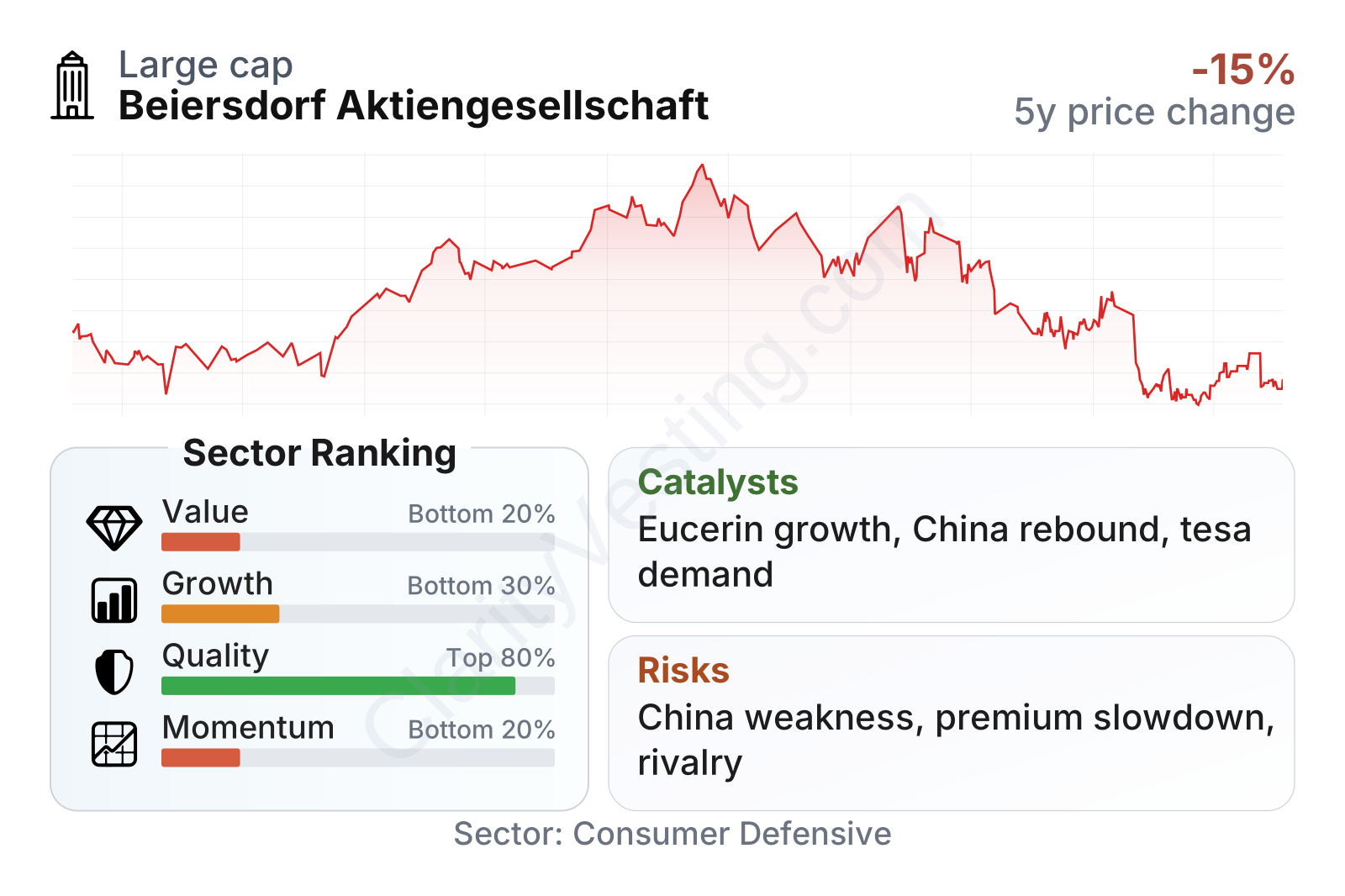
Beiersdorf stands out more for balance sheet strength and profitability than for cheap valuation or rapid recent growth. The company’s quality profile is comfortably above many peers: returns on capital and assets are strong, profit margin is above the sector median, and leverage is exceptionally low. In fact, net debt metrics are negative, which points to a net cash position rather than a debt-heavy structure. On the other hand, the value and growth factors are weaker. The earnings multiple is near the sector median, but the price-to-book ratio is noticeably higher, free cash flow yield is lower than many peers, and recent year-over-year revenue performance has been softer than the broader sector.
The stock’s trading pattern has also been subdued. Over the last three years, the share price has lagged the sector, although there has been some recovery from the 2026 low. That combination often indicates a company the market still views as solid, but not currently exciting.
Growth
Beiersdorf operates in categories with attractive long-term characteristics, especially skin care, derma cosmetics, sun care, and premium beauty. These are not hypergrowth markets, but they benefit from durable demand drivers: aging populations, growing interest in skin health, premiumization, wider use of dermatology-backed products, and rising beauty consumption in emerging markets. That makes the sector appealing for long-duration compounding when a company has strong brands and global distribution.
Beiersdorf’s strategy is broadly coherent with those trends. NIVEA gives the group scale in mass skin care, Eucerin gives it exposure to faster-growing derma cosmetics, and La Prairie and Chantecaille provide a premium layer. The tesa business adds industrial diversification and exposure to technical applications such as electronics and automotive, which broadens the revenue base beyond consumer beauty.
Recent growth has been mixed. The latest year-over-year revenue reading is negative, which is weaker than the sector median and shows that the business is not in a clean acceleration phase right now. Even so, the longer picture is more stable: five-year revenue per share growth remains ahead of the sector median, and operating margin trend over five years has improved. In other words, short-term momentum has softened, but the medium-term operating track record is still respectable.
Cash generation remains an important support. Trailing free cash flow is around the high hundreds of millions of euros, which is substantial for a company of this size, even though the five-year free cash flow growth rate has been under pressure. For a branded consumer company, this matters because internally generated cash helps fund product innovation, marketing, acquisitions, and shareholder distributions without stressing the balance sheet.
A notable catalyst is the continued expansion of Eucerin and the broader derma cosmetics portfolio. This area fits well with consumer demand for medically positioned skin care and has generally been one of the more attractive pockets of beauty. Another catalyst is any normalization in premium beauty demand, particularly if China improves, since weakness in that market has weighed on premium brands across the sector. A further positive element is the group’s ability to invest consistently in research, product upgrades, and advertising while still keeping margins healthy.
Recent company communication has also emphasized product innovation, premium skin care development, and international brand expansion. Those initiatives are not dramatic one-time events, but they are the kind of steady execution steps that tend to matter more for long-term consumer brand performance than headline-making announcements.
Risks
This article is for informational purposes only and does not constitute financial advice. Some content is AI-generated. See Disclaimer


