Stock Analysis · Bombardier Inc (BDRBF)
Overview
Bombardier Inc. is a Canadian aerospace manufacturer focused almost entirely on business jets. After selling other operations over the past several years, the company is now much more concentrated than it used to be. Its business centers on designing, building, selling, and supporting corporate aircraft used by companies, governments, charter operators, and wealthy individuals.
That simplified structure matters for long-term analysis. Bombardier is no longer a broad transportation group; it is now essentially a pure-play business aviation company with a growing aftermarket service network attached to that fleet. This makes the company easier to understand, but also more exposed to the ups and downs of one market.
Based on recent annual reporting and management disclosures, Bombardier’s revenue mainly comes from the following sources:
- Aircraft manufacturing and deliveries: approximately 75% to 80% of revenue. This includes sales of business jets such as the Challenger and Global families, as well as related completions and certain contract work.
- Services and support: approximately 20% to 25% of revenue. This includes maintenance, repair, refurbishment, parts, training, and support activities tied to Bombardier’s installed fleet.
Within aircraft manufacturing, the higher-end Global platform is especially important because large-cabin jets usually carry better pricing and stronger margins than smaller aircraft. Within services, the attraction is recurring revenue: once a jet is delivered, it can generate maintenance and support income for many years.
Over the last few years, Bombardier’s revenue base has become larger and cleaner. Revenue rose from about $6.1 billion in 2021 to about $9.6 billion in 2025, while gross profit also expanded. Interest expense remained meaningful, but the business mix became more favorable as deliveries increased and service activity grew.
The financial flow shows a business that has been scaling up steadily: revenue and gross profit have both moved higher since 2021, while interest costs, though still large, have not risen at the same pace. That combination helps explain why profitability has improved much faster than sales alone would suggest.
Key Figures
| Metric | Value | Sector ⓘ |
|---|---|---|
| Date | Oct 24, 2026 | |
| Context | ||
| Sector | Industrials | |
| Industry | Aerospace & Defense | |
| Market Cap ⓘ | $43.90B | |
| Beta ⓘ | 2.09 | |
Value (Cheapness) | ||
| P/E Ratio ⓘ | 24.38 | 22.29 |
| P/B Ratio ⓘ | N/A | 1.98 |
| FCF Yield ⓘ | 5.74% | 6.26% |
| Dividend Yield ⓘ | N/A | 1.92% |
| EBIT / EV ⓘ | 4.27% | 4.83% |
| PEG ⓘ | 9.28 | |
Growth (Business expansion) | ||
| Revenue Growth ⓘ | 6.00% | 9.30% |
| RPS Growth (5Y CAGR) ⓘ | 147.60% | 7.76% |
| EPS Growth (5Y CAGR) ⓘ | 64.27% | -13.17% |
| BVPS Growth (5Y CAGR) ⓘ | N/A | 6.13% |
| Margin Growth (5Y Trend) ⓘ | 10.28% | 0.74% |
| FCF Growth (5Y CAGR) ⓘ | 83.24% | 10.79% |
| DPS Growth (5Y CAGR) ⓘ | 123.93% | 9.41% |
Quality (Business durability) | ||
| ROIC (Latest) ⓘ | 24.03% | 10.75% |
| ROA (Latest) ⓘ | 6.80% | 5.41% |
| ROIC (5Y Median) ⓘ | 19.61% | 9.37% |
| ROA (5Y Median) ⓘ | 3.59% | 4.95% |
| Net Debt / EBIT (Latest) ⓘ | 2.46 | 2.04 |
| Net Debt / EBIT (5Y Median) ⓘ | 5.11 | 2.27 |
| Net Debt / EBITDA (Latest) ⓘ | 1.69 | 1.39 |
| Net Debt / Assets ⓘ | 18.37% | 19.27% |
| EBITDA / Interest ⓘ | 3.67 | 9.58 |
| Operating Margin (Latest) ⓘ | 10.83% | 10.49% |
| Operating Margin (5Y Median) ⓘ | 8.79% | 10.30% |
| Debt to Equity (Latest) ⓘ | N/A | 64.82% |
| Profit Margin (Latest) ⓘ | 9.58% | 6.67% |
| Free Cash Flow (Latest) ⓘ | $2.52B | |
Momentum (Price trend) | ||
| 3Y Return ⓘ | +694.08% | +67.77% |
| 12M Return (excl. last month) ⓘ | +70.15% | +12.05% |
| 6M Return ⓘ | +25.62% | 0.00% |
| Price vs. 200-Day MA ⓘ | +12.63% | +0.67% |
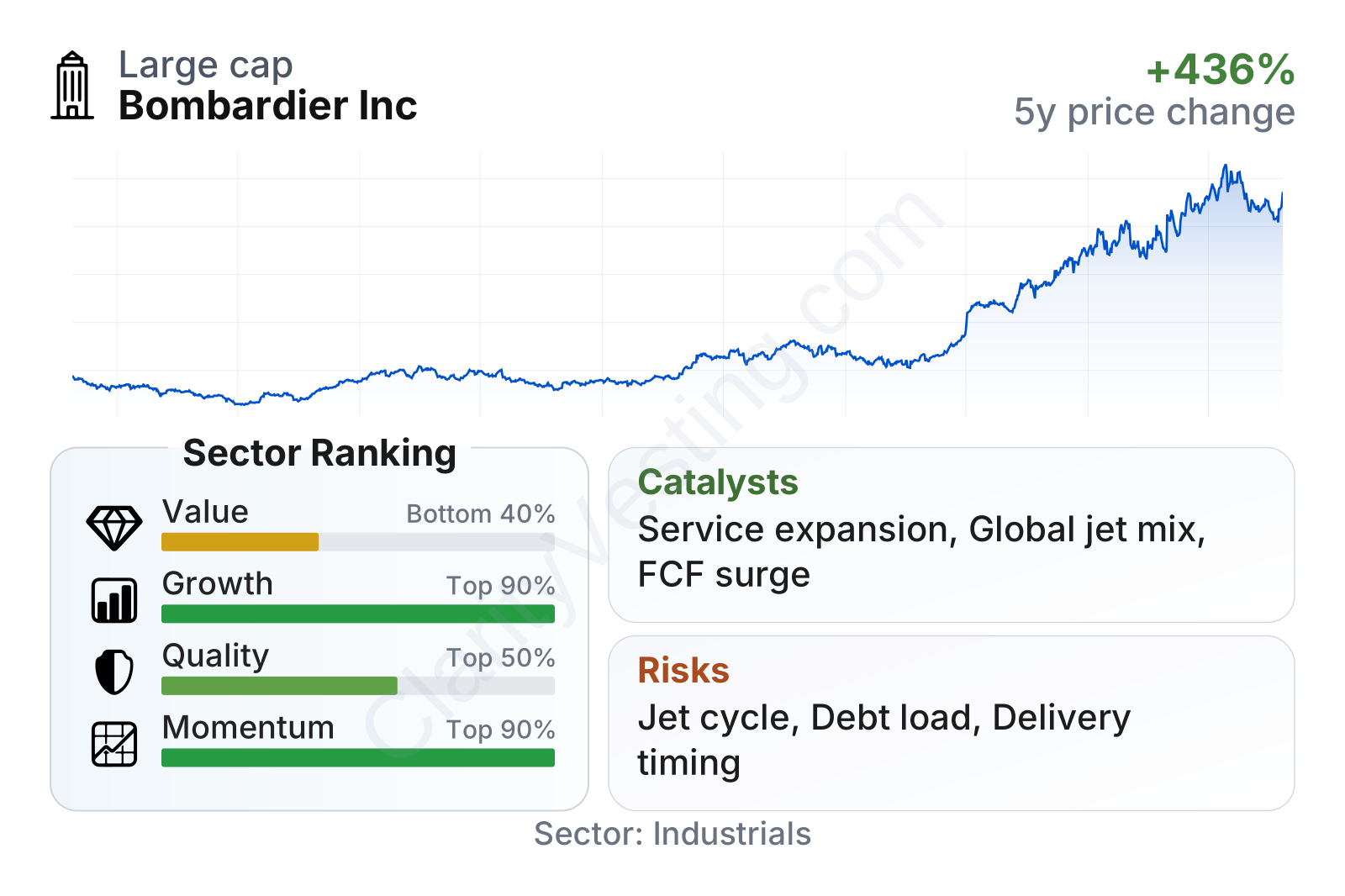
Bombardier stands out for strong growth and strong market momentum relative to much of the aerospace and defense sector, while its valuation appears closer to the middle of the pack rather than clearly cheap. The company’s profit margin is currently above the sector median, and free cash flow has improved sharply. At the same time, the stock’s high beta signals that price moves can be much more volatile than the broader market, which fits the company’s cyclical industry and leveraged history.
The share price performance over the last several years has been exceptionally strong, reflecting a major re-rating as the company moved away from restructuring concerns and toward execution, margin improvement, and debt reduction. That said, rapid appreciation usually raises expectations, so future performance becomes more sensitive to delivery execution and cash generation.
Growth
Bombardier operates in the business aviation market, which is a niche but still attractive part of aerospace. Long-term demand is supported by global wealth creation, corporate travel needs, government and special-mission use, and the practical value of private aviation for time-sensitive travel. The sector is cyclical, but the installed base of aircraft also supports long-duration service revenue.
Bombardier’s strategy is coherent for future growth because it concentrates on segments where the company has established products, brand recognition, and technical know-how. Its Global family gives it exposure to the premium end of business jets, while the service business can expand even without matching aircraft delivery growth every year. This balance is important: aircraft sales are lumpy, whereas maintenance and support are usually steadier.
Revenue growth has not been perfectly smooth quarter to quarter, which is normal in aerospace because timing of deliveries can shift between periods. Still, the broader direction has been upward, and recent year-over-year growth has remained positive. That suggests Bombardier is no longer relying only on turnaround optics; it is now operating from a larger revenue base.
Free cash flow is one of the most important indicators for Bombardier because the company previously carried a heavy debt burden and needed hard cash, not just accounting profit, to strengthen its balance sheet. The recent jump in trailing free cash flow is a major positive signal. If sustained, it gives the company more room to reduce debt, reinvest in products and services, and lower financing pressure over time.
A notable catalyst is Bombardier’s continued push into aftermarket services. Management has spent several years expanding service centers and support capabilities. This can matter more than it first appears: service revenue tends to be stickier, less cyclical than new aircraft sales, and often more profitable. Another catalyst is the company’s exposure to the ultra-long-range category, where customer budgets are less sensitive than in entry-level business aviation.
Recent company updates have also highlighted continued order activity, fleet support expansion, and progress on new capabilities around defense- and mission-related variants. Those areas do not transform Bombardier into a defense prime contractor, but they widen the addressable market and can provide useful diversification beyond purely corporate buyers.
Risks
This article is for informational purposes only and does not constitute financial advice. Some content is AI-generated. See Disclaimer