Stock Analysis · Bombardier Inc (BDRAF)
Overview
Bombardier Inc. is a Canadian aerospace company focused on business jets. After exiting commercial aircraft and rail activities in prior years, the company is now centered on designing, manufacturing, selling, and servicing private aircraft for corporate, government, and high-net-worth customers. Its best-known aircraft families include Learjet historically, and more importantly today the Challenger and Global platforms, with the Global series positioned at the larger, longer-range end of the market.
That simplified business model matters for long-term analysis because Bombardier is no longer a sprawling industrial group. It is now much more directly tied to one niche: business aviation. This gives the company clearer strategic focus, but it also means results depend heavily on demand for private jets, aircraft deliveries, and aftermarket support.
Revenue mainly comes from two broad sources, with aircraft sales still the dominant driver and services becoming increasingly important.
- Aircraft manufacturing and deliveries: approximately 75% to 80% of revenue in recent years. This includes sales of new business jets, especially Challenger and Global aircraft, as well as related completion work.
- Aftermarket services: approximately 20% to 25% of revenue. This includes maintenance, parts, repairs, refurbishments, training, and service center activity that supports Bombardier’s installed fleet.
Geographically, Bombardier sells globally, with North America remaining its largest market, followed by Europe, the Middle East, and other international regions. The company has also been expanding its service network, which is important because recurring support revenue tends to be steadier and often carries attractive margins compared with aircraft deliveries alone.
The business mix has improved over the last several years. Revenue has climbed from a little above $6 billion in 2021 to roughly $9.6 billion in 2025, while operating income and net income have recovered meaningfully. Interest expense has also moved down from earlier levels, showing some progress in balance-sheet repair after a difficult restructuring period.
The long-term pattern is encouraging: a larger revenue base, stronger gross profit, and much better operating earnings than a few years ago. The biggest remaining drag is financing cost, which still absorbs a notable share of operating profit.
Key Figures
| Metric | Value | Sector ⓘ |
|---|---|---|
| Date | Oct 03, 2026 | |
| Context | ||
| Sector | Industrials | |
| Industry | Aerospace & Defense | |
| Market Cap ⓘ | $41.66B | |
| Beta ⓘ | 2.04 | |
Value (Cheapness) | ||
| P/E Ratio ⓘ | 23.80 | 22.45 |
| P/B Ratio ⓘ | N/A | 1.98 |
| FCF Yield ⓘ | 6.05% | 6.31% |
| Dividend Yield ⓘ | N/A | 1.96% |
| EBIT / EV ⓘ | 4.27% | 4.81% |
| PEG ⓘ | 9.23 | |
Growth (Business expansion) | ||
| Revenue Growth ⓘ | 6.00% | 9.10% |
| RPS Growth (5Y CAGR) ⓘ | 147.60% | 7.75% |
| EPS Growth (5Y CAGR) ⓘ | 80.80% | -13.59% |
| BVPS Growth (5Y CAGR) ⓘ | N/A | 6.22% |
| Margin Growth (5Y Trend) ⓘ | 10.28% | 0.72% |
| FCF Growth (5Y CAGR) ⓘ | 83.24% | 10.98% |
| DPS Growth (5Y CAGR) ⓘ | 123.93% | 9.48% |
Quality (Business durability) | ||
| ROIC (Latest) ⓘ | 24.03% | 10.92% |
| ROA (Latest) ⓘ | 6.80% | 5.41% |
| ROIC (5Y Median) ⓘ | 19.61% | 9.21% |
| ROA (5Y Median) ⓘ | 3.59% | 4.94% |
| Net Debt / EBIT (Latest) ⓘ | 2.46 | 2.07 |
| Net Debt / EBIT (5Y Median) ⓘ | 5.11 | 2.28 |
| Net Debt / EBITDA (Latest) ⓘ | 1.69 | 1.43 |
| Net Debt / Assets ⓘ | 18.37% | 19.27% |
| EBITDA / Interest ⓘ | 3.67 | 9.53 |
| Operating Margin (Latest) ⓘ | 10.83% | 10.50% |
| Operating Margin (5Y Median) ⓘ | 8.79% | 10.27% |
| Debt to Equity (Latest) ⓘ | N/A | 65.48% |
| Profit Margin (Latest) ⓘ | 9.58% | 6.62% |
| Free Cash Flow (Latest) ⓘ | $2.52B | |
Momentum (Price trend) | ||
| 3Y Return ⓘ | +543.80% | +58.56% |
| 12M Return (excl. last month) ⓘ | +87.57% | +15.63% |
| 6M Return ⓘ | +32.51% | +4.19% |
| Price vs. 200-Day MA ⓘ | +8.38% | +0.93% |
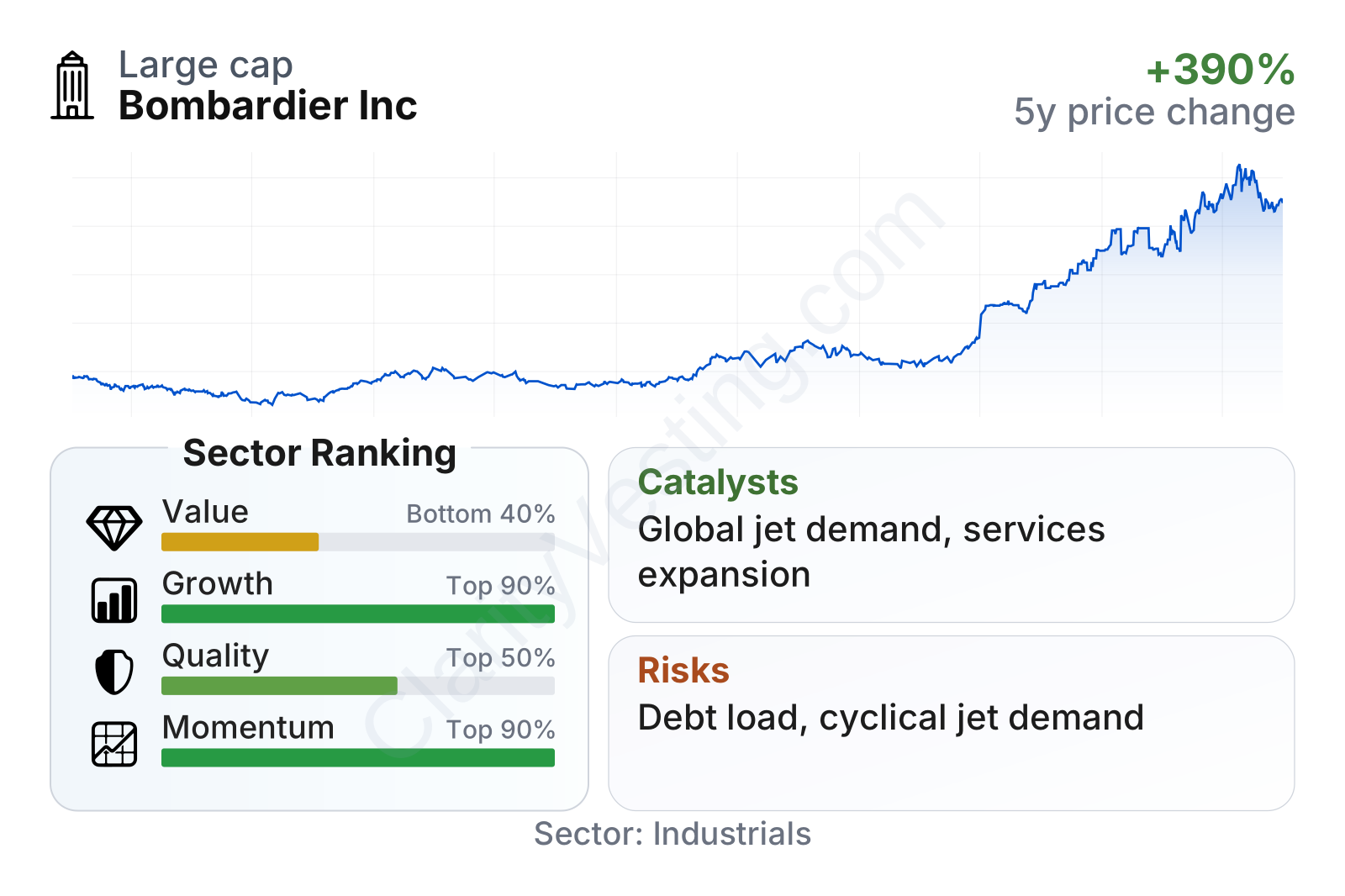
Bombardier currently stands out for strong growth and market momentum relative to much of the industrial sector, while value looks less compelling and balance-sheet strength remains mixed. Profitability metrics are generally solid, with returns on invested capital and profit margin above sector medians, but leverage and interest coverage still point to a business that has not fully shaken off its past debt burden. The stock has also been far more volatile than the average industrial name, which fits a company in the middle of a major turnaround and rerating.
Growth
Bombardier operates in the business aviation market, a segment that has benefited from structural and cyclical support. On the structural side, wealthy individuals, corporations, charter operators, and government customers continue to value time savings, privacy, security, and direct access to smaller airports. On the cyclical side, fleet renewal and demand for larger-cabin, longer-range aircraft have supported premium pricing in the upper end of the market, where Bombardier is especially active.
The company’s strategy is straightforward and mostly coherent. It is concentrating resources on higher-value aircraft platforms, particularly the Global family, while also building a broader and more recurring services business around its fleet. That approach makes sense because a larger installed base can feed maintenance, parts, and training revenue for many years after the original aircraft sale. In aerospace, that type of revenue often improves resilience across cycles.
Recent annual growth has been healthy, with 2025 revenue rising at a high-teens rate. That is stronger than the latest trailing annual pace shown in the factor table, which suggests the company’s growth path has been uneven quarter to quarter but still materially improved over a multi-year period. Over five years, Bombardier’s revenue per share, earnings per share, margin trend, and cash generation have all improved sharply, which is why its growth profile ranks near the top of the sector.
Cash generation deserves a more careful reading than the long-term trend alone suggests. The broader record shows major improvement, and trailing free cash flow is substantial, but the shorter-term line has been choppy, including a negative reading in early 2025. That is not unusual in aerospace, where working capital can swing around delivery timing, inventories, and customer advances. Still, it is a reminder that even a better business can produce lumpy cash flow.
One of the more meaningful growth catalysts is Bombardier’s push into services infrastructure. Expanding maintenance capacity, parts support, and refurbishment capabilities can deepen customer relationships and lift recurring revenue. Another catalyst is continued demand for large-cabin and long-range jets, where Bombardier competes with some of the industry’s strongest products. If the company keeps executing on deliveries while increasing service penetration, growth can become less dependent on pure unit volume.
Recent company updates have also highlighted ongoing focus on debt reduction, operational execution, and the ramp of higher-value aircraft programs. In Bombardier’s case, better execution does not only help revenue growth; it can also widen margins and improve equity value by reducing pressure from interest expense over time.
Risks
This article is for informational purposes only and does not constitute financial advice. Some content is AI-generated. See Disclaimer