Stock Analysis · Banco Do Brasil SA (BDORY)
Overview
Banco do Brasil is one of the largest financial institutions in Brazil and one of the country’s oldest banks. It operates as a universal bank, which means it serves individuals, small businesses, large companies, agribusiness clients, and public-sector entities through a broad mix of lending, deposits, payments, insurance distribution, asset management, pension products, and capital markets services. Its scale is especially relevant in agribusiness, payroll-related banking, and public-sector relationships, where its historic presence gives it reach that newer competitors often do not match.
For a bank, revenue is not as straightforward as it is for an industrial or retail company. Banco do Brasil’s earnings mainly come from financial intermediation and fee-based services. Based on the company’s reporting structure and business mix, the main sources of revenue and profit are broadly concentrated in the following areas:
- Net interest income from lending and treasury activities: approximately 60% to 75% of total banking revenue in a typical year. This includes spreads earned on corporate loans, consumer loans, agribusiness financing, credit cards, and treasury management.
- Service fees and commissions: approximately 15% to 25%. This usually includes account fees, cards, consortiums, asset management, cash management, collections, and other banking services.
- Insurance, pensions, and capitalization-related results: approximately 5% to 15% of profit contribution, mainly through partnerships and distribution rather than fully standalone banking revenue.
- Capital markets, brokerage, and other financial services: a smaller but still relevant share, generally below 10%, depending on market conditions and client activity.
What makes Banco do Brasil different from many regional banks is that it combines commercial banking scale with a strategic role in Brazil’s financial system. It is not just a lender; it is also an important channel for agricultural credit, government-linked programs, and day-to-day financial services across the country.
The business flow over recent years shows that revenue expanded strongly into 2024 and 2025, but profitability became less consistent as funding costs, credit provisions, and margin pressure weighed on results. That pattern matters for long-term analysis because it suggests that size alone does not guarantee stable earnings quality.
Key Figures
| Metric | Value | Sector ⓘ |
|---|---|---|
| Date | Nov 21, 2026 | |
| Context | ||
| Sector | Financial Services | |
| Industry | Banks - Regional | |
| Market Cap ⓘ | $14.04B | |
| Beta ⓘ | 0.38 | |
Value (Cheapness) | ||
| P/E Ratio ⓘ | 6.65 | 12.01 |
| P/B Ratio ⓘ | N/A | 1.48 |
| FCF Yield ⓘ | 74.83% | 8.77% |
| Dividend Yield ⓘ | 1.65% | 3.01% |
| EBIT / EV ⓘ | 0.11% | 8.31% |
| PEG ⓘ | N/A | |
Growth (Business expansion) | ||
| Revenue Growth ⓘ | -19.60% | 6.70% |
| RPS Growth (5Y CAGR) ⓘ | 19.39% | 12.35% |
| EPS Growth (5Y CAGR) ⓘ | -27.66% | -0.27% |
| BVPS Growth (5Y CAGR) ⓘ | 6.81% | 4.83% |
| Margin Growth (5Y Trend) ⓘ | -17.41% | -4.16% |
| FCF Growth (5Y CAGR) ⓘ | N/A | 4.69% |
| DPS Growth (5Y CAGR) ⓘ | 0.86% | 8.82% |
Quality (Business durability) | ||
| ROIC (Latest) ⓘ | 3.17% | 9.49% |
| ROE (Latest) ⓘ | 5.96% | 14.02% |
| ROA (Latest) ⓘ | 0.44% | 1.53% |
| ROIC (5Y Median) ⓘ | 7.66% | 7.80% |
| ROE (5Y Median) ⓘ | 15.51% | 12.09% |
| ROA (5Y Median) ⓘ | 1.16% | 1.28% |
| Net Debt / EBIT (Latest) ⓘ | 201.11 | 0.88 |
| Net Debt / EBIT (5Y Median) ⓘ | -0.29 | 0.73 |
| Net Debt / EBITDA (Latest) ⓘ | 203.01 | 0.71 |
| Operating Margin (Latest) ⓘ | 1.69% | 23.37% |
| Operating Margin (5Y Median) ⓘ | 8.92% | 24.29% |
| Debt to Equity (Latest) ⓘ | 613.66% | 59.34% |
| Profit Margin (Latest) ⓘ | 21.33% | 26.65% |
| Free Cash Flow (Latest) ⓘ | $10.51B | |
Momentum (Price trend) | ||
| 3Y Return ⓘ | -43.80% | +73.29% |
| 12M Return (excl. last month) ⓘ | +27.27% | +18.35% |
| 6M Return ⓘ | -41.73% | +3.24% |
| Price vs. 200-Day MA ⓘ | -42.98% | +2.17% |
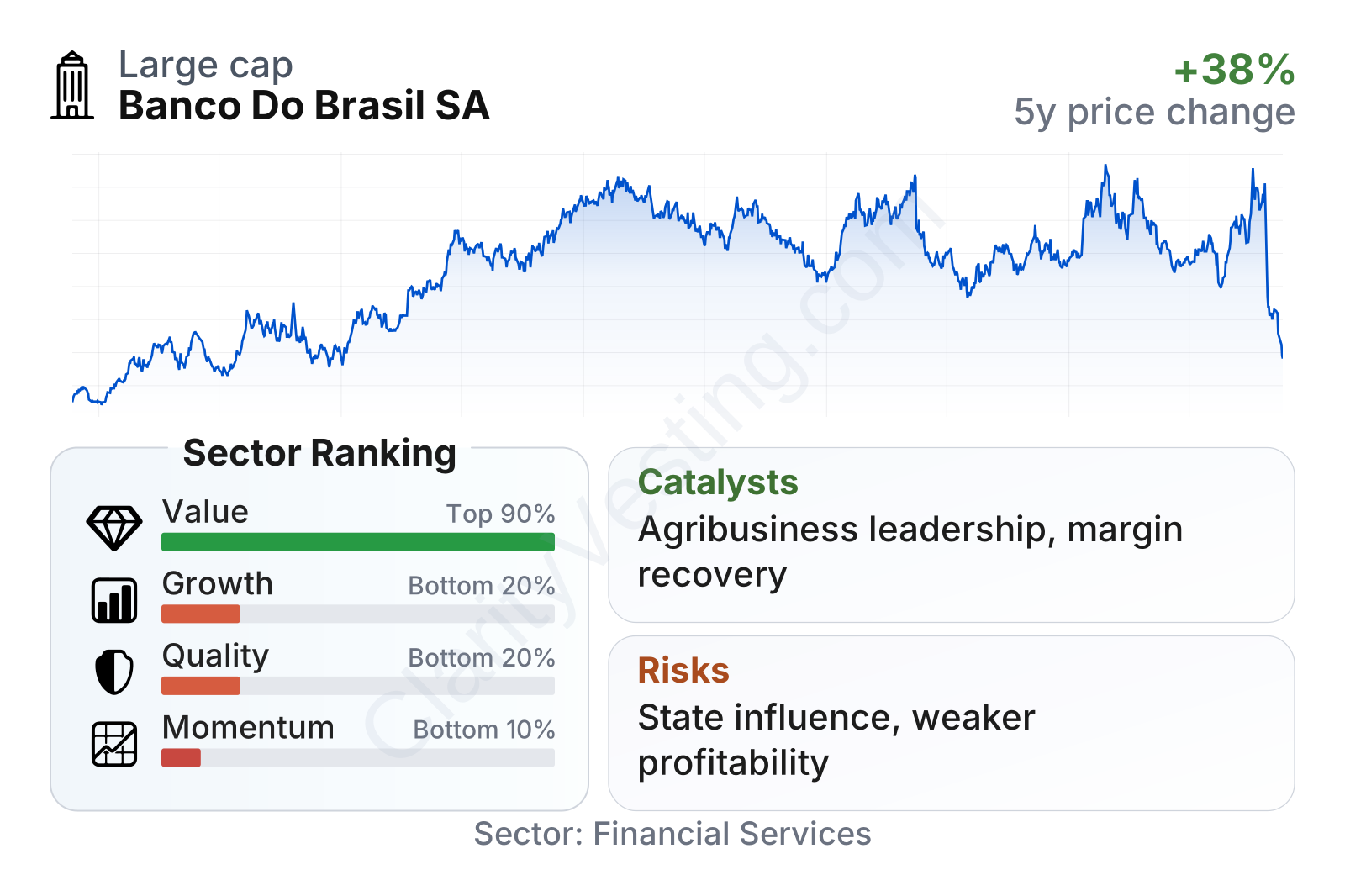
Banco do Brasil is a large bank by Brazilian standards, but its U.S.-traded ADR still behaves like an emerging-market financial stock, with meaningful swings tied to Brazil’s rates, currency, politics, and credit cycle. The recent share-price path shows that the stock had a strong run through 2023 and early 2024, but momentum weakened sharply afterward, with the price now well below its longer-term average.
The valuation profile looks optically cheap. The price-to-earnings ratio is well below the sector median, which usually signals that the market is discounting slower growth, lower confidence in earnings durability, or country-specific risk. Income generation remains notable, and free cash flow appears very strong on a screen, although cash flow metrics for banks need more caution than for non-financial companies because balance-sheet movements can distort the picture.
The factor mix is uneven. Value looks favorable, but growth, quality, and momentum rank much weaker versus the broader financial sector. In plain terms, the market is giving Banco do Brasil credit for being inexpensive, but not for having especially strong current operating quality or a strong stock trend.
Growth
Banco do Brasil operates in a sector that should remain structurally relevant for many years. Brazil is a large banking market, credit penetration still has room to deepen in several segments, and financial products tied to agribusiness, insurance, payments, payroll, and wealth services can expand over time. Digitalization is also reshaping the sector, reducing friction for customers and potentially improving cost efficiency for incumbent banks that adapt well.
The bank’s strategy for growth is logical on paper because it builds on areas where it already has scale: agribusiness lending, cross-selling to existing clients, fee-generating services, digital channels, and relationships with public-sector and corporate customers. This matters because mature banks usually grow best not by opening completely new markets, but by extracting more value from large client bases at controlled risk.
That said, the recent earnings trend has become softer. Earnings per share climbed strongly from 2021 through 2024, then dropped materially in 2025, showing that recent pressure was not just a stock-market issue but an operating one as well.
For long-term shareholders, book value per share is another important lens because banks are often judged by how consistently they grow capital while producing acceptable returns on that capital. On that measure, Banco do Brasil looks steadier. Book value per share has continued to rise over the last several years, suggesting that even with more volatile earnings, the franchise has still been adding to its equity base.
A major medium-term catalyst is the possibility of normalization in profitability if credit costs ease and spreads stabilize. Another is continued strength in agribusiness, where Banco do Brasil has a strong competitive position and where Brazil remains globally important. Efficiency gains from digital adoption could also help offset cost pressure over time. Recent corporate updates have also highlighted management’s focus on recurring business lines such as loans, insurance-related distribution, and service revenue, which are key areas for more resilient growth if execution improves.
In short, the sector itself offers room for expansion, and Banco do Brasil has enough scale and market access to participate in that expansion. The main question is not whether the market exists, but whether the bank can convert its scale into stronger and more consistent profit growth than it has recently delivered.
Risks
This article is for informational purposes only and does not constitute financial advice. Some content is AI-generated. See Disclaimer


