Stock Analysis · BOC Aviation Limited (BCVVF)
Overview
BOC Aviation Limited is an aircraft leasing company. In simple terms, it buys commercial airplanes from manufacturers such as Airbus and Boeing, then rents those aircraft to airlines around the world under multi-year contracts. This business model allows airlines to expand or renew their fleets without paying the full purchase price upfront, while BOC Aviation earns recurring lease income and can also generate gains by selling aircraft later in their life cycle.
The company is headquartered in Singapore and is controlled by Bank of China, which gives it access to a large banking network and funding relationships. Its fleet is globally diversified across airlines, countries, and aircraft types, with a focus on modern, fuel-efficient narrowbody jets that are widely used on short- and medium-haul routes.
BOC Aviation’s revenue base is concentrated in a few core activities. Based on the latest annual reporting and the company’s business model, the main sources are approximately the following:
- Aircraft lease rental income: about 80% to 90% of revenue. This is the recurring rent paid by airline customers for using aircraft under operating leases.
- Sales of aircraft and related gains: about 10% to 20%. This includes proceeds and gains from selling aircraft from the portfolio, often as part of fleet recycling.
- Other income: typically below 10%. This can include lease management fees, end-of-lease income, maintenance-related recoveries, and interest or miscellaneous items depending on the year.
The business is attractive when airline traffic grows, financing remains available, and demand stays strong for young, efficient aircraft. It is less like a traditional airline and more like a long-duration asset owner financed with large amounts of debt and long-term contracts.
The broad financial flow shows a business with high reported margins but also very large financing needs. Revenue has generally moved upward over the last several years, while profitability can swing depending on aircraft sales, accounting items, funding costs, and lease conditions.
One notable pattern is that revenue has trended higher from 2021 through 2025, and net income rebounded strongly after a weak 2022. At the same time, interest expense remains a critical line to watch because this business depends heavily on borrowed money to fund aircraft purchases.
Key Figures
| Metric | Value | Sector ⓘ |
|---|---|---|
| Date | Oct 17, 2026 | |
| Context | ||
| Sector | Industrials | |
| Industry | Rental & Leasing Services | |
| Market Cap ⓘ | $5.80B | |
| Beta ⓘ | 0.87 | |
Value (Cheapness) | ||
| P/E Ratio ⓘ | 7.27 | 22.10 |
| P/B Ratio ⓘ | 0.11 | 1.97 |
| FCF Yield ⓘ | -66.71% | 6.38% |
| Dividend Yield ⓘ | 5.18% | 1.94% |
| EBIT / EV ⓘ | 13.67% | 4.79% |
| PEG ⓘ | 3.98 | |
Growth (Business expansion) | ||
| Revenue Growth ⓘ | 6.60% | 9.30% |
| RPS Growth (5Y CAGR) ⓘ | 74.09% | 7.81% |
| EPS Growth (5Y CAGR) ⓘ | -38.49% | -13.06% |
| BVPS Growth (5Y CAGR) ⓘ | 78.32% | 6.14% |
| Margin Growth (5Y Trend) ⓘ | 10.17% | 0.88% |
| FCF Growth (5Y CAGR) ⓘ | N/A | 11.01% |
| DPS Growth (5Y CAGR) ⓘ | 94.23% | 9.48% |
Quality (Business durability) | ||
| ROIC (Latest) ⓘ | 11.82% | 10.84% |
| ROA (Latest) ⓘ | 6.09% | 5.41% |
| ROIC (5Y Median) ⓘ | 3.57% | 9.38% |
| ROA (5Y Median) ⓘ | 3.07% | 4.95% |
| Net Debt / EBIT (Latest) ⓘ | 5.42 | 2.08 |
| Net Debt / EBIT (5Y Median) ⓘ | 13.56 | 2.27 |
| Net Debt / EBITDA (Latest) ⓘ | 3.68 | 1.39 |
| Net Debt / Assets ⓘ | 65.19% | 19.28% |
| EBITDA / Interest ⓘ | N/A | 9.58 |
| Operating Margin (Latest) ⓘ | 67.47% | 10.50% |
| Operating Margin (5Y Median) ⓘ | 57.77% | 10.29% |
| Debt to Equity (Latest) ⓘ | 262.56% | 65.48% |
| Profit Margin (Latest) ⓘ | 33.84% | 6.67% |
| Free Cash Flow (Latest) ⓘ | -$3.87B | |
Momentum (Price trend) | ||
| 3Y Return ⓘ | +40.27% | +61.68% |
| 12M Return (excl. last month) ⓘ | +3.82% | +12.58% |
| 6M Return ⓘ | -7.94% | 0.00% |
| Price vs. 200-Day MA ⓘ | +16.43% | +0.02% |
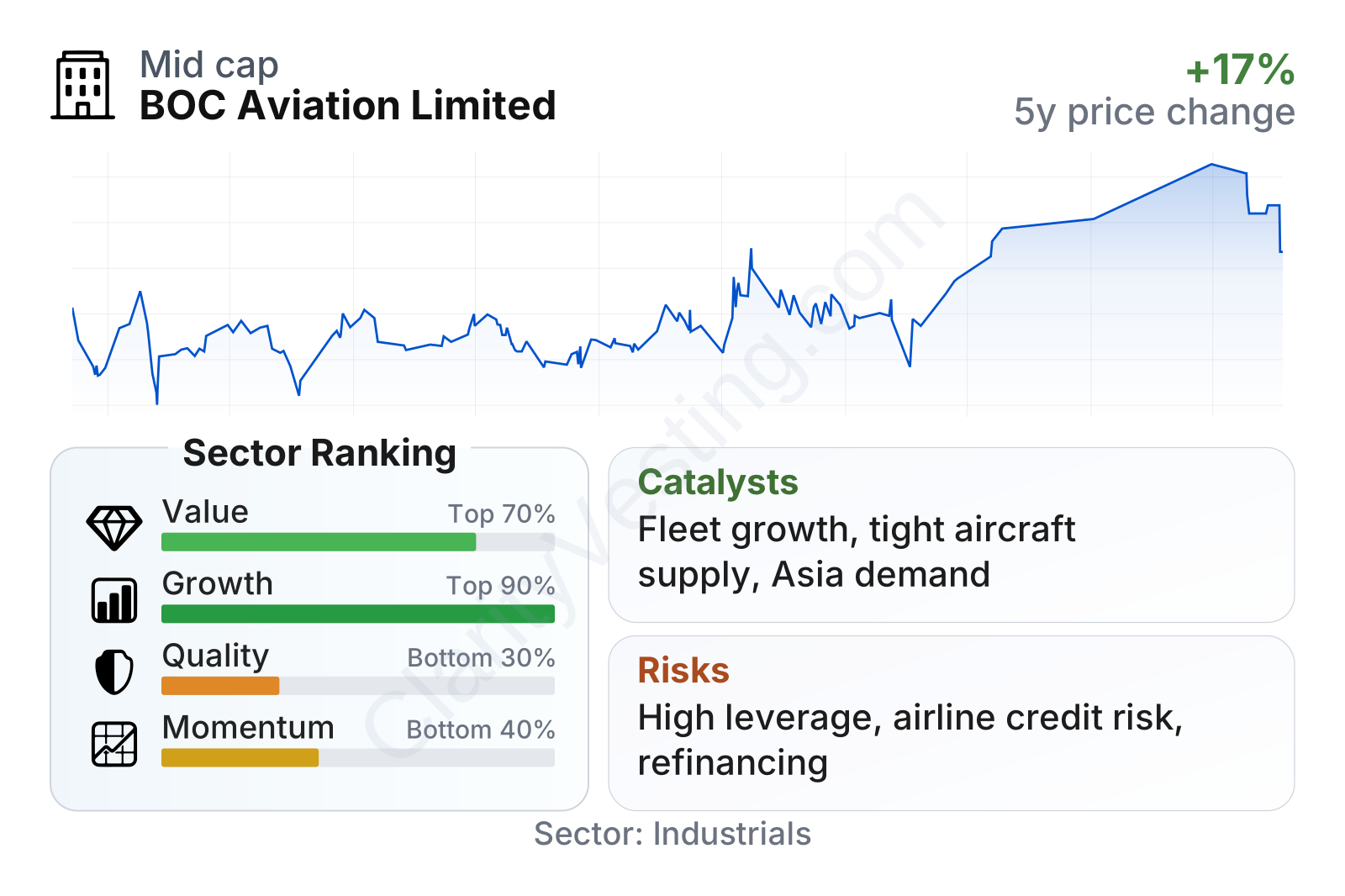
BOC Aviation stands out as a mid-to-large player in leasing, with a market value in the multi-billion-dollar range and a beta below 1, which suggests the stock has been less volatile than the broader market. On valuation, the shares screen at a low earnings multiple and a very low price-to-book ratio versus the sector median, while the dividend yield is clearly above the sector norm. On operating profitability, margins are unusually strong for the broader industrials universe, but that needs to be read together with the company’s balance-sheet structure.
The biggest caution in the metrics is leverage. Debt-to-equity is above 260%, net debt relative to EBIT and EBITDA is well above the sector median, and free cash flow is deeply negative. For an aircraft lessor, negative free cash flow is not automatically a sign of weakness because the company regularly spends large sums on new aircraft investments. Still, it shows how dependent the model is on ongoing access to debt markets, bank funding, and disciplined asset sales.
Growth indicators are mixed but generally constructive. Recent revenue growth is modest, yet longer-term growth in revenue per share, book value per share, and dividends has been much stronger than the sector median. Momentum is less impressive over the last year, although the share price remains meaningfully above its 200-day average, which signals that the market has not turned decisively negative on the name.
Growth
BOC Aviation operates in a sector with favorable long-term demand drivers. Global air travel has continued to recover and expand over time, especially in Asia, where rising middle-class travel demand and ongoing airline fleet modernization support aircraft leasing. Leasing has also become more important to airlines because it offers flexibility, preserves cash, and reduces the need to fund aircraft purchases directly on their own balance sheets.
The company’s strategy is broadly aligned with these trends. It focuses heavily on in-demand aircraft types, especially newer and more fuel-efficient models. That matters because airlines are under pressure to lower fuel consumption, cut emissions intensity, and keep operating costs down. Aircraft with these characteristics are typically easier to place with customers and can retain value better than older models.
Another growth catalyst is the supply side of the aircraft market. Deliveries from manufacturers have been constrained by production bottlenecks and engine-related issues across the industry. For leasing companies that already control order books and existing fleets, limited new supply can strengthen lease rates, extend lease terms, and support aircraft values. In other words, scarcity can improve economics for owners of available aircraft.
BOC Aviation also benefits from portfolio recycling. The company regularly sells selected aircraft and reinvests in newer ones. When done well, this can help refresh the fleet, realize gains, and maintain customer demand. Because it is backed by a major Chinese banking group and has longstanding relationships in aviation finance, it has an important structural advantage in funding access compared with smaller independent lessors.
Recent company updates have also pointed to continued fleet expansion, active aircraft delivery pipelines, and broad customer diversification. Those are meaningful signs because they indicate that airlines are still taking aircraft, and that demand is not tied to one region or one customer group alone.
Risks
This article is for informational purposes only and does not constitute financial advice. Some content is AI-generated. See Disclaimer


