Stock Analysis · BioCryst Pharmaceuticals Inc (BCRX)
Overview
BioCryst Pharmaceuticals is a biotechnology company focused on rare diseases. Its business centers on discovering, developing, and commercializing medicines that target conditions with limited treatment options. For long-term analysis, the company matters primarily because it has already moved beyond the purely experimental stage: it now has a marketed product generating substantial revenue, while still keeping additional pipeline programs that could affect its future size and profitability.
The company’s revenue base is heavily concentrated in one product. Based on recent annual reporting and company disclosures, the main sources of revenue are approximately:
- ORLADEYO product revenue: about 97% to 99% — ORLADEYO is an oral treatment for hereditary angioedema, a rare genetic disease that causes severe swelling attacks. This is BioCryst’s core commercial asset and the main driver of its growth.
- Collaboration, royalty, and other revenue: about 1% to 3% — this includes smaller partnership-related and miscellaneous items that are not currently central to the business model.
That concentration creates a very clear investment profile. BioCryst is no longer an early-stage biotech with no commercial engine, but it is also not yet broadly diversified. The company’s progress depends largely on how far ORLADEYO can expand globally, how durable demand remains, and whether new pipeline assets can eventually reduce single-product dependence.
Over the past several years, revenue has risen sharply while research spending has become a smaller share of sales. That shift helped move the business from large operating losses toward periods of operating profitability and positive cash generation, even though reported net income remains volatile.
The broader financial picture shows a business that has scaled meaningfully: sales have grown from a relatively modest base into a much larger commercial footprint, gross profit has expanded strongly, and operating leverage has improved. At the same time, selling costs and interest expense remain important items, which helps explain why accounting profits are still less stable than revenue growth alone might suggest.
Key Figures
| Metric | Value | Sector ⓘ |
|---|---|---|
| Date | Oct 17, 2026 | |
| Context | ||
| Sector | Healthcare | |
| Industry | Drug Manufacturers - Specialty & Generic | |
| Market Cap ⓘ | $2.08B | |
| Beta ⓘ | 0.55 | |
Value (Cheapness) | ||
| P/E Ratio ⓘ | N/A | 24.79 |
| P/B Ratio ⓘ | N/A | 3.08 |
| FCF Yield ⓘ | 17.15% | 3.15% |
| Dividend Yield ⓘ | N/A | 1.94% |
| EBIT / EV ⓘ | -11.76% | 0.57% |
| PEG ⓘ | 9.39 | |
Growth (Business expansion) | ||
| Revenue Growth ⓘ | 33.60% | 7.45% |
| RPS Growth (5Y CAGR) ⓘ | 46.14% | 8.61% |
| EPS Growth (5Y CAGR) ⓘ | N/A | -17.81% |
| BVPS Growth (5Y CAGR) ⓘ | -2.26% | 3.72% |
| Margin Growth (5Y Trend) ⓘ | N/A | -0.62% |
| FCF Growth (5Y CAGR) ⓘ | N/A | 1.04% |
| DPS Growth (5Y CAGR) ⓘ | N/A | 6.77% |
Quality (Business durability) | ||
| ROIC (Latest) ⓘ | -55.51% | 3.24% |
| ROA (Latest) ⓘ | -76.61% | 3.01% |
| ROIC (5Y Median) ⓘ | -23.17% | 4.60% |
| ROA (5Y Median) ⓘ | -39.89% | 1.89% |
| Net Debt / EBIT (Latest) ⓘ | N/A | 1.34 |
| Net Debt / EBIT (5Y Median) ⓘ | N/A | 1.84 |
| Net Debt / EBITDA (Latest) ⓘ | N/A | 1.00 |
| Net Debt / Assets ⓘ | 45.69% | 5.45% |
| EBITDA / Interest ⓘ | N/A | 9.64 |
| Operating Margin (Latest) ⓘ | -32.84% | 9.27% |
| Operating Margin (5Y Median) ⓘ | -35.60% | 7.38% |
| Debt to Equity (Latest) ⓘ | -90.22% | 28.58% |
| Profit Margin (Latest) ⓘ | -40.90% | 3.59% |
| Free Cash Flow (Latest) ⓘ | $357.11M | |
Momentum (Price trend) | ||
| 3Y Return ⓘ | +35.02% | +42.80% |
| 12M Return (excl. last month) ⓘ | +5.97% | +18.50% |
| 6M Return ⓘ | -15.04% | +7.57% |
| Price vs. 200-Day MA ⓘ | -7.95% | +5.12% |
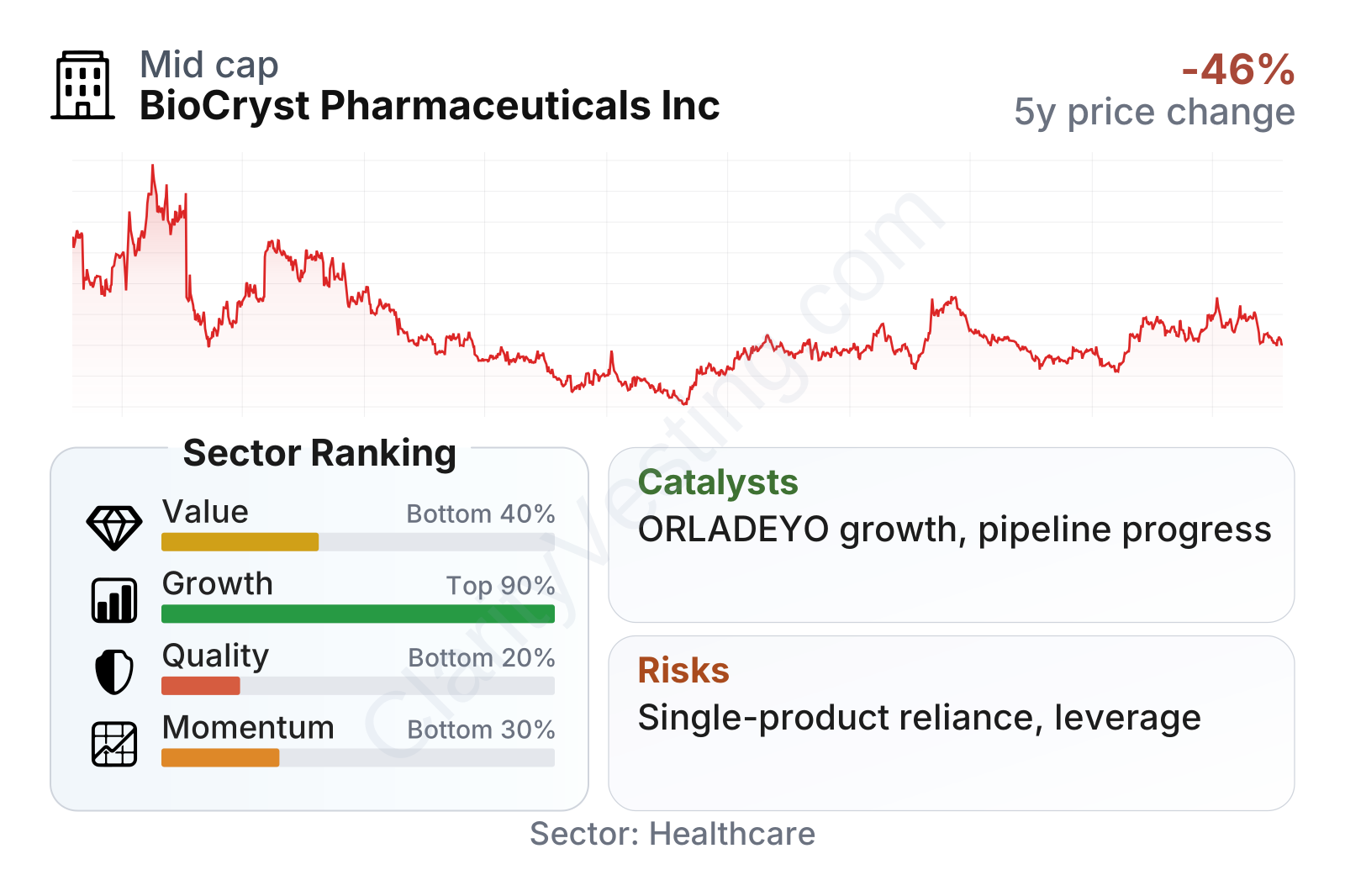
BioCryst is a mid-sized healthcare company with a stock that has been volatile over the last several years, though the recent trend has been better than the earlier decline from 2022 through 2024. In the latest factor snapshot, the strongest area is growth, where the company ranks near the top of its sector thanks to revenue expansion well above the healthcare median and very strong multi-year revenue-per-share growth.
The weaker areas are quality and momentum. Quality remains pressured by negative returns on capital and still-negative margins on a trailing basis, even after major improvement from earlier years. Momentum is also weak relative to the sector, suggesting that the market is still cautious despite better operating performance. On value, the picture is mixed: traditional earnings-based measures are difficult to read cleanly, but free cash flow generation looks stronger than many sector peers.
Growth
BioCryst operates in a part of healthcare that can support long growth runways. Rare disease treatment is attractive because patients often need long-term therapy, pricing can be strong when the medicine addresses a serious unmet need, and competition is usually narrower than in mass-market drug categories. That does not remove risk, but it does mean a successful product can compound for years if clinical value and patient retention remain solid.
The company’s strategy is straightforward and sensible. First, it is trying to deepen ORLADEYO’s position in hereditary angioedema across more countries and treatment settings. Second, it is using the cash generated by the commercial business to support pipeline development rather than relying entirely on repeated external financing. For a biotech company, that is an important change in business quality.
Revenue growth has stayed well above the sector median, even after the company moved beyond its earliest launch phase. Growth has naturally become less explosive than at the beginning, but the recent pattern still points to a business expanding at a much faster rate than most healthcare peers. That supports the idea that ORLADEYO still has room to penetrate its target market rather than having already reached maturity.
Free cash flow is another meaningful positive shift. The company moved from clearly negative cash generation to strongly positive trailing free cash flow by 2026. That does not guarantee a smooth path from here, but it changes the long-term profile materially. A biotech funded by its own commercial asset is generally in a stronger position than one dependent on capital markets to keep operating.
A major catalyst remains continued ORLADEYO execution: patient additions, persistence on therapy, international reimbursement wins, and broader physician adoption. Beyond that, pipeline progress could become important if BioCryst can show that its development programs have a realistic path to commercialization. Recent company updates have also highlighted ongoing efforts to strengthen the balance sheet and extend financial flexibility, which matters because it can give management more time to develop assets without immediate financing pressure.
Risks
This article is for informational purposes only and does not constitute financial advice. Some content is AI-generated. See Disclaimer


