Stock Analysis · Balchem Corporation (BCPC)
Overview
Balchem Corporation is a specialty ingredients and performance materials company. In simple terms, it makes highly engineered products that help improve nutrition, health, food preservation, and the performance of industrial applications. Its products are used in areas such as human nutrition, animal nutrition, pharmaceuticals, food and beverage, and specialty packaging.
The business is organized into three main segments. Based on the latest annual results, revenue is spread roughly as follows:
- Human Nutrition & Health: about 56% of revenue. This is the largest segment and includes minerals, vitamins, choline nutrients, microencapsulation technologies, chelated minerals, specialty ingredients for foods and beverages, and solutions used in dietary supplements, infant nutrition, and pharmaceutical applications.
- Animal Nutrition & Health: about 28% of revenue. This segment focuses mainly on choline products, rumen-protected nutrients, and other ingredients designed to improve livestock health, dairy productivity, and feed efficiency.
- Specialty Products: about 16% of revenue. This includes encapsulated ingredients and industrial products, most notably ethylene oxide, propylene oxide, and related derivatives used in sterilization, medical device applications, and other industrial end markets.
What makes Balchem easier to understand as a long-term business is that much of its revenue comes from repeat-use ingredients rather than one-time purchases. Customers often integrate these ingredients into formulations, feed programs, or manufacturing processes, which can support recurring demand and sticky commercial relationships.
The earnings profile has also been improving. Over the last several years, sales have moved from roughly $800 million to more than $1.0 billion, while operating income and net income have risen faster than revenue. That points to a business mix shift toward higher-value products and better cost discipline.
The profit flow has become more favorable over time: revenue has expanded, gross profit has grown faster than cost of revenue, and operating income has steadily widened. Interest expense rose after acquisitions and higher borrowing, but the more recent trend shows balance sheet pressure easing while net income keeps improving.
Key Figures
| Metric | Value | Sector ⓘ |
|---|---|---|
| Date | Oct 24, 2026 | |
| Context | ||
| Sector | Basic Materials | |
| Industry | Specialty Chemicals | |
| Market Cap ⓘ | $5.47B | |
| Beta ⓘ | 0.85 | |
Value (Cheapness) | ||
| P/E Ratio ⓘ | 33.78 | 16.92 |
| P/B Ratio ⓘ | 4.23 | 1.66 |
| FCF Yield ⓘ | 3.13% | 5.83% |
| Dividend Yield ⓘ | 0.56% | 2.07% |
| EBIT / EV ⓘ | 4.03% | 6.38% |
| PEG ⓘ | 3.26 | |
Growth (Business expansion) | ||
| Revenue Growth ⓘ | 11.20% | 11.25% |
| RPS Growth (5Y CAGR) ⓘ | 6.79% | 4.49% |
| EPS Growth (5Y CAGR) ⓘ | -9.15% | -15.24% |
| BVPS Growth (5Y CAGR) ⓘ | 9.48% | 5.49% |
| Margin Growth (5Y Trend) ⓘ | 4.19% | -1.54% |
| FCF Growth (5Y CAGR) ⓘ | 8.90% | 0.37% |
| DPS Growth (5Y CAGR) ⓘ | 10.92% | 5.91% |
Quality (Business durability) | ||
| ROIC (Latest) ⓘ | N/A | 9.59% |
| ROA (Latest) ⓘ | 9.82% | 4.92% |
| ROIC (5Y Median) ⓘ | 11.79% | 7.91% |
| ROA (5Y Median) ⓘ | 8.10% | 3.92% |
| Net Debt / EBIT (Latest) ⓘ | 0.47 | 1.36 |
| Net Debt / EBIT (5Y Median) ⓘ | 0.87 | 1.69 |
| Net Debt / EBITDA (Latest) ⓘ | 0.39 | 0.93 |
| Net Debt / Assets ⓘ | 6.14% | 13.69% |
| EBITDA / Interest ⓘ | 29.60 | 12.38 |
| Operating Margin (Latest) ⓘ | 20.31% | 13.24% |
| Operating Margin (5Y Median) ⓘ | 17.33% | 11.82% |
| Debt to Equity (Latest) ⓘ | 12.80% | 40.30% |
| Profit Margin (Latest) ⓘ | 15.14% | 6.38% |
| Free Cash Flow (Latest) ⓘ | $171.36M | |
Momentum (Price trend) | ||
| 3Y Return ⓘ | +41.80% | +73.47% |
| 12M Return (excl. last month) ⓘ | +7.57% | +27.59% |
| 6M Return ⓘ | -2.79% | -4.02% |
| Price vs. 200-Day MA ⓘ | +1.15% | -0.65% |
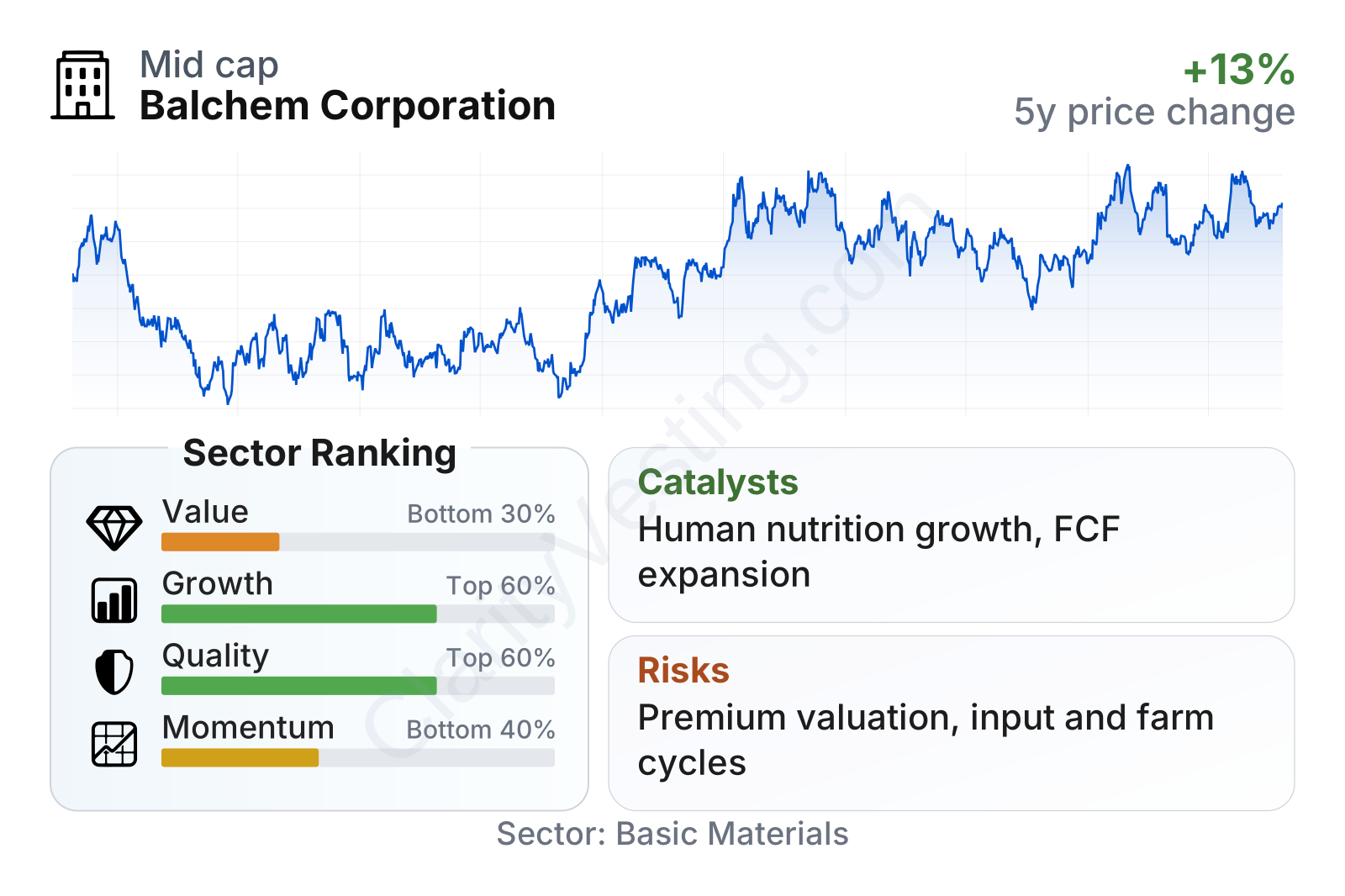
Balchem stands out more for business quality than for cheapness. Profitability, cash generation, and leverage compare well with much of the specialty chemicals universe, while valuation measures sit on the expensive side. Growth metrics are solid rather than exceptional, and recent share price momentum has been weaker than the sector even as the company’s underlying financial performance has remained steady.
The company is now a mid-sized specialty chemicals name with a stock that has been less volatile than the broader market, as reflected by a beta below 1. The dividend exists, but it is small, so the investment case is tied much more to compounding earnings and cash flow than to income.
Growth
Balchem operates in niches that benefit from durable long-term demand. Nutrition and health ingredients are supported by trends such as healthier food formulations, aging populations, wellness products, fortified foods, infant nutrition, and productivity needs in animal agriculture. These are not purely cyclical themes; they are tied to regulation, consumer habits, and efficiency requirements.
The company’s strategy also looks coherent. Rather than competing mainly on commodity volumes, Balchem focuses on specialized formulations, nutrient delivery technologies, and ingredients that solve performance problems for customers. That is usually a better place to be in chemicals because it can support higher margins and better customer retention.
Recent sales growth shows a temporary slowdown in 2023 followed by a healthier recovery through 2024, 2025, and into 2026. The latest pace is around the low-double-digit range, which suggests end-market demand and product mix have improved after a softer period.
Cash generation has also moved in the right direction. Free cash flow has climbed materially over the last few years and is now well above where it stood in 2022. That matters because it gives Balchem more flexibility to fund acquisitions, invest in capacity, support research and development, and continue dividend growth without relying heavily on new debt.
A meaningful catalyst is the company’s exposure to higher-value nutrition platforms, especially in human health and specialty food ingredients. Balchem has also spent years building technical capabilities in encapsulation and mineral delivery, which can open additional product applications. In animal nutrition, dairy and livestock efficiency remains a practical demand driver because producers are under pressure to improve output while managing feed costs and sustainability requirements.
Another positive point is acquisition integration. Balchem has historically used bolt-on deals to expand technologies and customer reach. If that pattern continues with discipline, it can add to growth beyond the company’s internal product development.
Risks
This article is for informational purposes only and does not constitute financial advice. Some content is AI-generated. See Disclaimer


