Stock Analysis · Brinks Company (BCO)
Overview
The Brink’s Company is a global provider of cash and valuables management services. In simple terms, it helps banks, retailers, and other businesses move, store, process, and protect cash and other high-value items. Its operations include armored transportation, cash processing, ATM services, digital retail cash tools, and vaulting solutions. While the company is widely recognized for armored trucks, the business today is broader and increasingly centered on outsourced cash management.
Brink’s generates most of its revenue from recurring service relationships with commercial customers rather than one-time projects. Based on the company’s recent annual reporting, revenue is geographically diversified, with the largest contribution coming from North America, followed by Latin America, then Europe, and a smaller contribution from the rest of the world. Exact service-line percentages are not always broken out in a detailed public mix, but the business can be understood through its main operating activities:
- Cash-in-transit and route-based services: armored transportation of cash and valuables between stores, banks, ATMs, and processing centers. This remains the company’s largest activity.
- Cash management services: counting, sorting, validating, storing, and depositing cash on behalf of retailers and financial institutions.
- ATM managed services: replenishment, monitoring, maintenance coordination, and related outsourced ATM support.
- Digital retail cash ecosystem: software-connected safes and related services that allow retailers to automate cash handling and improve visibility over store deposits.
- Other valuables logistics: transport and handling of items such as precious metals, jewelry, pharmaceuticals, and high-value documents in selected markets.
The company’s recent revenue and profit progression shows a business that has been expanding steadily, with total revenue rising from about $4.2 billion in 2021 to about $5.3 billion in 2025. Operating income has also improved over that period, suggesting that Brink’s has not relied only on volume growth but has also been working on pricing and operating efficiency.
The long-term pattern points to improving gross profit and operating income, although interest expense remains meaningful. That matters because Brink’s is a service business with solid cash generation, but part of that cash flow is still absorbed by financing costs.
Key Figures
| Metric | Value | Sector ⓘ |
|---|---|---|
| Date | Oct 03, 2026 | |
| Context | ||
| Sector | Industrials | |
| Industry | Security & Protection Services | |
| Market Cap ⓘ | $4.25B | |
| Beta ⓘ | 1.02 | |
Value (Cheapness) | ||
| P/E Ratio ⓘ | 24.26 | 22.45 |
| P/B Ratio ⓘ | 23.47 | 1.98 |
| FCF Yield ⓘ | 9.27% | 6.31% |
| Dividend Yield ⓘ | 0.97% | 1.96% |
| EBIT / EV ⓘ | 8.02% | 4.81% |
| PEG ⓘ | 1.16 | |
Growth (Business expansion) | ||
| Revenue Growth ⓘ | 7.10% | 9.10% |
| RPS Growth (5Y CAGR) ⓘ | 10.49% | 7.75% |
| EPS Growth (5Y CAGR) ⓘ | -10.19% | -13.59% |
| BVPS Growth (5Y CAGR) ⓘ | N/A | 6.22% |
| Margin Growth (5Y Trend) ⓘ | 3.11% | 0.72% |
| FCF Growth (5Y CAGR) ⓘ | 8.92% | 10.98% |
| DPS Growth (5Y CAGR) ⓘ | 7.85% | 9.48% |
Quality (Business durability) | ||
| ROIC (Latest) ⓘ | 7.90% | 10.92% |
| ROA (Latest) ⓘ | 2.53% | 5.41% |
| ROIC (5Y Median) ⓘ | 8.17% | 9.21% |
| ROA (5Y Median) ⓘ | 2.46% | 4.94% |
| Net Debt / EBIT (Latest) ⓘ | 4.46 | 2.07 |
| Net Debt / EBIT (5Y Median) ⓘ | 6.14 | 2.28 |
| Net Debt / EBITDA (Latest) ⓘ | 2.88 | 1.43 |
| Net Debt / Assets ⓘ | 35.25% | 19.27% |
| EBITDA / Interest ⓘ | 3.58 | 9.53 |
| Operating Margin (Latest) ⓘ | 10.56% | 10.50% |
| Operating Margin (5Y Median) ⓘ | 9.02% | 10.27% |
| Debt to Equity (Latest) ⓘ | 1366.28% | 65.48% |
| Profit Margin (Latest) ⓘ | 3.30% | 6.62% |
| Free Cash Flow (Latest) ⓘ | $393.60M | |
Momentum (Price trend) | ||
| 3Y Return ⓘ | +43.28% | +58.56% |
| 12M Return (excl. last month) ⓘ | -1.91% | +15.63% |
| 6M Return ⓘ | -2.10% | +4.19% |
| Price vs. 200-Day MA ⓘ | -9.61% | +0.93% |
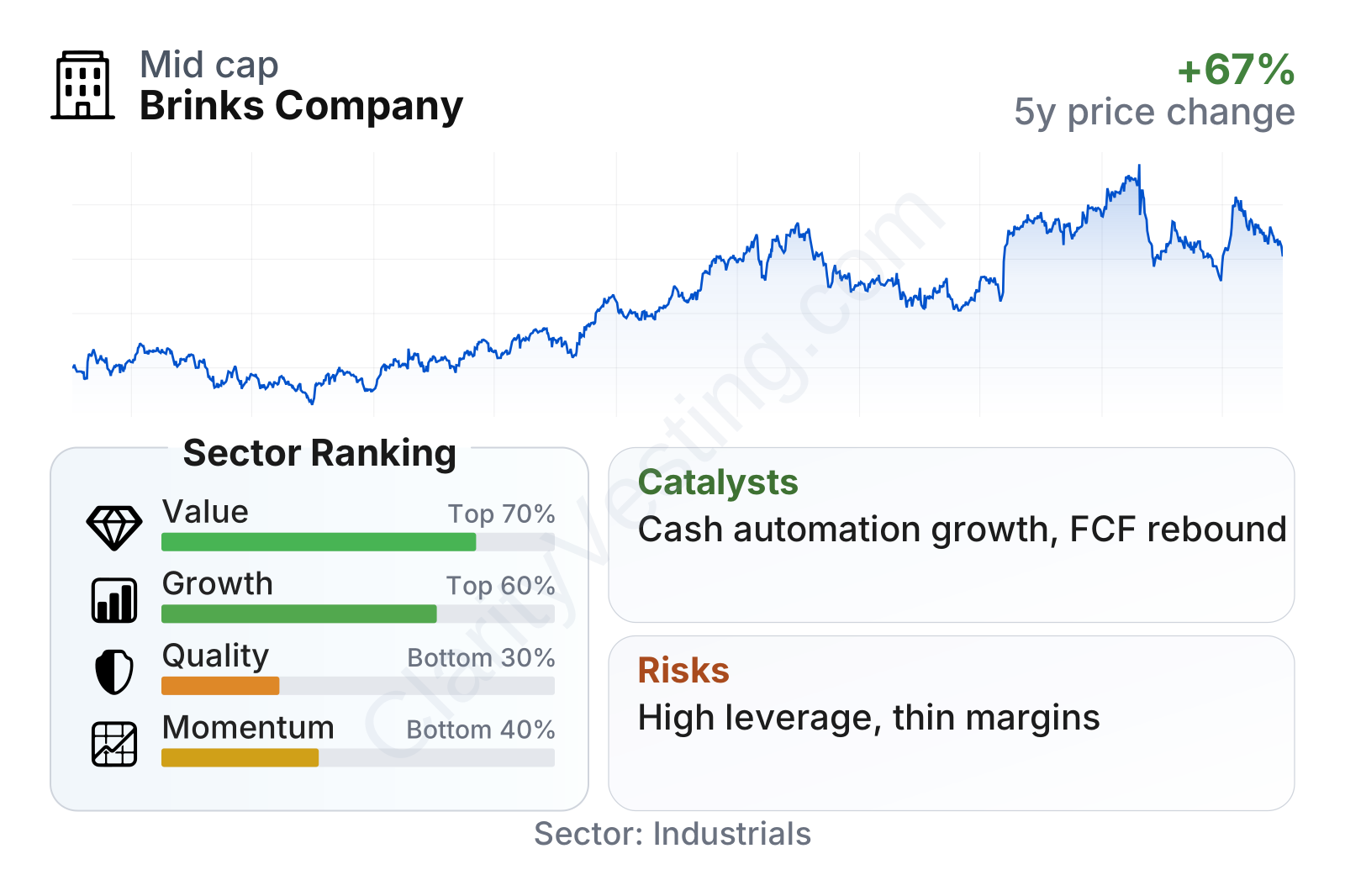
Brink’s is a mid-sized industrial services company with share-price volatility close to the broader market. The table points to a mixed profile: valuation and cash generation look comparatively solid, growth is respectable rather than exceptional, while balance-sheet quality is the main weak spot. Free cash flow metrics compare well with the sector, but leverage and returns on capital remain less favorable than many peers.
The stock’s path over the last several years has been upward overall, but not smooth. After a strong run through 2024 and into early 2026, the shares pulled back and then stabilized. That pattern fits a company where operational progress is visible, yet the market remains sensitive to debt, margins, and execution.
Growth
Brink’s operates in a niche that is more resilient than many people assume. Cash usage is declining in some developed markets, but it remains important in many countries and in large parts of retail, banking, gaming, convenience, and informal commerce. More importantly, Brink’s is not simply tied to the amount of cash in circulation. It benefits when customers choose to outsource cash handling, route planning, ATM servicing, and deposit processing rather than do those tasks internally.
The company’s strategy for future growth appears logical. Brink’s has been pushing toward higher-value services, especially integrated cash management and digital tools for retailers. Those offerings can deepen customer relationships and make the service harder to replace than basic armored transport alone. They also create room for pricing discipline and cross-selling.
Recent revenue growth has reaccelerated after slowing through 2024. Growth was modest at that point, then strengthened again into late 2025 and the first half of 2026, landing around the high-single-digit range most recently. That is not rapid expansion by technology-sector standards, but for a mature logistics and security business it indicates healthy commercial momentum.
Cash generation is another important part of the growth picture. Free cash flow has been volatile from year to year, but the broader trend remains constructive, with a strong rebound after the temporary drop seen in 2025. That matters because Brink’s can use cash to invest in service upgrades, support bolt-on acquisitions, and reduce debt over time.
A notable catalyst is the company’s continuing shift toward recurring outsourced solutions for retailers and financial institutions. The more customers adopt connected safes, cash automation, and broader managed services, the more Brink’s becomes embedded in day-to-day operations. In practical terms, this can make revenue stickier and improve the value of each customer relationship.
Another supportive element is geographic diversification. Brink’s is not dependent on a single economy, and in several international markets cash still plays a central role in commerce. That gives the company a broader runway than a purely domestic cash logistics operator would have.
Risks
This article is for informational purposes only and does not constitute financial advice. Some content is AI-generated. See Disclaimer