Stock Analysis · Barco NV (BCNAY)
Overview
Barco NV is a Belgian technology company focused on professional visualization and collaboration equipment. Rather than selling consumer electronics, it serves businesses, hospitals, entertainment venues, education customers, and control-room operators that need reliable image quality, specialized software, and integrated systems.
Its business is organized around three main divisions:
- Entertainment — digital cinema projectors, image processing, and related services for movie theaters and large venues.
- Healthcare — diagnostic display systems, surgical and clinical displays, and workflow tools used by radiologists, surgeons, and hospitals.
- Enterprise — meeting-room collaboration products such as ClickShare, plus control-room and visualization solutions for corporate and public-sector users.
Based on recent annual disclosures, revenue is fairly diversified across those activities, with Enterprise usually the largest contributor. A practical breakdown is approximately:
- Enterprise: about 40% to 45% of revenue, led by ClickShare wireless conferencing and collaboration solutions, plus control-room visualization.
- Healthcare: about 30% to 35% of revenue, mainly medical displays and connected workflow products.
- Entertainment: about 20% to 30% of revenue, centered on cinema projection and immersive visualization.
That mix matters because it gives Barco exposure to several end markets with different demand cycles. Enterprise brings recurring demand from hybrid work environments, Healthcare tends to be more resilient because it is tied to hospital infrastructure and imaging quality requirements, and Entertainment offers upside when cinema and large-format installation spending improves.
Financially, the company has gone through a volatile period. Revenue climbed strongly in 2022, stayed around the same level in 2023, fell in 2024, and recovered only modestly in 2025. Profitability remains positive, but margins have not yet returned to a clear expansion path. Research and development spending has stayed meaningful throughout, which fits a company competing through product performance rather than low price alone.
The long-term pattern shows a business that preserved gross profitability and continued investing in innovation even as sales softened. Operating profit narrowed from the 2023 peak, then improved somewhat in 2025, suggesting Barco is still in a rebuilding phase rather than in a clean growth cycle.
Key Figures
| Metric | Value | Sector ⓘ |
|---|---|---|
| Date | Oct 03, 2026 | |
| Context | ||
| Sector | Technology | |
| Industry | Electronic Components | |
| Market Cap ⓘ | $665.66M | |
| Beta ⓘ | 0.66 | |
Value (Cheapness) | ||
| P/E Ratio ⓘ | 13.63 | 29.95 |
| FCF Yield ⓘ | 3.88% | 4.22% |
| Dividend Yield ⓘ | 7.90% | 1.30% |
| EBIT / EV ⓘ | N/A | 2.83% |
| PEG ⓘ | 7.99 | |
Growth (Business expansion) | ||
| Revenue Growth ⓘ | -8.00% | 15.80% |
| RPS Growth (5Y CAGR) ⓘ | -10.85% | 8.55% |
| EPS Growth (5Y CAGR) ⓘ | 165.16% | -11.72% |
| Margin Growth (5Y Trend) ⓘ | 7.02% | 0.39% |
| FCF Growth (5Y CAGR) ⓘ | -6.86% | 9.72% |
| DPS Growth (5Y CAGR) ⓘ | 3.19% | 7.73% |
Quality (Business durability) | ||
| ROIC (Latest) ⓘ | 15.37% | 9.36% |
| ROIC (5Y Median) ⓘ | 8.60% | 8.32% |
| Net Debt / EBIT (Latest) ⓘ | 0.23 | 0.50 |
| Net Debt / EBIT (5Y Median) ⓘ | -2.90 | 0.46 |
| Net Debt / EBITDA (Latest) ⓘ | 0.14 | 0.28 |
| Net Debt / Assets ⓘ | 2.82% | 3.44% |
| EBITDA / Interest ⓘ | 36.40 | 12.67 |
| Operating Margin (Latest) ⓘ | 7.59% | 9.81% |
| Operating Margin (5Y Median) ⓘ | 8.54% | 8.50% |
| Debt to Equity (Latest) ⓘ | 20.06% | 33.33% |
| Profit Margin (Latest) ⓘ | 4.68% | 7.15% |
| Free Cash Flow (Latest) ⓘ | $25.84M | |
Momentum (Price trend) | ||
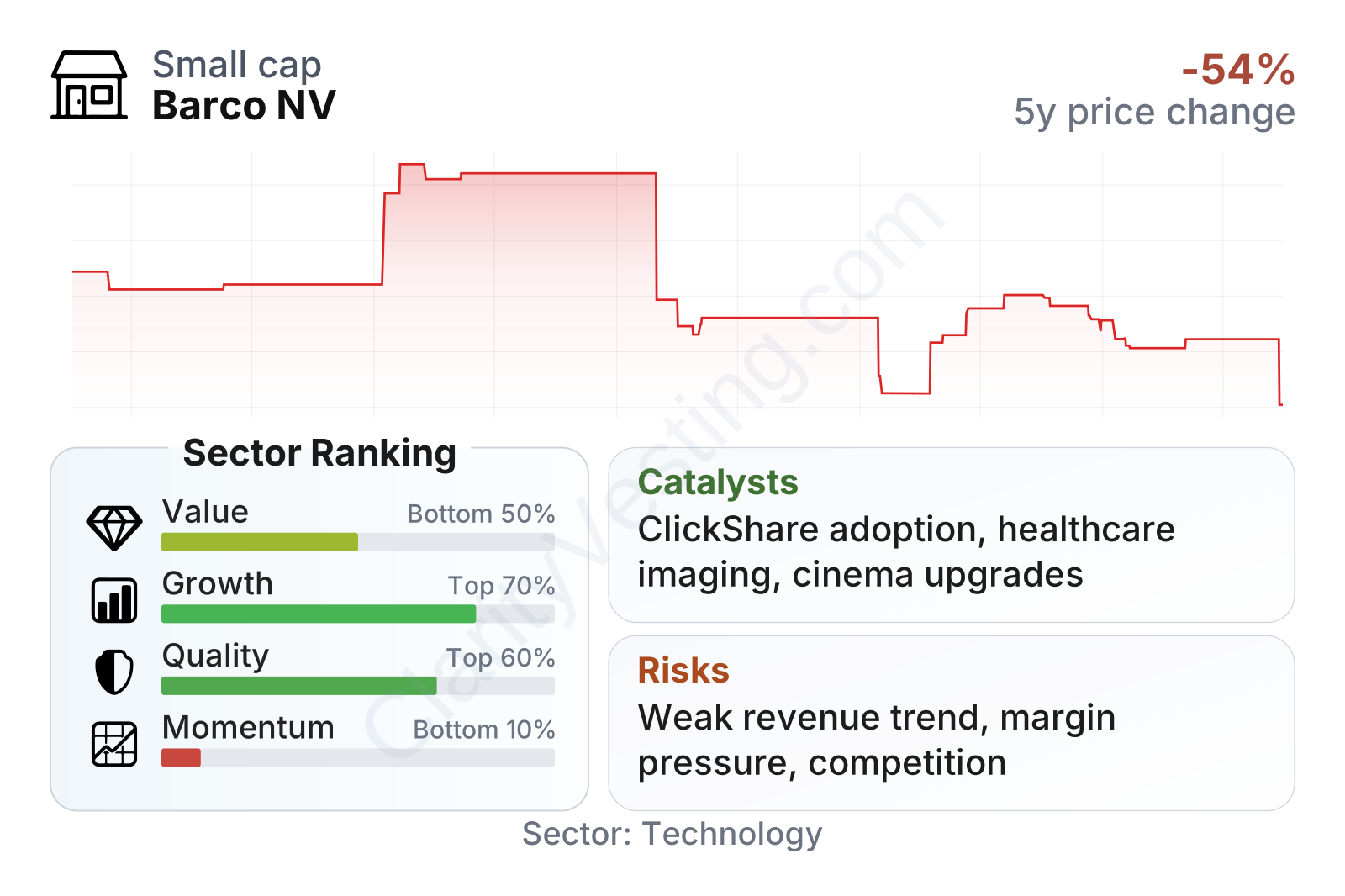
| 3Y Return ⓘ | -67.07% | +49.46% |
| 12M Return (excl. last month) ⓘ | -19.74% | +16.51% |
| 6M Return ⓘ | -33.26% | +24.29% |
| Price vs. 200-Day MA ⓘ | -35.97% | +4.74% |
Barco is a small-cap technology company with relatively low share-price volatility, as reflected by a beta well below 1. On valuation, the stock trades at a lower earnings multiple than the sector median, while the dividend yield stands far above the typical technology peer. Quality metrics are mixed but generally solid: returns on invested capital are above sector norms and leverage is modest. The weak spot is growth. Recent revenue and five-year sales trends trail the sector, even though earnings growth over five years looks unusually strong because profitability rebounded from a lower base. Market momentum is clearly poor, with the shares far below their longer-term average and trailing the broader sector over multiple time frames.
Growth
Barco operates in segments that still have structural relevance. Collaboration tools remain important as companies adapt offices for hybrid work. Healthcare imaging continues to benefit from demand for higher-resolution diagnostics, digital workflows, and connected operating rooms. Entertainment is more cyclical, but premium cinema formats, laser projection upgrades, and immersive installations can still support replacement demand.
The company’s strategy also makes sense on paper. It is not trying to compete broadly across consumer hardware. Instead, it focuses on niches where image quality, reliability, certification, software integration, and installed relationships matter. That positioning is especially important in hospital displays and professional collaboration systems, where customers often care more about performance and workflow compatibility than about lowest upfront price.
The challenge is that reported growth has been uneven. After a strong rebound in 2022, year-over-year revenue growth slowed sharply, turned negative through much of 2023 and 2024, then stabilized around flat to slightly positive territory before slipping again. That pattern suggests the end markets are attractive, but Barco has not consistently converted them into sustained top-line expansion.
The most credible catalyst is the Enterprise segment, particularly ClickShare. This product family addresses a broad installed base of meeting rooms that still require simple, device-agnostic conferencing and presentation tools. A second growth driver is Healthcare, where regulation, image quality standards, and long replacement cycles can support durable demand. Entertainment offers a more cyclical catalyst: if theater operators resume upgrades or premium-format investment improves, Barco could benefit because of its established cinema presence.
Recent company communications have also emphasized portfolio refinement, operating discipline, and selective innovation. For long-term analysis, that is important because Barco does not need explosive growth to improve its profile; steadier execution, better mix, and margin recovery could matter as much as raw sales acceleration.
Risks
This article is for informational purposes only and does not constitute financial advice. Some content is AI-generated. See Disclaimer