Stock Analysis · Babcock International Group PLC (BCKIY)
Overview
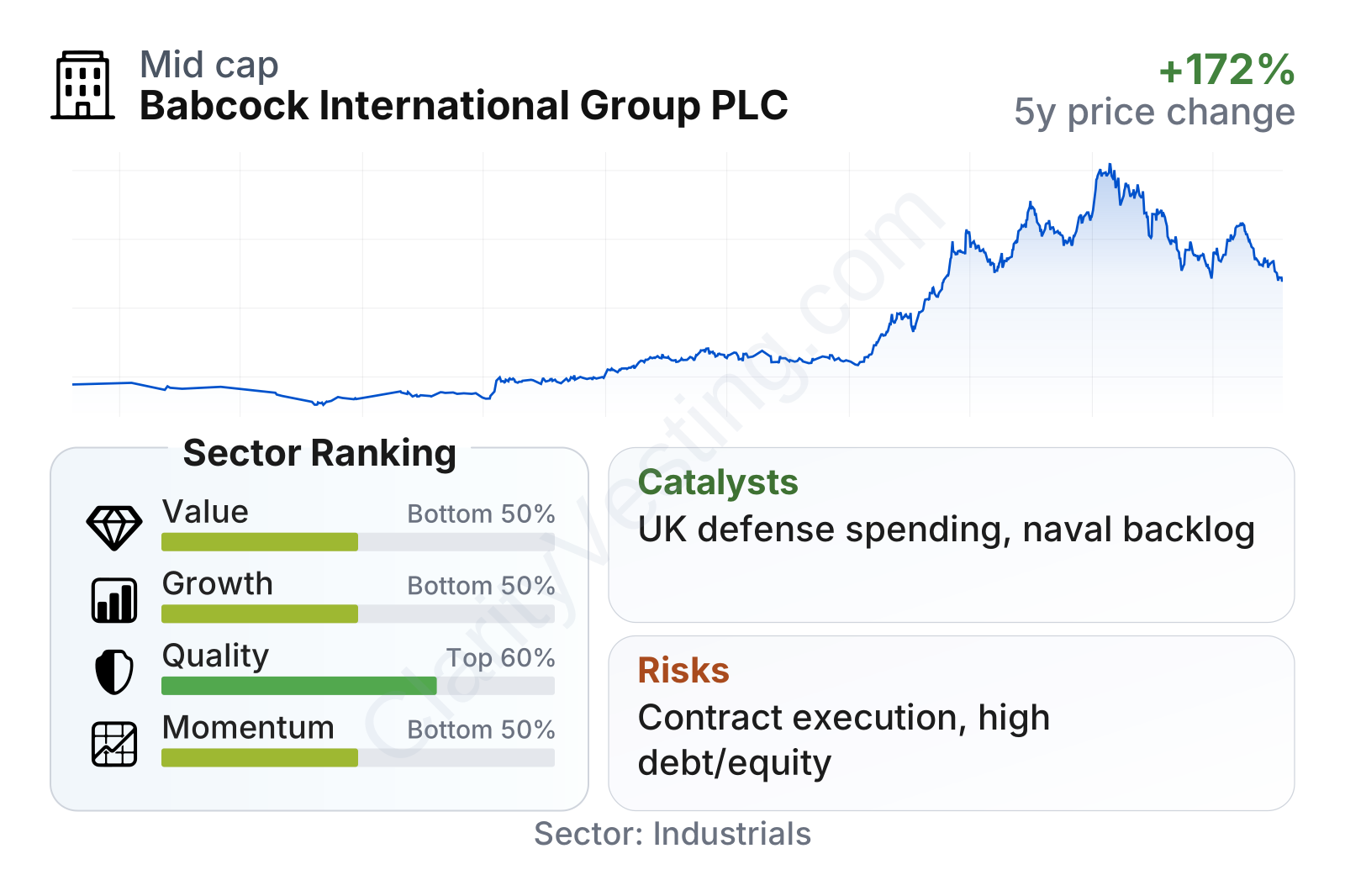
Babcock International Group PLC is a British engineering support and defense services company. Rather than making consumer products, it helps governments and major public-sector customers keep complex assets working safely over long periods. Its activities include supporting naval fleets, maintaining military vehicles, training armed forces personnel, managing critical infrastructure, and handling specialist civil and emergency services work.
The group is heavily connected to defense and government spending, especially in the United Kingdom, with additional exposure to allied markets such as Australia, Canada, France, and South Africa. That gives the business a relatively steady demand base compared with more cyclical industrial companies, because much of its work is tied to long-term contracts and mission-critical services.
Based on the company’s latest annual reporting, revenue is mainly split across four operating segments:
- Marine: about 38% of revenue. This includes naval support, submarine and warship maintenance, fleet management, and related engineering services.
- Nuclear: about 21% of revenue. This covers work on nuclear infrastructure, decommissioning support, and specialist services linked to defense nuclear programs.
- Land: about 21% of revenue. This segment includes vehicle and equipment support, training, and army-related engineering contracts.
- Aviation: about 20% of revenue. This includes aerial emergency services, pilot training, and defense aviation support.
That mix matters because Marine and Nuclear are closely tied to national security and strategic infrastructure, areas where customers usually prioritize reliability, technical know-how, and security clearance over low-price competition alone. The broad picture is a company that has become more focused on higher-value support work after reshaping its portfolio in recent years.
The business has expanded revenue meaningfully since 2022, while operating profit and net income have also improved from the weaker 2023 period. The latest year shows higher sales and solid operating earnings, although margins remain modest for an engineering services company and cash conversion remains an important part of the investment case.
Key Figures
| Metric | Value | Sector ⓘ |
|---|---|---|
| Date | Oct 17, 2026 | |
| Context | ||
| Sector | Industrials | |
| Industry | Engineering & Construction | |
| Market Cap ⓘ | $5.93B | |
| Beta ⓘ | 0.89 | |
Value (Cheapness) | ||
| P/E Ratio ⓘ | 22.09 | 22.10 |
| P/B Ratio ⓘ | 10.22 | 1.97 |
| FCF Yield ⓘ | 7.89% | 6.38% |
| Dividend Yield ⓘ | 0.83% | 1.94% |
| EBIT / EV ⓘ | N/A | 4.79% |
| PEG ⓘ | 1.49 | |
Growth (Business expansion) | ||
| Revenue Growth ⓘ | 8.90% | 9.30% |
| RPS Growth (5Y CAGR) ⓘ | 6.43% | 7.81% |
| EPS Growth (5Y CAGR) ⓘ | -0.97% | -13.06% |
| BVPS Growth (5Y CAGR) ⓘ | -3.20% | 6.14% |
| Margin Growth (5Y Trend) ⓘ | -0.46% | 0.88% |
| FCF Growth (5Y CAGR) ⓘ | N/A | 11.01% |
| DPS Growth (5Y CAGR) ⓘ | -18.84% | 9.48% |
Quality (Business durability) | ||
| ROIC (Latest) ⓘ | 37.67% | 10.84% |
| ROA (Latest) ⓘ | 12.08% | 5.41% |
| ROIC (5Y Median) ⓘ | 13.90% | 9.38% |
| ROA (5Y Median) ⓘ | 4.81% | 4.95% |
| Net Debt / EBIT (Latest) ⓘ | 0.52 | 2.08 |
| Net Debt / EBIT (5Y Median) ⓘ | 2.49 | 2.27 |
| Net Debt / EBITDA (Latest) ⓘ | 0.38 | 1.39 |
| Net Debt / Assets ⓘ | 9.12% | 19.28% |
| EBITDA / Interest ⓘ | 9.69 | 9.58 |
| Operating Margin (Latest) ⓘ | 6.91% | 10.50% |
| Operating Margin (5Y Median) ⓘ | 6.05% | 10.29% |
| Debt to Equity (Latest) ⓘ | 178.86% | 65.48% |
| Profit Margin (Latest) ⓘ | 4.08% | 6.67% |
| Free Cash Flow (Latest) ⓘ | $468.20M | |
Momentum (Price trend) | ||
| 3Y Return ⓘ | +156.94% | +61.68% |
| 12M Return (excl. last month) ⓘ | -16.12% | +12.58% |
| 6M Return ⓘ | -29.10% | 0.00% |
| Price vs. 200-Day MA ⓘ | -22.61% | +0.02% |
Babcock sits in the mid-sized range within the industrial sector and has shown a strong multiyear share-price recovery, even after a pullback in recent months. The quality profile is better than the broad sector on return metrics and current leverage measured against earnings, helped by much lower net debt relative to EBIT and EBITDA than the sector median. Free cash flow is also meaningful, and its cash flow yield is slightly ahead of the sector median.
The weaker areas are valuation multiples based on book value, income distribution, and some long-term growth measures. Operating margin and profit margin remain below many industrial peers, and book value trends have not been particularly strong. In other words, the market is recognizing operational progress, but the company still does not look like a high-margin compounder.
Growth
Babcock operates in a part of the market that currently has favorable long-term demand drivers. Defense budgets across Europe and among NATO-aligned countries have been under upward pressure, and military readiness, naval modernization, submarine support, and infrastructure resilience have become more important. That backdrop is supportive for companies that already have trusted positions inside sensitive government programs.
The company’s strategy also looks coherent. Management has spent the last several years simplifying the group, exiting weaker areas, strengthening the balance sheet, and focusing on contracts where technical capability and embedded customer relationships matter most. For a business like Babcock, that focus is important because growth is less about selling more units and more about winning larger support roles, extending existing contracts, and moving into adjacent specialist services.
Recent revenue growth has been positive, running around the high-single-digit range on the latest trailing measure, which is broadly in line with the wider sector. That is not explosive growth, but it is respectable for a contractor with a large installed base and long contract cycles. The more interesting point is that growth is happening in a sector where demand visibility has improved.
One of the clearest catalysts is Babcock’s exposure to naval and nuclear work in the UK, including submarine-related support and fleet maintenance. These are highly specialized activities with significant barriers to entry. The company has also highlighted a large contract backlog in recent annual materials, which gives some visibility on future workload. In addition, ongoing rearmament efforts in Europe and allied countries could create follow-on opportunities in training, equipment readiness, and life-extension programs for existing defense assets.
Recent company updates have also pointed to continued contract momentum and disciplined execution rather than a turnaround narrative based only on cost cutting. That is a healthier foundation for long-term growth, because it suggests the business is being supported by customer demand as well as internal restructuring.
Risks
This article is for informational purposes only and does not constitute financial advice. Some content is AI-generated. See Disclaimer


