Stock Analysis · Boise Cascad Llc (BCC)
Overview
Boise Cascade is a U.S. building-products company focused on wood products and construction materials. Its business is tied closely to residential construction, home repair and remodeling, and light commercial building. In simple terms, the company both makes engineered wood and plywood and distributes building materials to dealers, builders, and other customers across the country.
The company reports through two main operating segments. Based on recent annual reporting, revenue is dominated by distribution, while manufacturing contributes a smaller but often higher-margin share depending on wood product pricing and market conditions.
- Building Materials Distribution: about 85% to 90% of revenue. This segment distributes items such as engineered wood products, plywood, oriented strand board, lumber, siding, roofing, insulation, metal products, and general line building materials through a nationwide network.
- Wood Products: about 10% to 15% of revenue. This segment manufactures engineered wood products such as laminated veneer lumber, I-joists, and laminated beams, along with plywood and related wood items used in residential and light commercial construction.
That mix matters because distribution gives Boise Cascade scale and customer reach, while manufacturing can add earnings power when pricing and demand are favorable. Over the last several years, however, revenue and profits have clearly normalized after the unusually strong housing and commodity backdrop seen in 2021 and 2022. Revenue has declined from roughly $8.4 billion in 2022 to about $6.4 billion in 2025, while net income has fallen much more sharply, showing how cyclical the business can be when wood-product pricing weakens.
The business profile shown above highlights that Boise Cascade still generates multi-billion-dollar sales, but a much larger share of revenue is now being absorbed by production and operating costs than during the 2021-2022 peak. In other words, the company remains sizable and operationally sound, but current profitability is much leaner than it was at the top of the cycle.
Key Figures
| Metric | Value | Sector ⓘ |
|---|---|---|
| Date | Oct 24, 2026 | |
| Context | ||
| Sector | Basic Materials | |
| Industry | Lumber & Wood Production | |
| Market Cap ⓘ | $2.66B | |
| Beta ⓘ | 1.05 | |
Value (Cheapness) | ||
| P/E Ratio ⓘ | 25.51 | 16.92 |
| P/B Ratio ⓘ | 1.31 | 1.66 |
| FCF Yield ⓘ | 3.88% | 5.83% |
| Dividend Yield ⓘ | 1.17% | 2.07% |
| EBIT / EV ⓘ | 5.86% | 6.38% |
| PEG ⓘ | 2.94 | |
Growth (Business expansion) | ||
| Revenue Growth ⓘ | 5.20% | 11.25% |
| RPS Growth (5Y CAGR) ⓘ | -3.52% | 4.49% |
| EPS Growth (5Y CAGR) ⓘ | -46.08% | -15.24% |
| BVPS Growth (5Y CAGR) ⓘ | 13.25% | 5.49% |
| Margin Growth (5Y Trend) ⓘ | -9.32% | -1.54% |
| FCF Growth (5Y CAGR) ⓘ | -61.19% | 0.37% |
| DPS Growth (5Y CAGR) ⓘ | -35.44% | 5.91% |
Quality (Business durability) | ||
| ROIC (Latest) ⓘ | 4.89% | 9.59% |
| ROA (Latest) ⓘ | 3.11% | 4.92% |
| ROIC (5Y Median) ⓘ | 19.55% | 7.91% |
| ROA (5Y Median) ⓘ | 14.44% | 3.92% |
| Net Debt / EBIT (Latest) ⓘ | 1.34 | 1.36 |
| Net Debt / EBIT (5Y Median) ⓘ | -0.37 | 1.69 |
| Net Debt / EBITDA (Latest) ⓘ | 0.68 | 0.93 |
| Net Debt / Assets ⓘ | 6.84% | 13.69% |
| EBITDA / Interest ⓘ | 13.96 | 12.38 |
| Operating Margin (Latest) ⓘ | 2.67% | 13.24% |
| Operating Margin (5Y Median) ⓘ | 9.81% | 11.82% |
| Debt to Equity (Latest) ⓘ | 26.49% | 40.30% |
| Profit Margin (Latest) ⓘ | 1.64% | 6.38% |
| Free Cash Flow (Latest) ⓘ | $103.31M | |
Momentum (Price trend) | ||
| 3Y Return ⓘ | -7.18% | +73.47% |
| 12M Return (excl. last month) ⓘ | -3.68% | +27.59% |
| 6M Return ⓘ | -7.76% | -4.02% |
| Price vs. 200-Day MA ⓘ | -1.80% | -0.65% |
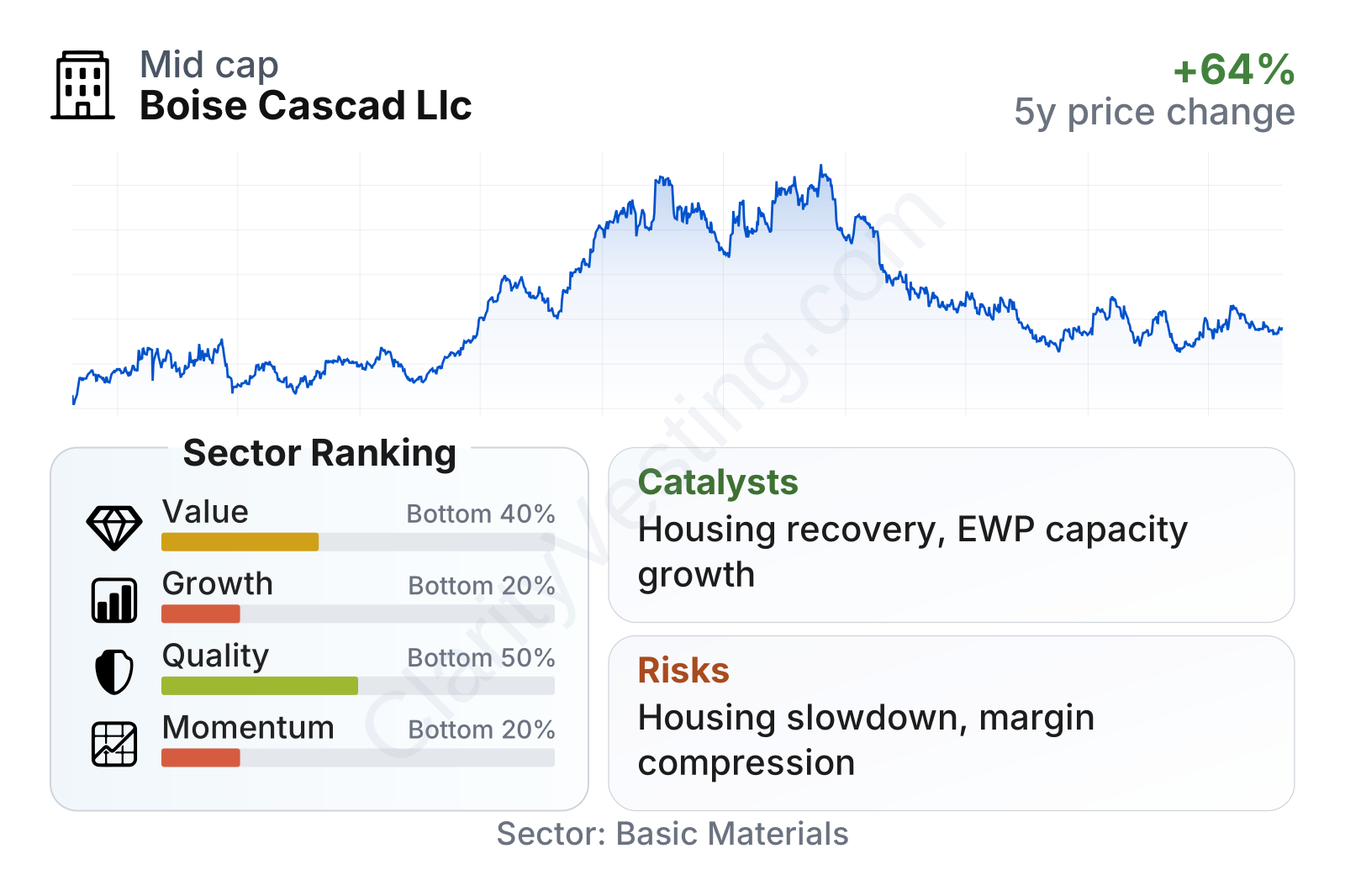
Boise Cascade sits in the mid-cap range, with share-price behavior that is close to the broader market in volatility terms. The broader picture from the latest metrics is mixed. Balance-sheet leverage remains conservative, but current profitability, growth, and market performance all rank in the lower part of the sector. Valuation metrics also do not stand out as especially cheap relative to peers, largely because earnings and cash flow have retreated from prior highs. That combination often happens in cyclical businesses: a stock can look more expensive on earnings-based measures precisely when the cycle is weak.
The stock-price history also shows that the market has already gone through a full sentiment swing. Shares climbed strongly into 2024 as investors reacted to resilient construction activity and still-solid earnings, then gave back a meaningful part of that move as margins, cash generation, and industry expectations cooled.
Growth
Boise Cascade operates in a sector with long-term structural support but meaningful short-term swings. Demand for wood-based building products is supported over time by U.S. household formation, aging housing stock, repair and remodeling activity, and the need for additional housing supply. That gives the company exposure to a market with durable relevance. The challenge is that these drivers do not move in a straight line. Housing affordability, mortgage rates, commodity prices, and builder sentiment can all have a major impact from one year to the next.
The company’s strategy is logical for this kind of industry. Boise Cascade has continued investing in engineered wood capacity and distribution reach, which can strengthen its position with builders and dealers. Engineered wood products are particularly important because they offer performance advantages in floor and roof systems and tend to be more specialized than commodity lumber. On the distribution side, scale and customer relationships matter, and Boise Cascade’s network gives it a broad platform that can deepen market share over time.
Recent revenue trends suggest the business may be stabilizing, but not yet returning to a strong growth phase. After several quarters of declines, year-over-year sales recently turned modestly positive again. That is encouraging as an early sign that demand and pricing pressure may be easing, but the pace remains below the sector median and far below the boom conditions of earlier years.
Cash generation is the bigger issue. Free cash flow has fallen sharply from the elevated levels reached during the post-pandemic building cycle and was only modest on a trailing basis most recently. This does not mean the company is financially distressed; rather, it shows that current earnings power is much lower than peak-cycle results suggested. For long-term analysis, the key question is whether Boise Cascade can convert future housing recovery and engineered wood demand into a more durable cash-flow base.
Recent company updates have continued to emphasize capital spending aimed at capacity, efficiency, and product availability. Those investments can become an important catalyst if U.S. housing starts improve and if engineered wood volumes recover. A more favorable interest-rate backdrop would also help the sector, since home affordability remains one of the biggest swing factors for demand.
Risks
This article is for informational purposes only and does not constitute financial advice. Some content is AI-generated. See Disclaimer


