Stock Analysis · Bicara Therapeutics Inc (BCAX)
Overview
Bicara Therapeutics is a clinical-stage biotechnology company focused on cancer treatment. Its lead program is ficerafusp alfa, an investigational bifunctional antibody designed to target EGFR while also trapping TGF-β, two pathways that can help tumors grow and resist treatment. The company’s current emphasis is head and neck cancer, with the broader objective of improving outcomes in solid tumors where existing therapies still leave major unmet need.
This is still a development-stage business rather than a commercial pharmaceutical company. Based on its latest public filings, Bicara has not yet generated product revenue from approved medicines. That means the economic profile today is mainly defined by research spending, clinical trial progress, and balance-sheet resources rather than recurring sales.
The company’s revenue mix is therefore very limited at this stage.
- Product revenue: 0%. Bicara does not currently sell an approved drug.
- Collaboration, licensing, or other operating revenue: no meaningful recurring revenue disclosed in the latest annual profile.
- Interest and other non-operating items: minor compared with operating expenses and not a core business source.
The financial picture is typical of an early biotech: no commercial sales yet, rapidly rising research and development expense, and losses that widened as the company advanced its lead asset. Over the last several years, spending has been increasingly concentrated on clinical development rather than manufacturing or sales, which fits the company’s stage of maturity.
The operating flow shows a business with essentially no revenue and a cost base dominated by research and development. That research bill climbed sharply from 2024 into 2025, signaling a company pushing harder into clinical execution rather than one already harvesting returns from a marketed product.
Key Figures
| Metric | Value | Sector ⓘ |
|---|---|---|
| Date | Oct 17, 2026 | |
| Context | ||
| Sector | Healthcare | |
| Industry | Biotechnology | |
| Market Cap ⓘ | $1.15B | |
| Beta ⓘ | -0.69 | |
Value (Cheapness) | ||
| P/E Ratio ⓘ | N/A | 24.79 |
| P/B Ratio ⓘ | 2.55 | 3.08 |
| FCF Yield ⓘ | -11.79% | 3.15% |
| Dividend Yield ⓘ | N/A | 1.94% |
| EBIT / EV ⓘ | -21.54% | 0.57% |
| PEG ⓘ | N/A | |
Growth (Business expansion) | ||
| Revenue Growth ⓘ | N/A | 7.45% |
| RPS Growth (5Y CAGR) ⓘ | N/A | 8.61% |
| EPS Growth (5Y CAGR) ⓘ | -17.33% | -17.81% |
| BVPS Growth (5Y CAGR) ⓘ | N/A | 3.72% |
| Margin Growth (5Y Trend) ⓘ | N/A | -0.62% |
| FCF Growth (5Y CAGR) ⓘ | N/A | 1.04% |
| DPS Growth (5Y CAGR) ⓘ | N/A | 6.77% |
Quality (Business durability) | ||
| ROIC (Latest) ⓘ | -32.33% | 3.24% |
| ROA (Latest) ⓘ | -39.57% | 3.01% |
| ROIC (5Y Median) ⓘ | N/A | 4.60% |
| ROA (5Y Median) ⓘ | -27.58% | 1.89% |
| Net Debt / EBIT (Latest) ⓘ | N/A | 1.34 |
| Net Debt / EBIT (5Y Median) ⓘ | N/A | 1.84 |
| Net Debt / EBITDA (Latest) ⓘ | N/A | 1.00 |
| Net Debt / Assets ⓘ | -18.63% | 5.45% |
| EBITDA / Interest ⓘ | N/A | 9.64 |
| Operating Margin (Latest) ⓘ | N/A | 9.27% |
| Operating Margin (5Y Median) ⓘ | N/A | 7.38% |
| Debt to Equity (Latest) ⓘ | 0.25% | 28.58% |
| Profit Margin (Latest) ⓘ | N/A | 3.59% |
| Free Cash Flow (Latest) ⓘ | -$135.25M | |
Momentum (Price trend) | ||
| 3Y Return ⓘ | N/A | +42.80% |
| 12M Return (excl. last month) ⓘ | +99.21% | +18.50% |
| 6M Return ⓘ | -25.72% | +7.57% |
| Price vs. 200-Day MA ⓘ | -17.27% | +5.12% |
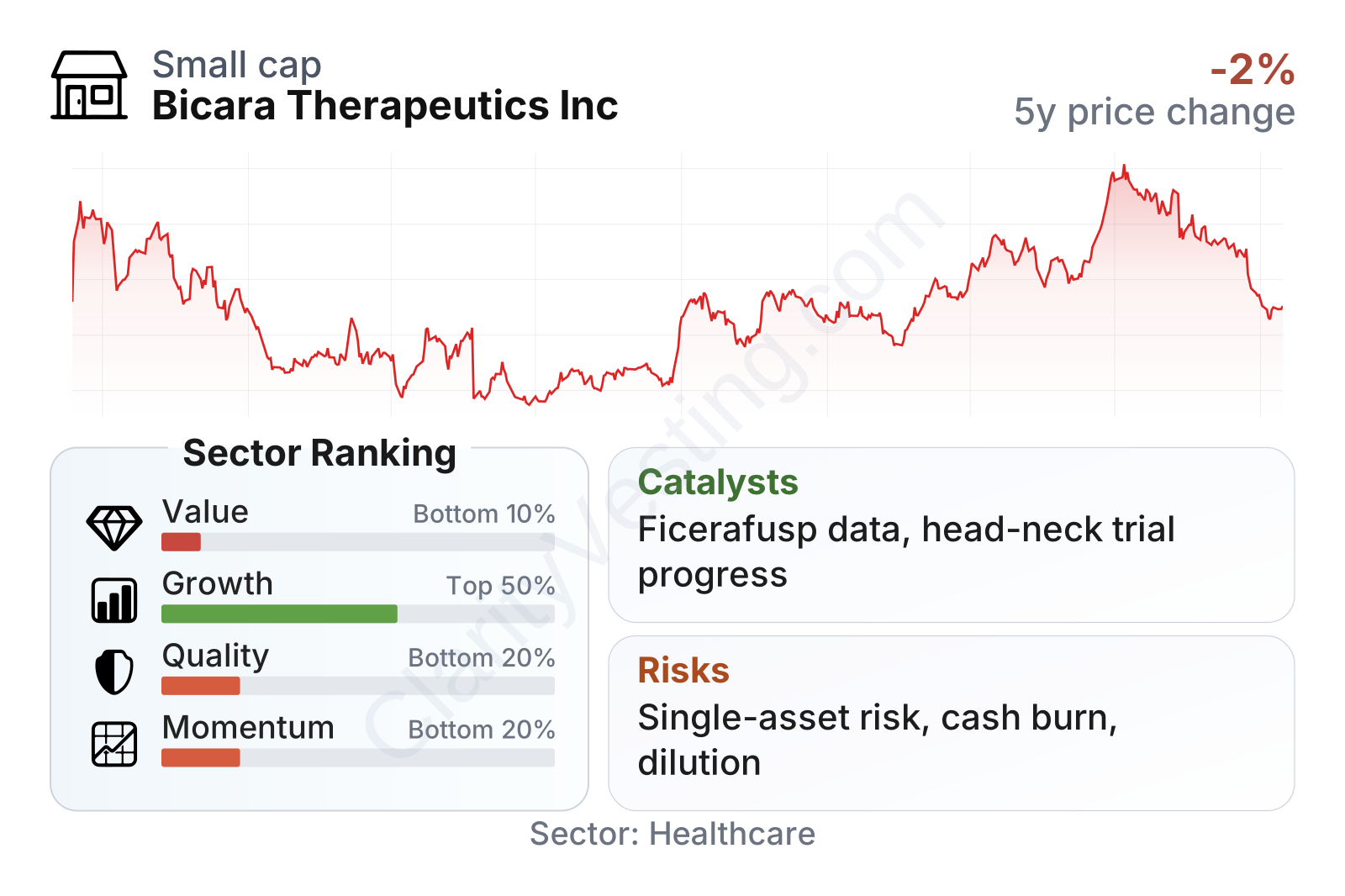
Bicara is a small-cap biotechnology company with market value still tied mainly to one clinical platform. The factor profile is weak on traditional valuation and profitability measures, which is normal for a business without approved products, and stronger on relative growth positioning only because much of the sector also contains early-stage companies with losses. Price performance has been volatile: the shares recovered strongly over the last year overall, but more recent trading has softened, leaving momentum below the sector median over shorter periods.
Balance-sheet leverage is extremely low, with debt to equity close to 0% versus a sector median around the high-20% range. That does not make the business financially strong in a conventional earnings sense, but it does mean current risk comes more from cash burn and future funding needs than from debt pressure.
Growth
Bicara operates in oncology, one of the most active and best-funded areas in biotechnology. That is a favorable backdrop because large pharmaceutical companies continue to seek differentiated cancer assets, especially in tumors where checkpoint inhibitors and targeted therapies still leave room for better response rates or durability. Head and neck cancer remains a meaningful unmet-need market, and a successful therapy in that setting can also create optionality for expansion into additional tumor types.
The company’s strategy is easy to understand: focus capital on a lead molecule with a distinct mechanism, generate clinical evidence in a hard-to-treat population, and then expand through additional studies if the signal holds up. For a company of Bicara’s size, that is a sensible structure. It avoids spreading resources across too many programs, but it also creates concentration around one main asset.
A major catalyst is the continued clinical development of ficerafusp alfa, especially data that could support differentiation versus current standard approaches in recurrent or metastatic head and neck squamous cell carcinoma. In biotech, strong mid-stage or late-stage clinical data can change the value of a company far more quickly than ordinary revenue growth would in other industries. Regulatory interactions, trial enrollment progress, and any updates on pivotal development plans are therefore central to Bicara’s long-term outlook.
There is also a broader strategic angle. If the company can show that combining EGFR targeting with TGF-β blockade produces cleaner or more durable efficacy than existing options, Bicara could become more visible to larger oncology players looking for pipeline additions. That possibility is not a substitute for execution, but it does increase the relevance of each clinical update.
Cash generation remains deeply negative and moved further downward over the last year, which is consistent with heavier clinical investment. In practical terms, growth at Bicara currently means program advancement rather than financial expansion. The business is trying to convert cash into data, and the quality of that data will determine whether future value creation becomes more tangible.
Risks
This article is for informational purposes only and does not constitute financial advice. Some content is AI-generated. See Disclaimer


