Stock Analysis · Beta Bionics Inc (BBNX)
Overview
Beta Bionics is a medical device company focused on diabetes care. Its main product is the iLet Bionic Pancreas, an automated insulin delivery system designed to simplify diabetes management for people with Type 1 diabetes. The system combines an insulin pump with dosing algorithms that adjust insulin delivery based on glucose data, with the goal of reducing the daily burden on users. The company is also developing additional configurations intended to broaden the platform over time.
For a long-term view, the business is relatively easy to understand: Beta Bionics generates revenue by selling and supporting diabetes technology used on an ongoing basis. That creates a mix of device revenue and recurring follow-on sales tied to use of the system.
Based on recent company reporting, revenue appears to come mainly from the following areas:
- Insulin pump system sales and related starter components: the largest source of revenue, likely representing the clear majority of total sales. This includes the iLet device and associated initial setup items.
- Recurring supplies and consumables: an important and growing source, including infusion sets, cartridges, and other items needed for continued use of the system.
- Other revenue: a smaller contribution, which can include training, support-related items, or limited ancillary services depending on the period.
The financial profile shows a company that has moved beyond the pre-revenue stage and is now scaling commercial operations. Revenue rose from a very small base in 2022 to more meaningful levels in 2023, 2024, and 2025. At the same time, operating costs increased sharply as the company expanded research, commercial infrastructure, and administrative capacity. Gross profit has improved with revenue growth, but losses remain substantial because spending is still far above current scale.
The business has become much larger in a short time: sales increased from almost negligible levels in 2022 to more than $100 million in 2025, while gross profit also expanded materially. The main tension is that operating expenses have risen even faster, especially in research and commercialization, which explains why losses remain heavy despite strong top-line progress.
Key Figures
| Metric | Value | Sector ⓘ |
|---|---|---|
| Date | Oct 17, 2026 | |
| Context | ||
| Sector | Healthcare | |
| Industry | Medical Devices | |
| Market Cap ⓘ | $1.02B | |
| Beta ⓘ | N/A | |
Value (Cheapness) | ||
| P/E Ratio ⓘ | N/A | 24.79 |
| P/B Ratio ⓘ | 3.28 | 3.08 |
| FCF Yield ⓘ | -6.00% | 3.15% |
| Dividend Yield ⓘ | N/A | 1.94% |
| EBIT / EV ⓘ | -7.35% | 0.57% |
| PEG ⓘ | N/A | |
Growth (Business expansion) | ||
| Revenue Growth ⓘ | 37.80% | 7.45% |
| RPS Growth (5Y CAGR) ⓘ | 739.38% | 8.61% |
| EPS Growth (5Y CAGR) ⓘ | -54.63% | -17.81% |
| BVPS Growth (5Y CAGR) ⓘ | N/A | 3.72% |
| Margin Growth (5Y Trend) ⓘ | N/A | -0.62% |
| FCF Growth (5Y CAGR) ⓘ | -2.67% | 1.04% |
| DPS Growth (5Y CAGR) ⓘ | N/A | 6.77% |
Quality (Business durability) | ||
| ROIC (Latest) ⓘ | -21.12% | 3.24% |
| ROA (Latest) ⓘ | -23.45% | 3.01% |
| ROIC (5Y Median) ⓘ | N/A | 4.60% |
| ROA (5Y Median) ⓘ | -42.17% | 1.89% |
| Net Debt / EBIT (Latest) ⓘ | N/A | 1.34 |
| Net Debt / EBIT (5Y Median) ⓘ | N/A | 1.84 |
| Net Debt / EBITDA (Latest) ⓘ | N/A | 1.00 |
| Net Debt / Assets ⓘ | -12.93% | 5.45% |
| EBITDA / Interest ⓘ | N/A | 9.64 |
| Operating Margin (Latest) ⓘ | -63.14% | 9.27% |
| Operating Margin (5Y Median) ⓘ | -225.86% | 7.38% |
| Debt to Equity (Latest) ⓘ | 2.54% | 28.58% |
| Profit Margin (Latest) ⓘ | -61.32% | 3.59% |
| Free Cash Flow (Latest) ⓘ | -$61.41M | |
Momentum (Price trend) | ||
| 3Y Return ⓘ | N/A | +42.80% |
| 12M Return (excl. last month) ⓘ | +1.22% | +18.50% |
| 6M Return ⓘ | +88.51% | +7.57% |
| Price vs. 200-Day MA ⓘ | +18.89% | +5.12% |
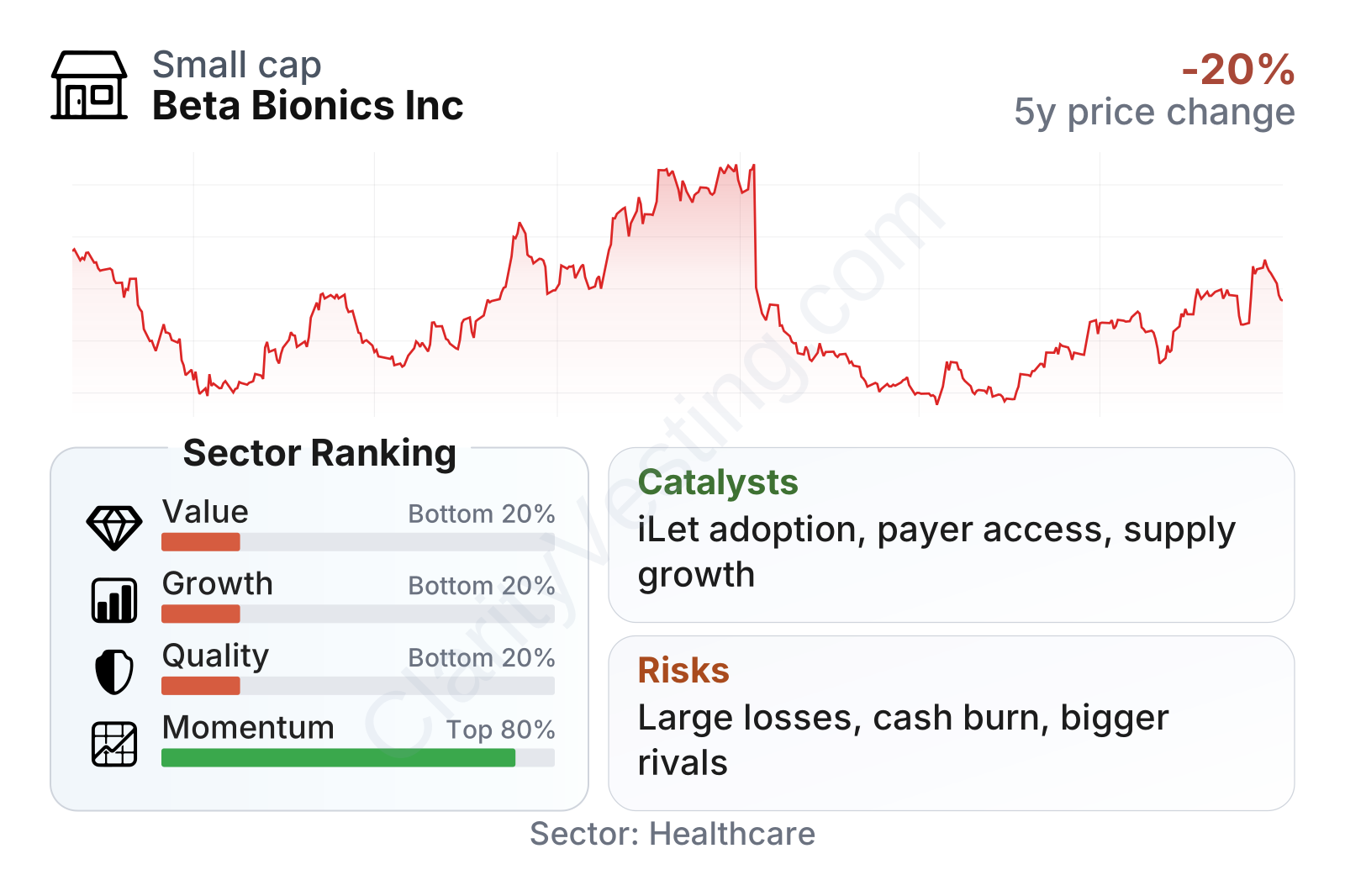
Beta Bionics is a small-cap healthcare company with an unusual mix of strengths and weaknesses. Growth has been very strong, but the broader profile still ranks weakly versus much of the medical device sector because profitability and cash generation remain deeply negative. Valuation metrics are also difficult to frame in traditional terms since earnings and free cash flow are still below zero. On the positive side, balance-sheet leverage is very low, which gives the company more flexibility than many early-stage device businesses. Share performance has also been volatile, with a strong rebound over the last six months after a sharp decline earlier in the period.
Growth
Beta Bionics operates in a healthcare niche with durable long-term demand drivers. Type 1 diabetes requires lifelong management, and automated insulin delivery remains an area of active adoption as patients and clinicians look for better outcomes and simpler routines. This is the kind of market where a successful product can build recurring revenue over time, because each installed user can generate ongoing supply sales in addition to the initial hardware sale.
The company’s strategy is sensible for that backdrop. It is centered on expanding adoption of the iLet platform, increasing the installed base, and then benefiting from repeat purchases of supplies. That model is attractive if execution holds up, because recurring consumables usually improve visibility and customer lifetime value. It also helps explain why management has been willing to absorb large current losses: the company appears to be prioritizing scale, clinician adoption, and market access while the platform is still early in its commercial rollout.
Recent revenue growth has been exceptionally strong even by medtech standards, with year-over-year expansion staying well above the sector median. Growth has cooled from the very highest recent levels but still remains elevated, suggesting that adoption is continuing rather than stalling. That matters because high-growth device companies often see valuation support only as long as commercial momentum stays clearly above average.
The weaker side of the growth picture is cash consumption. Free cash flow remains negative by a wide margin, and there has not yet been a meaningful turn toward self-funding. In practical terms, the company is still proving that strong revenue growth can eventually translate into a more efficient business model.
A meaningful catalyst is continued expansion of real-world adoption of the iLet system and broader payer coverage, since reimbursement and access are critical in diabetes technology. Another important catalyst is platform development: if Beta Bionics can extend the usefulness of its system, deepen clinician acceptance, and keep adding users, the installed-base effect could become much more powerful over time. Recent company communications have also highlighted ongoing commercial execution and product-related progress, which supports the idea that the opportunity remains tied to adoption rather than a one-time launch cycle.
Risks
This article is for informational purposes only and does not constitute financial advice. Some content is AI-generated. See Disclaimer


