Stock Analysis · BridgeBio Pharma Inc (BBIO)
Overview
BridgeBio Pharma is a biotechnology company focused on genetic diseases and cancers with well-defined biological causes. Its model is to discover or in-license drug programs, develop them through clinical trials, and then either commercialize them directly or through partnerships. That makes BridgeBio different from a large diversified pharmaceutical company: it is still in a build-out phase, with a smaller number of products and a heavier dependence on research progress, regulatory decisions, and launch execution.
The company’s revenue mix has become much more commercial in recent periods, but it is still not broadly diversified. Based on recent annual disclosures and reported trends, the main revenue sources are approximately:
- Product revenue: about 90% to 95% — primarily sales of Attruby, BridgeBio’s transthyretin amyloid cardiomyopathy treatment, which has become the main driver of reported revenue.
- Collaboration and licensing revenue: about 5% to 10% — milestone payments, partner-related development revenue, and other collaboration arrangements tied to specific programs.
- Other revenue: minimal — smaller items that do not materially change the overall picture.
The broad financial pattern is easy to understand: revenue has risen sharply as commercialization has expanded, but operating expenses remain very high because BridgeBio continues to fund a large pipeline. Research and development spending has stayed substantial over time, and selling costs also increased as the company moved from development into launch mode.
The business has clearly shifted from a low-revenue research platform into a company with a real commercial base. At the same time, expenses have scaled up alongside that transition, so higher sales have not yet translated into profitability.
Key Figures
| Metric | Value | Sector ⓘ |
|---|---|---|
| Date | Oct 24, 2026 | |
| Context | ||
| Sector | Healthcare | |
| Industry | Biotechnology | |
| Market Cap ⓘ | $13.24B | |
| Beta ⓘ | 0.97 | |
Value (Cheapness) | ||
| P/E Ratio ⓘ | N/A | 25.42 |
| P/B Ratio ⓘ | N/A | 3.08 |
| FCF Yield ⓘ | -3.32% | 3.12% |
| Dividend Yield ⓘ | N/A | 1.85% |
| EBIT / EV ⓘ | -4.22% | 0.56% |
| PEG ⓘ | N/A | |
Growth (Business expansion) | ||
| Revenue Growth ⓘ | 120.40% | 7.50% |
| RPS Growth (5Y CAGR) ⓘ | 51.52% | 8.60% |
| EPS Growth (5Y CAGR) ⓘ | -20.06% | -17.73% |
| BVPS Growth (5Y CAGR) ⓘ | N/A | 3.72% |
| Margin Growth (5Y Trend) ⓘ | N/A | -0.57% |
| FCF Growth (5Y CAGR) ⓘ | -4.89% | 0.96% |
| DPS Growth (5Y CAGR) ⓘ | 20.71% | 6.69% |
Quality (Business durability) | ||
| ROIC (Latest) ⓘ | N/A | 3.17% |
| ROA (Latest) ⓘ | -62.85% | 2.98% |
| ROIC (5Y Median) ⓘ | -108.09% | 4.56% |
| ROA (5Y Median) ⓘ | -73.11% | 1.87% |
| Net Debt / EBIT (Latest) ⓘ | N/A | 1.34 |
| Net Debt / EBIT (5Y Median) ⓘ | N/A | 1.86 |
| Net Debt / EBITDA (Latest) ⓘ | N/A | 1.00 |
| Net Debt / Assets ⓘ | 149.17% | 5.06% |
| EBITDA / Interest ⓘ | N/A | 9.55 |
| Operating Margin (Latest) ⓘ | -86.43% | 9.25% |
| Operating Margin (5Y Median) ⓘ | -520.57% | 7.33% |
| Debt to Equity (Latest) ⓘ | -99.15% | 26.68% |
| Profit Margin (Latest) ⓘ | -97.03% | 3.34% |
| Free Cash Flow (Latest) ⓘ | -$439.89M | |
Momentum (Price trend) | ||
| 3Y Return ⓘ | +181.02% | +51.61% |
| 12M Return (excl. last month) ⓘ | +34.32% | +19.90% |
| 6M Return ⓘ | -8.49% | +10.10% |
| Price vs. 200-Day MA ⓘ | -6.59% | +6.44% |
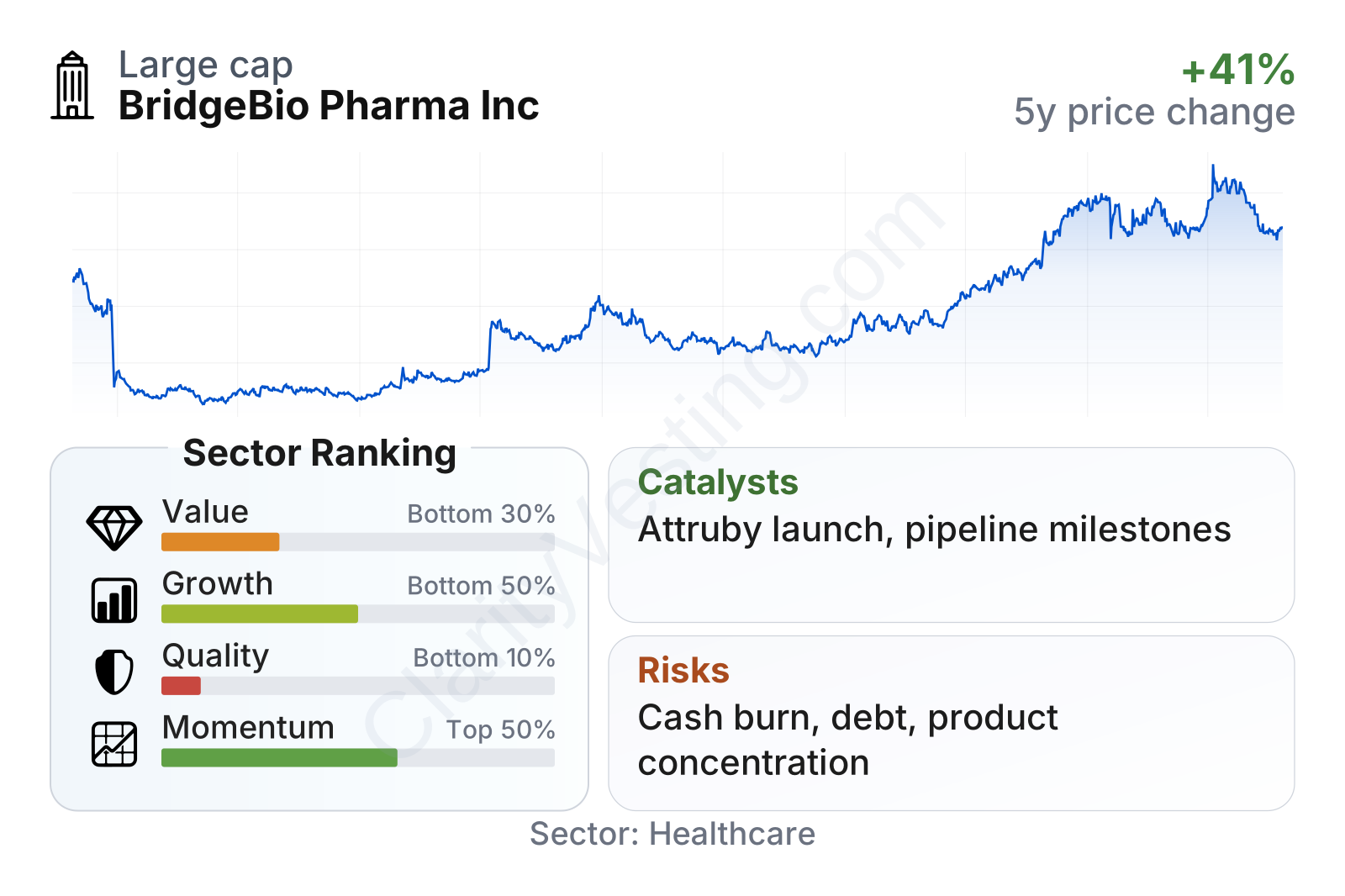
BridgeBio is now a large mid-cap biotech by market value, and the stock’s long-term performance has been strong despite significant swings along the way. The factor profile is mixed. Growth in revenue has been much stronger than the sector median, but quality and value measures rank weakly because the company is still generating losses, negative free cash flow, and weak returns on assets and capital. Momentum also looks uneven: the longer-term share performance has been strong, but the shorter-term trend has cooled.
The table also highlights a common pattern in commercial-stage biotech companies: operational progress can be real even while traditional valuation and profitability ratios still look poor. That means the market is placing more weight on future revenue potential and pipeline milestones than on current earnings power.
Growth
BridgeBio operates in a favorable part of healthcare. Rare disease drug development is one of the more attractive segments in biotech because successful treatments can benefit from high medical need, premium pricing, relatively focused commercial efforts, and in some cases regulatory incentives such as orphan drug exclusivity. In addition, genetic diseases are an area where targeted science can create more defensible products than in broader primary-care markets.
The company’s strategy is coherent for future growth. It is not relying on a single early-stage idea; instead, it has built a portfolio around genetically defined diseases, with commercial revenue now beginning to support the broader platform. The logic is straightforward: use one launching product to establish capability and potentially fund additional assets, while continuing to advance follow-on opportunities in cardiovascular and rare genetic conditions.
Revenue growth has been highly uneven from quarter to quarter, which is common for a biotech company moving from partner payments toward product sales. Even so, the larger direction has changed materially. Reported annual revenue moved from a modest base earlier in the decade to more than $500 million in 2025, and year-over-year growth in the latest periods remained far above the sector median. That indicates the commercial engine is now meaningful, even if quarterly comparisons are still noisy.
Cash generation remains the key missing piece. Free cash flow is still negative, but the recent trend has been somewhat less severe than in earlier periods. That does not make the company self-funding yet, but it suggests that scaling revenue is beginning to absorb part of the heavy spending burden. For a long-term view, the central question is whether BridgeBio can keep growing sales faster than operating costs over the next several years.
Recent company updates have reinforced the idea that commercialization is the near-term catalyst, while pipeline execution remains the medium-term one. Attruby’s rollout is especially important because it can provide evidence that BridgeBio is more than a development-stage biotech. If launch metrics continue to improve and additional clinical or regulatory milestones are reached across the pipeline, the growth profile could strengthen further.
Risks
This article is for informational purposes only and does not constitute financial advice. Some content is AI-generated. See Disclaimer


