Stock Analysis · Baxter International Inc (BAX)
Overview
Baxter International is a healthcare products company focused on hospital and clinical care. Its portfolio is centered on products that are used repeatedly in everyday treatment settings rather than one-time blockbuster drugs. The company sells infusion systems, IV solutions, renal care products, patient monitoring and diagnostic technologies, surgical sealants and hemostats, and other equipment used in hospitals, clinics, and home care.
After the sale of its BioPharma Solutions business and the continuing reshaping of its portfolio, Baxter is more concentrated on medical products and connected care. That makes the business easier to understand for long-term readers: it is largely a maker of essential hospital supplies and equipment, with revenue tied to recurring medical usage and installed equipment bases.
Based on the company’s latest segment reporting, Baxter’s main revenue sources are approximately:
- Medical Products & Therapies: about 55% to 60% of revenue. This includes IV solutions, infusion pumps, administration sets, parenteral nutrition, renal care, and other products used in medication delivery and critical care.
- Healthcare Systems & Technologies: about 40% to 45% of revenue. This includes patient monitoring, connected care, clinical decision support, beds and related systems, and diagnostic technologies acquired through the Hillrom combination.
Within those broad groups, the biggest end markets are generally hospital-based care, where demand tends to be steady because many of Baxter’s products are essential to routine patient treatment. Geographically, the United States is the largest market, followed by a broad international base across Europe, Asia-Pacific, Latin America, Canada, and other regions.
The financial flow over recent years shows a company that kept revenue above $10 billion but saw profitability swing sharply. Gross profit remained meaningful, yet operating income and net income became much less stable, reflecting portfolio changes, restructuring, elevated costs, and pressure on margins. That pattern matters because Baxter still has scale and recurring demand, but the earnings profile has been far less consistent than the revenue base.
Key Figures
| Metric | Value | Sector ⓘ |
|---|---|---|
| Date | Oct 24, 2026 | |
| Context | ||
| Sector | Healthcare | |
| Industry | Medical Instruments & Supplies | |
| Market Cap ⓘ | $12.77B | |
| Beta ⓘ | 0.65 | |
Value (Cheapness) | ||
| P/E Ratio ⓘ | N/A | 25.42 |
| P/B Ratio ⓘ | 2.13 | 3.08 |
| FCF Yield ⓘ | 5.31% | 3.12% |
| Dividend Yield ⓘ | 0.82% | 1.85% |
| EBIT / EV ⓘ | -1.03% | 0.56% |
| PEG ⓘ | 36.68 | |
Growth (Business expansion) | ||
| Revenue Growth ⓘ | 5.30% | 7.50% |
| RPS Growth (5Y CAGR) ⓘ | -2.15% | 8.60% |
| EPS Growth (5Y CAGR) ⓘ | -29.99% | -17.73% |
| BVPS Growth (5Y CAGR) ⓘ | -9.36% | 3.72% |
| Margin Growth (5Y Trend) ⓘ | -12.80% | -0.57% |
| FCF Growth (5Y CAGR) ⓘ | -31.64% | 0.96% |
| DPS Growth (5Y CAGR) ⓘ | -10.20% | 6.69% |
Quality (Business durability) | ||
| ROIC (Latest) ⓘ | -2.32% | 3.17% |
| ROA (Latest) ⓘ | -5.20% | 2.98% |
| ROIC (5Y Median) ⓘ | 0.44% | 4.56% |
| ROA (5Y Median) ⓘ | -2.40% | 1.87% |
| Net Debt / EBIT (Latest) ⓘ | N/A | 1.34 |
| Net Debt / EBIT (5Y Median) ⓘ | 14.71 | 1.86 |
| Net Debt / EBITDA (Latest) ⓘ | 10.02 | 1.00 |
| Net Debt / Assets ⓘ | 37.98% | 5.06% |
| EBITDA / Interest ⓘ | 2.57 | 9.55 |
| Operating Margin (Latest) ⓘ | -1.77% | 9.25% |
| Operating Margin (5Y Median) ⓘ | 1.12% | 7.33% |
| Debt to Equity (Latest) ⓘ | 155.77% | 26.68% |
| Profit Margin (Latest) ⓘ | -9.27% | 3.34% |
| Free Cash Flow (Latest) ⓘ | $678.00M | |
Momentum (Price trend) | ||
| 3Y Return ⓘ | -17.44% | +51.61% |
| 12M Return (excl. last month) ⓘ | +4.01% | +19.90% |
| 6M Return ⓘ | +40.21% | +10.10% |
| Price vs. 200-Day MA ⓘ | +21.01% | +6.44% |
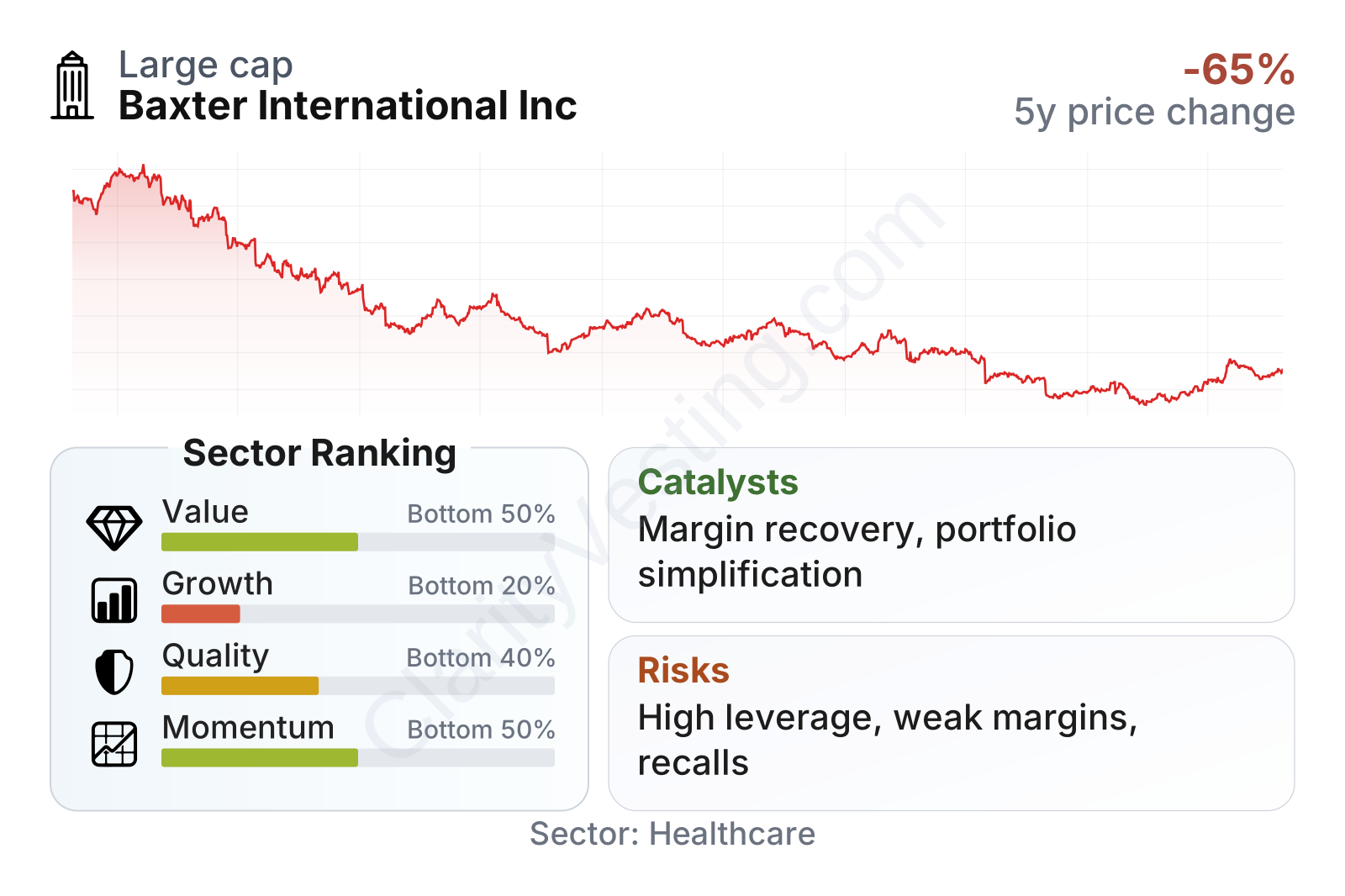
Baxter is a large healthcare company with relatively low share-price volatility, as shown by a beta below 1. The broad factor picture is mixed. Cash generation looks better than many peers, with free cash flow yield above the sector median, and the price-to-book ratio is below sector norms. But growth, profitability, and balance-sheet quality rank weakly versus the healthcare sector. The recent share-price rebound has improved momentum over the last six months, yet the longer-term record remains much weaker than the typical healthcare stock.
Growth
Baxter operates in a sector with durable long-term demand drivers. Aging populations, rising rates of chronic disease, higher hospital utilization, expansion of home-based care, and continued digitization of care settings all support demand for infusion, renal, monitoring, and connected-care products. These are not short-lived themes; they are structural trends in healthcare delivery.
The company’s strategy also makes industrial sense. Baxter has been simplifying its portfolio, focusing on areas where it has recurring hospital demand, consumables tied to installed devices, and opportunities to connect equipment with software and workflow tools. In theory, that combination can support steadier revenue and better cross-selling across hospital customers. The challenge is that the strategy still needs to produce cleaner execution and stronger margins than it has recently.
Recent revenue growth has turned positive again after a volatile period. The pace is still modest relative to the sector median, but it is an improvement from the declines seen in parts of 2023 and 2024. That suggests the underlying business has stabilized to some degree, even if it has not yet returned to a clearly stronger growth profile.
Cash generation is another area worth watching. Free cash flow dropped sharply from earlier levels, then recovered meaningfully in the latest period. That recovery matters because for a company in the middle of portfolio repositioning and operational repair, cash flow is often the clearest sign that the business is regaining footing before accounting earnings fully normalize.
A meaningful catalyst is the company’s ongoing effort to improve productivity, simplify operations, and focus on higher-return product categories after major portfolio actions. Another potential opportunity is renewed adoption of connected-care and hospital workflow solutions, especially where Baxter can bundle hardware, consumables, and software relationships. New product launches and upgrades in infusion and monitoring can also help, since hospitals tend to prefer trusted vendors once systems are installed.
Recent company updates have also emphasized operational improvements, cost actions, and portfolio streamlining. For a business like Baxter, these steps can have an outsized effect because even small improvements in manufacturing efficiency, pricing discipline, and supply-chain reliability can translate into noticeable margin recovery across a very large installed base.
Risks
This article is for informational purposes only and does not constitute financial advice. Some content is AI-generated. See Disclaimer


