Stock Analysis · BancFirst Corporation (BANF)
Overview
BancFirst Corporation is a regional bank headquartered in Oklahoma. Through BancFirst and related subsidiaries, it provides traditional banking services such as commercial and consumer lending, deposit accounts, treasury and cash-management services, mortgage banking, trust services, and some insurance-related activities. Its footprint is concentrated in Oklahoma, where it operates one of the broadest in-state banking networks, giving it a strong local presence with businesses, households, and public-sector customers.
Like most banks, BancFirst earns the majority of its revenue from the spread between what it earns on loans and securities and what it pays on deposits and other funding. Based on its recent annual reporting, the business mix is still heavily centered on net interest income, with non-interest revenue playing a smaller but useful supporting role.
- Net interest income: approximately 80% to 85% of total revenue. This is the core banking engine and includes income from commercial real estate loans, commercial and industrial loans, residential real estate lending, agricultural lending, consumer lending, and investment securities, minus interest paid on deposits and borrowings.
- Service charges and fees: approximately 6% to 8%. This includes deposit account fees, card-related fees, treasury management charges, and other routine banking service revenue.
- Insurance commissions and other non-interest income: approximately 5% to 7%. This generally reflects insurance-related commissions and a mix of trust fees and other customer-service revenue.
- Mortgage banking and securities gains: usually a low-single-source contributor that can vary meaningfully by year. These items can include mortgage origination and sales activity as well as gains or losses tied to securities or other asset transactions.
BancFirst’s financial flow shows a bank that has expanded revenue materially over the last several years, while interest expense rose sharply during the higher-rate period. Even so, operating income and net income remained solid, which suggests the franchise has been able to absorb funding pressure better than many smaller peers.
Key Figures
| Metric | Value | Sector ⓘ |
|---|---|---|
| Date | Oct 20, 2026 | |
| Context | ||
| Sector | Financial Services | |
| Industry | Banks - Regional | |
| Market Cap ⓘ | $3.63B | |
| Beta ⓘ | 0.66 | |
Value (Cheapness) | ||
| P/E Ratio ⓘ | 14.58 | 12.26 |
| P/B Ratio ⓘ | 1.88 | 1.23 |
| FCF Yield ⓘ | 6.76% | 10.33% |
| Dividend Yield ⓘ | 1.80% | 3.02% |
| EBIT / EV ⓘ | N/A | 8.14% |
| PEG ⓘ | 2.09 | |
Growth (Business expansion) | ||
| Revenue Growth ⓘ | 8.70% | 9.25% |
| RPS Growth (5Y CAGR) ⓘ | 12.98% | 12.19% |
| EPS Growth (5Y CAGR) ⓘ | -0.51% | -8.95% |
| BVPS Growth (5Y CAGR) ⓘ | 11.66% | 4.99% |
| Margin Growth (5Y Trend) ⓘ | -5.12% | -3.86% |
| FCF Growth (5Y CAGR) ⓘ | 9.88% | 4.81% |
| DPS Growth (5Y CAGR) ⓘ | 7.87% | 8.79% |
Quality (Business durability) | ||
| ROIC (Latest) ⓘ | 12.59% | 9.49% |
| ROE (Latest) ⓘ | 13.47% | 13.87% |
| ROA (Latest) ⓘ | 1.72% | 1.54% |
| ROIC (5Y Median) ⓘ | 14.25% | 7.86% |
| ROE (5Y Median) ⓘ | 14.97% | 12.17% |
| ROA (5Y Median) ⓘ | 1.72% | 1.30% |
| Net Debt / EBIT (Latest) ⓘ | -13.70 | 0.99 |
| Net Debt / EBIT (5Y Median) ⓘ | -9.42 | 0.73 |
| Net Debt / EBITDA (Latest) ⓘ | -12.76 | 0.91 |
| Operating Margin (Latest) ⓘ | 40.32% | 22.30% |
| Operating Margin (5Y Median) ⓘ | 36.80% | 24.63% |
| Debt to Equity (Latest) ⓘ | 4.71% | 58.32% |
| Profit Margin (Latest) ⓘ | 35.31% | 26.57% |
| Free Cash Flow (Latest) ⓘ | $245.28M | |
Momentum (Price trend) | ||
| 3Y Return ⓘ | +36.18% | +88.67% |
| 12M Return (excl. last month) ⓘ | -16.41% | +19.19% |
| 6M Return ⓘ | -6.60% | +4.70% |
| Price vs. 200-Day MA ⓘ | -2.38% | +3.66% |
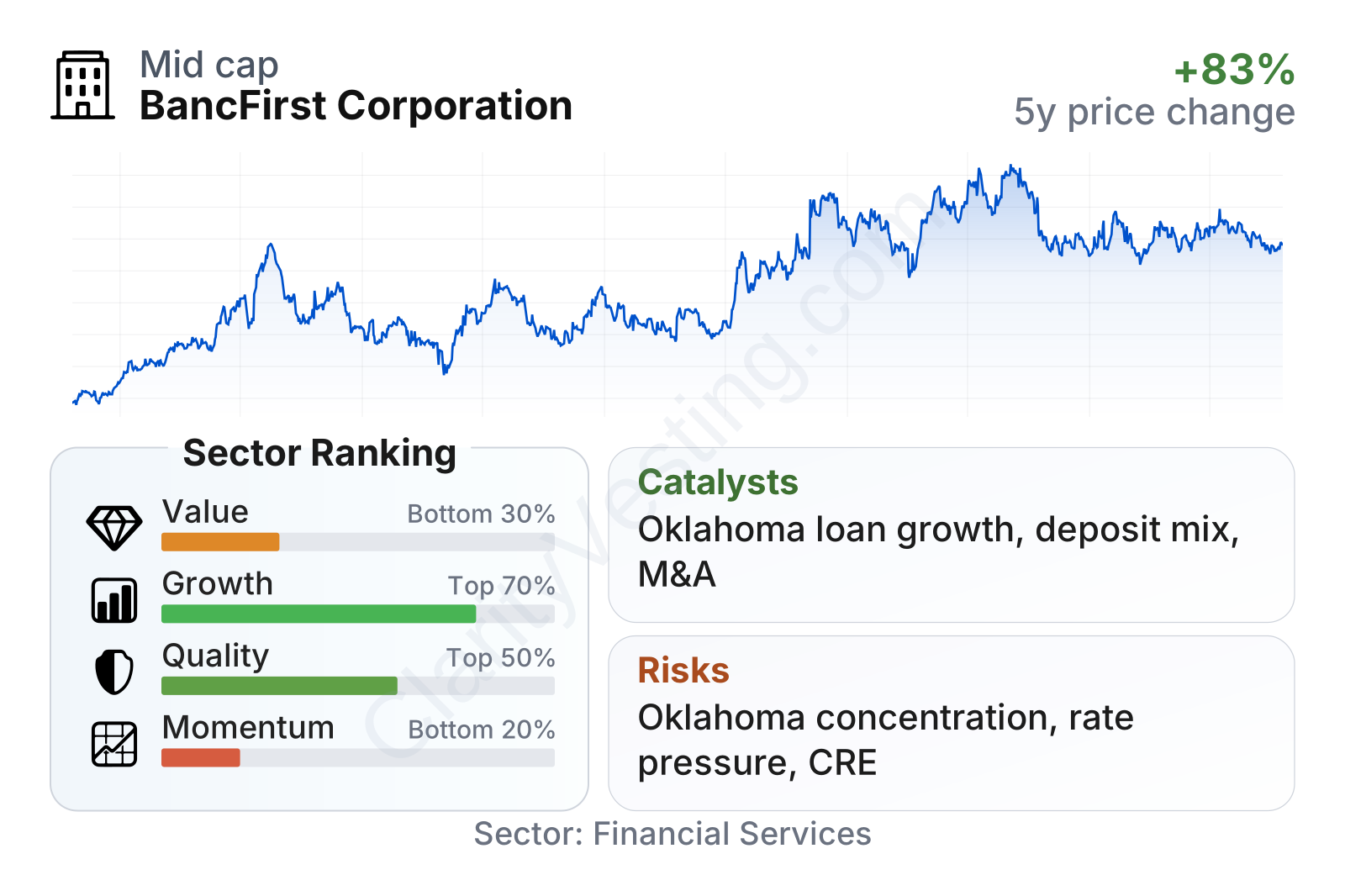
BancFirst sits in the regional banking space as a mid-sized institution by market value, with a lower-than-market beta that points to less share-price volatility than many stocks. The broader picture from the metrics is mixed but understandable for a bank of this type: valuation ranks below much of the sector because the shares trade above peer medians on both earnings and book value, while growth and quality are more favorable. Profitability metrics remain notably healthy, but recent price momentum has lagged the sector.
The stock-price history also reflects that pattern. Shares have advanced clearly over the past five years, but the path has been uneven, with periods of strong rerating followed by pauses as bank funding costs and rate expectations shifted.
Growth
Regional banking is not a fast-growth industry in the way software or semiconductors can be, but it remains an essential part of the economy. For BancFirst, long-term growth depends less on disruption and more on disciplined loan growth, deposit gathering, fee expansion, and consistent market-share gains in its home territory. That can still be attractive when paired with strong underwriting and steady profitability.
The company’s strategy appears coherent for that kind of environment. BancFirst has built a dense Oklahoma franchise with local decision-making, which can help it win business from commercial clients that value responsiveness. It has also used acquisitions selectively over time to add market presence and capabilities. In a banking sector where scale matters, but national scale is not always required, dominating a specific state can be a practical path to durable expansion.
Earnings per share have trended upward over the last several years, even if the pace has not been perfectly smooth. That matters because it shows the company has so far managed to grow through very different rate environments rather than relying on a single favorable cycle.
Another encouraging sign is book value per share, which has compounded at a strong pace over five years and has moved steadily higher year after year. For banks, book value is especially important because it reflects the balance sheet strength supporting future lending and earnings capacity.
As for catalysts, the most visible one is continued loan and deposit growth in Oklahoma and surrounding business corridors. Public filings also show BancFirst remains active across commercial, energy, agriculture, and real estate lending categories, giving it several ways to participate if local economic activity stays healthy. A second catalyst is operating leverage: if deposit costs stabilize while asset yields remain supportive, earnings can improve without the company needing dramatic balance-sheet expansion. A third is industry consolidation. Well-run regional banks can benefit when weaker competitors retrench or sell branches, creating openings to gather customers and low-cost deposits.
Recent company reporting also points to continued underlying profitability and capital generation rather than signs of stress. That does not create a sudden upside event on its own, but it supports the case that BancFirst is still executing the same disciplined model that has lifted revenue, earnings, and book value over time.
Risks
This article is for informational purposes only and does not constitute financial advice. Some content is AI-generated. See Disclaimer


