Stock Analysis · Banc of California Inc (BANC)
Overview
Banc of California Inc is a regional bank based in California that serves businesses, entrepreneurs, real estate operators, community associations, and consumers. Following its combination with PacWest, the company has become a larger commercial bank with a stronger presence across California and selected national lending niches. Its business is centered on gathering deposits and using those funds to make loans, while also earning fees from treasury services, wealth-related activities, and other banking products.
Like most banks, Banc of California does not present revenue in the same way an industrial company would. Its main earnings streams are usually best understood through net interest income first, then noninterest income.
- Net interest income: the largest source of revenue, generated by the spread between interest earned on loans and securities and interest paid on deposits and other funding. For regional banks, this typically represents the clear majority of total revenue, and Banc of California fits that model.
- Service charges, treasury management, and deposit-related fees: recurring fees tied to commercial banking relationships, cash management, and account services.
- Loan sale, servicing, and lending-related fees: includes income connected to specialized lending and loan activity.
- Wealth management and other fee income: a smaller contribution that can include advisory, investment-related, card, and miscellaneous banking fees.
Recent annual results also show a recovery pattern after the severe disruption tied to the PacWest merger period. Total revenue moved back into a healthier range in 2024 and remained elevated in 2025, while interest expense declined from the stressed 2023 level. That matters because for a bank, profitability often depends less on headline growth alone and more on whether funding costs, credit quality, and operating expenses normalize after a major integration.
The broad trend is encouraging: revenue has stayed relatively strong, interest costs have come down from the merger-related stress period, and net income turned positive again in 2024 and improved further in 2025. The key remaining issue is whether that recovery can become consistently efficient rather than just cyclical.
Key Figures
| Metric | Value | Sector ⓘ |
|---|---|---|
| Date | Oct 24, 2026 | |
| Context | ||
| Sector | Financial Services | |
| Industry | Banks - Regional | |
| Market Cap ⓘ | $2.75B | |
| Beta ⓘ | 1.21 | |
Value (Cheapness) | ||
| P/E Ratio ⓘ | N/A | 12.46 |
| P/B Ratio ⓘ | 0.87 | 1.25 |
| FCF Yield ⓘ | 13.45% | 9.82% |
| Dividend Yield ⓘ | 2.53% | 2.94% |
| EBIT / EV ⓘ | -0.97% | 8.11% |
| PEG ⓘ | 1.12 | |
Growth (Business expansion) | ||
| Revenue Growth ⓘ | 8.00% | 9.10% |
| RPS Growth (5Y CAGR) ⓘ | -0.17% | 12.31% |
| EPS Growth (5Y CAGR) ⓘ | -47.81% | -6.97% |
| BVPS Growth (5Y CAGR) ⓘ | 27.88% | 5.02% |
| Margin Growth (5Y Trend) ⓘ | -43.59% | -4.00% |
| FCF Growth (5Y CAGR) ⓘ | 22.89% | 4.71% |
| DPS Growth (5Y CAGR) ⓘ | 37.64% | 8.92% |
Quality (Business durability) | ||
| ROIC (Latest) ⓘ | -0.54% | 9.18% |
| ROE (Latest) ⓘ | -0.64% | 13.93% |
| ROA (Latest) ⓘ | -0.06% | 1.57% |
| ROIC (5Y Median) ⓘ | 4.18% | 7.80% |
| ROE (5Y Median) ⓘ | 4.71% | 12.15% |
| ROA (5Y Median) ⓘ | 0.67% | 1.28% |
| Net Debt / EBIT (Latest) ⓘ | N/A | 1.02 |
| Net Debt / EBIT (5Y Median) ⓘ | 0.70 | 0.72 |
| Net Debt / EBITDA (Latest) ⓘ | 3.39 | 0.88 |
| Operating Margin (Latest) ⓘ | -1.96% | 22.30% |
| Operating Margin (5Y Median) ⓘ | 17.98% | 24.50% |
| Debt to Equity (Latest) ⓘ | 95.06% | 59.34% |
| Profit Margin (Latest) ⓘ | -3.24% | 26.42% |
| Free Cash Flow (Latest) ⓘ | $370.14M | |
Momentum (Price trend) | ||
| 3Y Return ⓘ | +70.63% | +95.73% |
| 12M Return (excl. last month) ⓘ | +12.44% | +17.30% |
| 6M Return ⓘ | -2.32% | +6.07% |
| Price vs. 200-Day MA ⓘ | -5.64% | +5.36% |
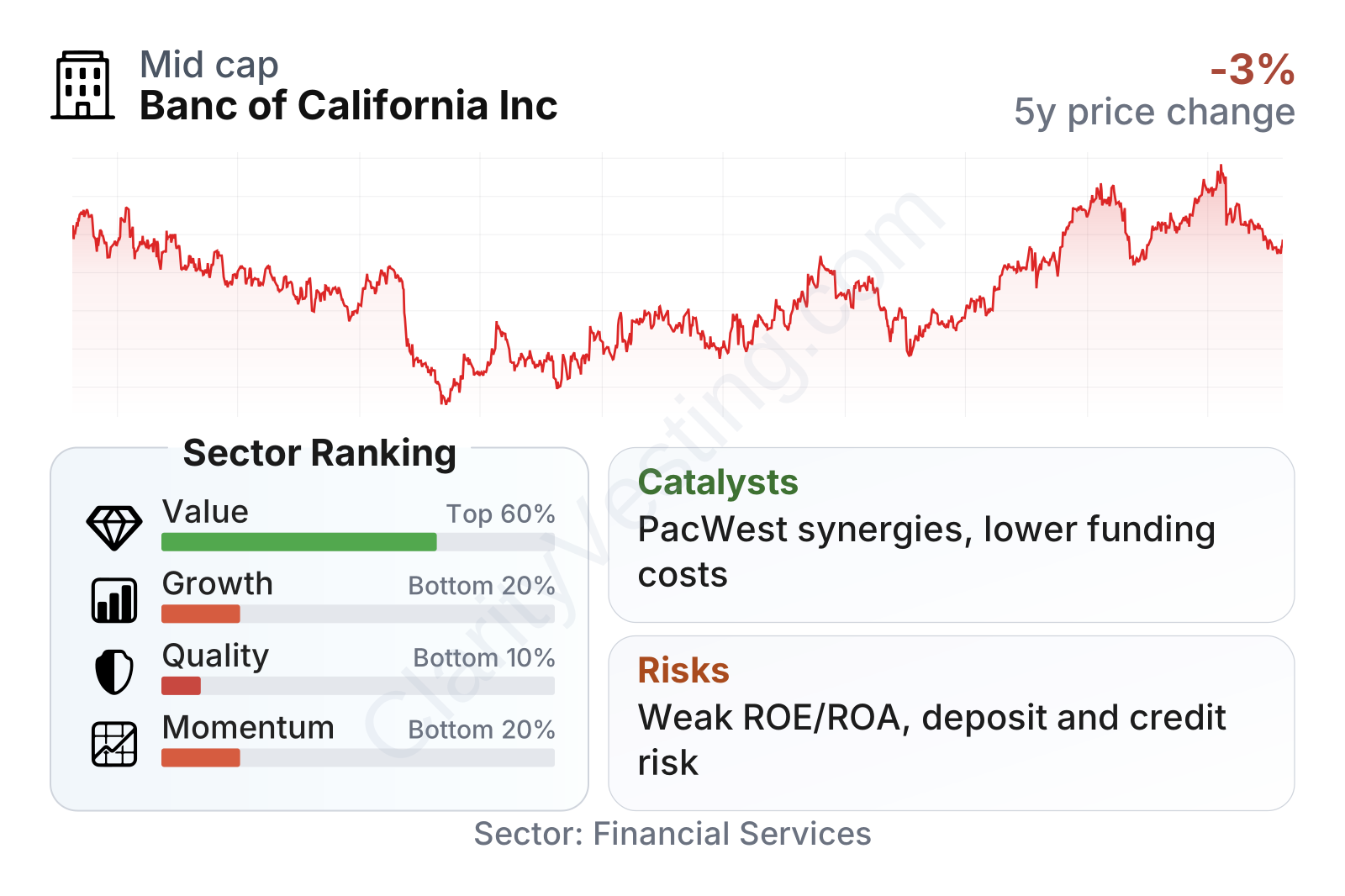
Banc of California is a mid-sized regional bank with a stock that has been volatile since the 2023 regional banking shock but has recovered meaningfully into 2026. On valuation, the shares trade below the sector median on price-to-book, which suggests the market is still applying a discount. At the same time, growth, quality, and momentum metrics remain weaker than much of the regional bank universe, showing that the market is still waiting for cleaner proof of durable profitability.
Growth
The company operates in a mature industry rather than a fast-growing one, so the long-term case depends more on execution than on a booming sector backdrop. Regional banking can still grow through deposit gathering, loan expansion, market share gains, and operating efficiency. In California, that opportunity is meaningful because the state has a very large base of commercial clients, real estate activity, and small-to-mid-sized businesses that often need relationship banking rather than purely digital products.
Banc of California’s strategy appears centered on turning scale from the PacWest combination into better earnings power. In practical terms, that means keeping and deepening deposits, reducing reliance on expensive funding, cross-selling treasury and commercial services, and extracting cost savings from the larger platform. If management executes well, a regional bank can improve profits even without rapid loan growth, simply by widening spreads and lowering overlapping costs.
The earnings path shows why the company draws attention. After a sharp loss in 2023, earnings turned positive again in 2024 and improved further in 2025. That kind of rebound can matter more than raw growth percentages because it suggests the merger shock may be fading. However, the recovery is not yet smooth enough to call fully established, especially with more recent profitability measures still uneven.
Book value per share remains an important anchor for banks, and Banc of California has rebuilt part of the value lost after the merger-related reset. The five-year compound growth in book value per share is well above the sector median, which reflects how transformative the balance sheet changes have been. Still, investors usually want to see not only book value stabilization, but also the ability to earn strong returns on that equity base.
A notable catalyst is the ongoing integration of PacWest. Large bank combinations can create a significant earnings uplift once systems are combined, deposits stabilize, and duplicate costs are removed. Another favorable factor is the decline in interest expense from peak stress levels, which can support margin improvement if deposit pricing stays disciplined. The company has also been working to strengthen its balance sheet and funding mix, which could improve confidence among customers and counterparties over time.
Risks
This article is for informational purposes only and does not constitute financial advice. Some content is AI-generated. See Disclaimer


