Stock Analysis · Booz Allen Hamilton Holding (BAH)
Overview
Booz Allen Hamilton Holding is a consulting and technology services company that works primarily for the U.S. government. Its role is not to manufacture weapons or sell consumer software. Instead, it helps agencies solve complex problems in areas such as defense, intelligence, cybersecurity, data analytics, digital modernization, engineering, and artificial intelligence. The company is especially known for supporting mission-critical government work where security clearances, regulatory knowledge, and long contracting relationships matter a great deal.
The business is heavily concentrated in federal spending. Based on the company’s recent annual reporting for fiscal 2026, most revenue comes from defense, intelligence, and civil government clients, with a smaller share from commercial work. A practical way to read the revenue mix is the following:
- U.S. federal defense clients: about 49% of revenue. This includes consulting, engineering, cyber, digital, and analytics work for military and defense organizations.
- U.S. federal intelligence clients: about 26% of revenue. This covers highly sensitive national security programs, often requiring cleared personnel and deep classified-environment expertise.
- U.S. federal civil clients: about 21% of revenue. This includes work for civilian agencies on modernization, health, energy, infrastructure, and administrative transformation.
- Commercial and other clients: about 4% of revenue. This is a relatively small part of the company and includes private-sector and international activity where applicable.
Booz Allen’s economic model is simple to understand: it wins contracts, supplies skilled staff and specialized solutions, bills clients under long-term contract structures, and aims to convert that revenue into steady cash flow. Over the last several years, revenue expanded meaningfully, although the latest year shows a pullback from the prior peak. The business still remains large, deeply embedded in federal missions, and cash generative.
The long-term trend shows a business that scaled from roughly $8 billion in annual revenue to above $11 billion over a few years. Profitability also improved materially through fiscal 2025, though the latest annual flow suggests some pressure on gross profit and operating profit compared with that high point. That makes the current period look less like a structural collapse and more like a business moving through a tougher comparison phase after very strong expansion.
Key Figures
| Metric | Value | Sector ⓘ |
|---|---|---|
| Date | Oct 24, 2026 | |
| Context | ||
| Sector | Industrials | |
| Industry | Consulting Services | |
| Market Cap ⓘ | $9.02B | |
| Beta ⓘ | 0.37 | |
Value (Cheapness) | ||
| P/E Ratio ⓘ | 11.79 | 22.29 |
| P/B Ratio ⓘ | 7.54 | 1.98 |
| FCF Yield ⓘ | 12.38% | 6.26% |
| Dividend Yield ⓘ | 3.08% | 1.92% |
| EBIT / EV ⓘ | 8.55% | 4.83% |
| PEG ⓘ | 1.09 | |
Growth (Business expansion) | ||
| Revenue Growth ⓘ | -4.20% | 9.30% |
| RPS Growth (5Y CAGR) ⓘ | 10.06% | 7.76% |
| EPS Growth (5Y CAGR) ⓘ | -23.14% | -13.17% |
| BVPS Growth (5Y CAGR) ⓘ | 3.70% | 6.13% |
| Margin Growth (5Y Trend) ⓘ | 1.52% | 0.74% |
| FCF Growth (5Y CAGR) ⓘ | 9.70% | 10.79% |
| DPS Growth (5Y CAGR) ⓘ | 9.63% | 9.41% |
Quality (Business durability) | ||
| ROIC (Latest) ⓘ | 18.82% | 10.75% |
| ROA (Latest) ⓘ | 10.54% | 5.41% |
| ROIC (5Y Median) ⓘ | 17.80% | 9.37% |
| ROA (5Y Median) ⓘ | 9.24% | 4.95% |
| Net Debt / EBIT (Latest) ⓘ | 3.33 | 2.04 |
| Net Debt / EBIT (5Y Median) ⓘ | 3.16 | 2.27 |
| Net Debt / EBITDA (Latest) ⓘ | 2.88 | 1.39 |
| Net Debt / Assets ⓘ | 47.57% | 19.27% |
| EBITDA / Interest ⓘ | 6.58 | 9.58 |
| Operating Margin (Latest) ⓘ | 9.81% | 10.49% |
| Operating Margin (5Y Median) ⓘ | 9.58% | 10.30% |
| Debt to Equity (Latest) ⓘ | 346.09% | 64.82% |
| Profit Margin (Latest) ⓘ | 7.01% | 6.67% |
| Free Cash Flow (Latest) ⓘ | $1.12B | |
Momentum (Price trend) | ||
| 3Y Return ⓘ | -34.50% | +67.77% |
| 12M Return (excl. last month) ⓘ | -22.00% | +12.05% |
| 6M Return ⓘ | -5.95% | 0.00% |
| Price vs. 200-Day MA ⓘ | -1.36% | +0.67% |
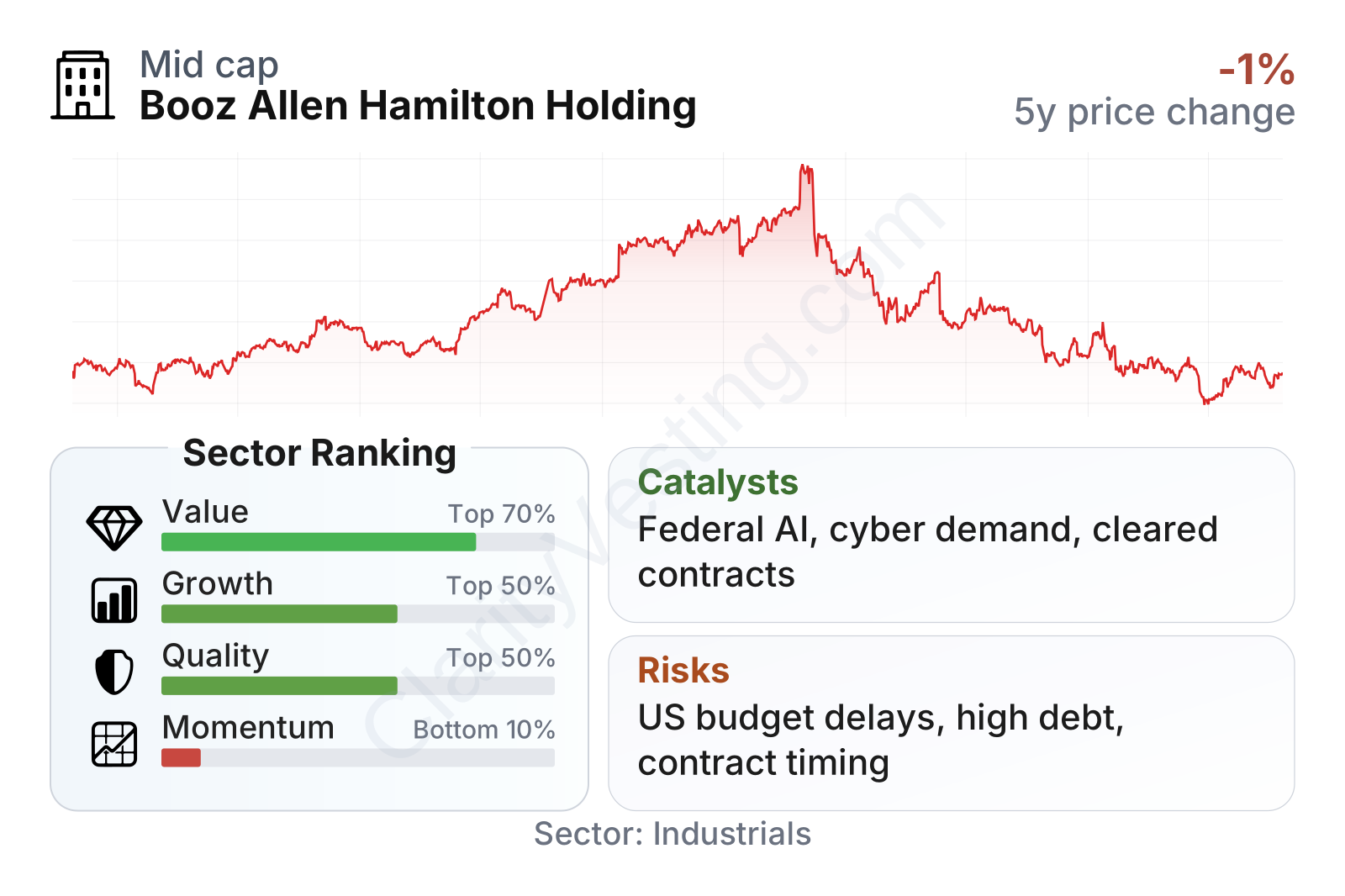
The overall profile is mixed but easy to summarize. On valuation measures, Booz Allen screens cheaper than much of its sector, with a low earnings multiple, a strong free cash flow yield, and a dividend yield above the sector median. Growth metrics are more balanced: the latest year-over-year revenue reading is negative, but the five-year revenue-per-share trend remains solid. Quality is split between strong returns on capital and elevated leverage. Market behavior has clearly been weak, with the stock far below its earlier highs and trailing most peers over the last year and three years.
Booz Allen is a mid-to-large government services company rather than a tiny niche contractor, and its low beta suggests the shares have historically moved less than the broader market. Even so, the recent stock decline has been pronounced, which is why the current valuation looks very different from where it stood in 2023 and 2024.
Growth
Booz Allen operates in a part of the market that still has favorable long-term drivers. U.S. government demand for cyber defense, secure cloud systems, AI-enabled decision tools, digital transformation, and modern mission support remains substantial. These are not short-lived themes. Federal agencies have aging systems, rising security needs, and growing pressure to use data and automation more effectively. That gives specialized contractors with existing contracts and cleared workforces a durable place in the spending chain.
The company’s strategy also makes sense for this environment. Booz Allen has been positioning itself less as a traditional advisory firm and more as a technology-enabled mission partner. That matters because pure consulting can be easier to cut, while embedded technical work tied to operational needs can be harder to replace. The company has highlighted offerings in AI, cyber, space, and advanced digital work as growth priorities, which aligns well with where federal budgets have shown resilience.
The recent revenue pattern is worth watching closely. Growth was strong for several years, often running in the high single digits to high teens, before turning negative in the latest periods. That slowdown does not automatically break the long-term case, but it does show that Booz Allen is not immune to procurement timing, contract transitions, and budget friction. In other words, the company still appears exposed to a healthy sector, yet near-term execution matters more now than it did during the earlier expansion phase.
Cash generation is a more encouraging part of the picture. Free cash flow dipped sharply in fiscal 2024 and then recovered strongly, remaining near the $1 billion level in the latest period. For a services business, that is important because it suggests earnings are not just accounting entries; the company is still producing meaningful cash that can support debt service, dividends, share repurchases, and reinvestment.
One notable recent opportunity is the broader federal push into AI adoption and mission modernization. Booz Allen has been actively expanding its AI-related capabilities and promoting secure, government-ready uses of generative AI and analytics. In a federal market where trust, compliance, and classified-environment experience are major barriers to entry, this can strengthen its role in large modernization programs if spending continues to move in that direction.
Risks
This article is for informational purposes only and does not constitute financial advice. Some content is AI-generated. See Disclaimer