Stock Analysis · Balfour Beatty plc (BAFBF)
Overview
Balfour Beatty plc is a U.K.-based infrastructure group that designs, builds, and maintains large projects such as roads, rail systems, power networks, defense facilities, schools, hospitals, and commercial buildings. The company mainly operates in the United Kingdom, the United States, and Hong Kong. Its business model is broader than a standard construction contractor: alongside project delivery, it also provides support services and invests its own capital in infrastructure concessions and public-private partnership assets.
The largest source of revenue is construction activity. Based on the latest annual reporting structure, revenue is heavily concentrated in its earnings-based construction segments, while support services and investment activities contribute much less to reported sales.
- Construction Services U.K. – approximately 35% to 40% of group revenue. This includes building, highways, rail, and power transmission work for public and private customers.
- Construction Services U.S. – approximately 35% to 40% of group revenue. This covers civil works and buildings, with meaningful exposure to transportation, defense, and government-related projects.
- Gammon (Hong Kong joint venture) – approximately 15% to 20% of group revenue on a proportional basis of business activity, focused on buildings and civil engineering in Hong Kong and nearby markets.
- Support Services – approximately 5% to 10% of group revenue. This includes asset and facilities maintenance, mainly in transport, utilities, and defense-related work.
- Infrastructure Investments – typically less than 5% of group revenue. This segment owns and manages interests in long-term infrastructure assets and can be more important for profit and cash realization than for sales.
That mix matters because Balfour Beatty is not simply chasing top-line growth. Management has spent several years emphasizing contract discipline, selective bidding, cash generation, and returns from its investment portfolio. The result is a business that still depends on large, low-margin projects, but with more balance than a pure construction name.
The profit flow shows the core reality of the business: revenue has grown steadily, but margins remain thin. Even so, operating income and net income improved meaningfully from the weak 2021 base, suggesting better project selection and execution rather than a dramatic change in the economics of construction itself.
Key Figures
| Metric | Value | Sector ⓘ |
|---|---|---|
| Date | Oct 17, 2026 | |
| Context | ||
| Sector | Industrials | |
| Industry | Engineering & Construction | |
| Market Cap ⓘ | $5.46B | |
| Beta ⓘ | 0.56 | |
Value (Cheapness) | ||
| P/E Ratio ⓘ | 17.15 | 22.10 |
| P/B Ratio ⓘ | 5.12 | 1.97 |
| FCF Yield ⓘ | 16.51% | 6.38% |
| Dividend Yield ⓘ | 1.59% | 1.94% |
| EBIT / EV ⓘ | N/A | 4.79% |
| PEG ⓘ | N/A | |
Growth (Business expansion) | ||
| Revenue Growth ⓘ | 10.10% | 9.30% |
| RPS Growth (5Y CAGR) ⓘ | 14.79% | 7.81% |
| EPS Growth (5Y CAGR) ⓘ | N/A | -13.06% |
| BVPS Growth (5Y CAGR) ⓘ | 2.15% | 6.14% |
| Margin Growth (5Y Trend) ⓘ | 1.85% | 0.88% |
| FCF Growth (5Y CAGR) ⓘ | 19.43% | 11.01% |
| DPS Growth (5Y CAGR) ⓘ | 30.51% | 9.48% |
Quality (Business durability) | ||
| ROIC (Latest) ⓘ | 12.17% | 10.84% |
| ROA (Latest) ⓘ | 5.67% | 5.41% |
| ROIC (5Y Median) ⓘ | 7.53% | 9.38% |
| ROA (5Y Median) ⓘ | 3.79% | 4.95% |
| Net Debt / EBIT (Latest) ⓘ | -3.27 | 2.08 |
| Net Debt / EBIT (5Y Median) ⓘ | -2.98 | 2.27 |
| Net Debt / EBITDA (Latest) ⓘ | -1.80 | 1.39 |
| Net Debt / Assets ⓘ | -14.92% | 19.28% |
| EBITDA / Interest ⓘ | 6.61 | 9.58 |
| Operating Margin (Latest) ⓘ | 2.05% | 10.50% |
| Operating Margin (5Y Median) ⓘ | 1.96% | 10.29% |
| Debt to Equity (Latest) ⓘ | 95.45% | 65.48% |
| Profit Margin (Latest) ⓘ | 2.60% | 6.67% |
| Free Cash Flow (Latest) ⓘ | $901.14M | |
Momentum (Price trend) | ||
| 3Y Return ⓘ | +231.36% | +61.68% |
| 12M Return (excl. last month) ⓘ | +55.82% | +12.58% |
| 6M Return ⓘ | +7.20% | 0.00% |
| Price vs. 200-Day MA ⓘ | +33.82% | +0.02% |
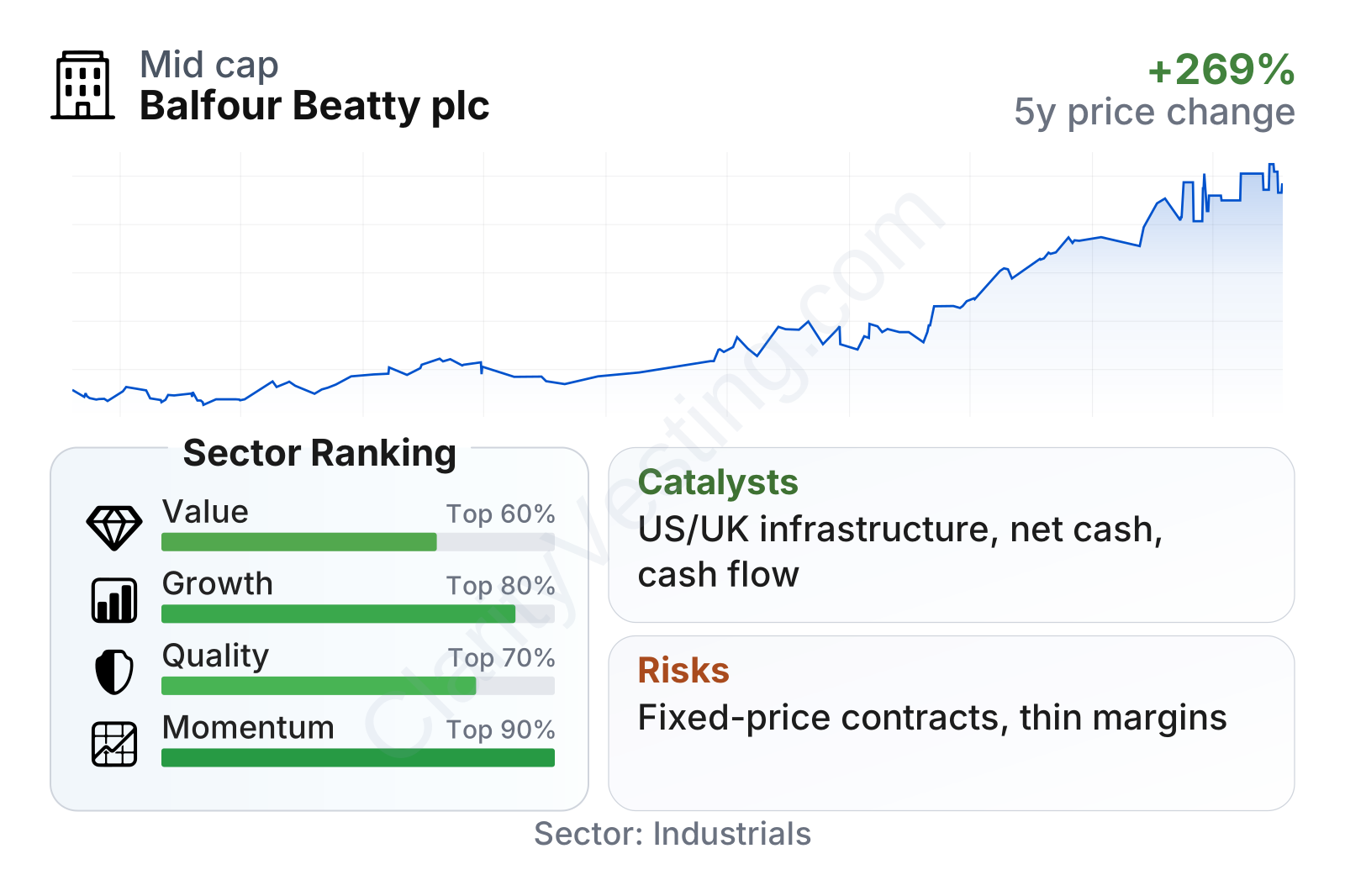
Balfour Beatty screens as a mid-sized industrial company with an unusually strong cash profile for its industry. Free cash flow yield stands well above the sector median, and recent revenue growth is slightly ahead of the typical engineering and construction peer. Balance sheet quality is also a notable point: the company currently carries net cash rather than net debt, which is uncommon in this sector.
Profitability, however, needs to be read with care. Returns on capital and assets are acceptable, but operating and net margins are still far below sector medians, reflecting the structurally low-margin nature of contracting. The stock’s recent market performance has been very strong, with multi-year price gains far ahead of most peers, which indicates improving sentiment but also raises the bar for future execution.
Growth
Balfour Beatty operates in a sector with durable long-term demand. Governments in its main markets continue to invest in transportation, energy networks, defense infrastructure, and public facilities. Aging infrastructure in the U.K. and U.S., grid upgrades linked to electrification, and resilience spending all support a favorable backdrop for companies with large-project capabilities.
The company’s strategy appears aligned with that opportunity. Management has focused on disciplined bidding, risk control, and targeting markets where public funding or strategic demand is more visible. In practice, that means less emphasis on chasing volume at any price and more emphasis on contracts with acceptable margins and cash conversion. For a construction group, that is a sensible approach because headline revenue growth means little if problem contracts later erase profits.
A strong catalyst is Balfour Beatty’s positioning in U.S. and U.K. infrastructure programs. In the U.S., federal and state spending on roads, transit, and defense-related facilities continues to create a large addressable pipeline. In the U.K., long-term needs in power transmission, transportation, and social infrastructure also remain substantial. The company’s established presence in these markets gives it access to repeat customers and framework agreements that can support steady work intake.
Another growth support is the investment portfolio. While this segment is not large in revenue terms, it can unlock value through disposals, cash distributions, and recurring returns from operational assets. That makes the group somewhat more flexible than a contractor that relies only on new project awards.
Recent operating trends also support the growth case. Revenue has moved up over the last several years, operating margin has improved from earlier trough levels, and free cash flow has expanded strongly over a five-year view. Those trends suggest the company is not only benefiting from a better market, but also from improved internal discipline.
Risks
This article is for informational purposes only and does not constitute financial advice. Some content is AI-generated. See Disclaimer


