Stock Analysis · The Boeing Company (BA)
Overview
The Boeing Company is one of the world’s largest aerospace and defense groups. It designs, manufactures, and supports commercial airplanes, military aircraft, satellites, defense systems, and a wide range of aviation services. For the general public, Boeing is best known for its commercial jets such as the 737, 767, 777, and 787 families, but its business is broader than passenger aircraft. It also has meaningful exposure to defense programs and aftermarket services, which gives it multiple sources of revenue.
Boeing reports its business through three main operating segments. Based on the latest full-year company reporting, revenue is approximately distributed as follows:
- Commercial Airplanes: about 66% of revenue. This includes the sale of passenger and cargo aircraft, mainly the 737, 767, 777, and 787 programs.
- Defense, Space & Security: about 27% of revenue. This includes military aircraft, rotorcraft, weapons, missile defense, satellites, and space-related programs for the U.S. government and allied customers.
- Global Services: about 7% of revenue. This includes maintenance, parts, upgrades, training, logistics, and digital support services for both commercial and defense customers.
This mix matters for long-term analysis. Commercial aviation gives Boeing the largest upside when aircraft production rises, while defense and services can add some stability because they are less tied to airline ordering cycles. The challenge is that the commercial unit is also the most operationally demanding and has been the main source of recent volatility.
The financial flow over the last several years shows a business that can generate very large revenue, but with profitability swinging sharply as production problems, charges, and execution issues move through the income statement. After a severe setback in 2024, 2025 showed a clear rebound in revenue and a return to positive net income, although margins remained thin.
Key Figures
| Metric | Value | Sector ⓘ |
|---|---|---|
| Date | Oct 24, 2026 | |
| Context | ||
| Sector | Industrials | |
| Industry | Aerospace & Defense | |
| Market Cap ⓘ | $150.54B | |
| Beta ⓘ | 1.26 | |
Value (Cheapness) | ||
| P/E Ratio ⓘ | 68.27 | 22.29 |
| P/B Ratio ⓘ | 24.93 | 1.98 |
| FCF Yield ⓘ | 0.00% | 6.26% |
| Dividend Yield ⓘ | N/A | 1.92% |
| EBIT / EV ⓘ | 2.91% | 4.83% |
| PEG ⓘ | 1.49 | |
Growth (Business expansion) | ||
| Revenue Growth ⓘ | 8.00% | 9.30% |
| RPS Growth (5Y CAGR) ⓘ | 2.59% | 7.76% |
| EPS Growth (5Y CAGR) ⓘ | -47.89% | -13.17% |
| BVPS Growth (5Y CAGR) ⓘ | N/A | 6.13% |
| Margin Growth (5Y Trend) ⓘ | N/A | 0.74% |
| FCF Growth (5Y CAGR) ⓘ | -19.16% | 10.79% |
| DPS Growth (5Y CAGR) ⓘ | -38.66% | 9.41% |
Quality (Business durability) | ||
| ROIC (Latest) ⓘ | N/A | 10.75% |
| ROA (Latest) ⓘ | 1.54% | 5.41% |
| ROIC (5Y Median) ⓘ | -4.10% | 9.37% |
| ROA (5Y Median) ⓘ | -2.89% | 4.95% |
| Net Debt / EBIT (Latest) ⓘ | 7.22 | 2.04 |
| Net Debt / EBIT (5Y Median) ⓘ | N/A | 2.27 |
| Net Debt / EBITDA (Latest) ⓘ | 5.56 | 1.39 |
| Net Debt / Assets ⓘ | 23.30% | 19.27% |
| EBITDA / Interest ⓘ | 2.71 | 9.58 |
| Operating Margin (Latest) ⓘ | 5.69% | 10.49% |
| Operating Margin (5Y Median) ⓘ | -3.69% | 10.30% |
| Debt to Equity (Latest) ⓘ | 752.30% | 64.82% |
| Profit Margin (Latest) ⓘ | 2.59% | 6.67% |
| Free Cash Flow (Latest) ⓘ | $1.00M | |
Momentum (Price trend) | ||
| 3Y Return ⓘ | +6.80% | +67.77% |
| 12M Return (excl. last month) ⓘ | -6.72% | +12.05% |
| 6M Return ⓘ | -12.27% | 0.00% |
| Price vs. 200-Day MA ⓘ | -12.20% | +0.67% |
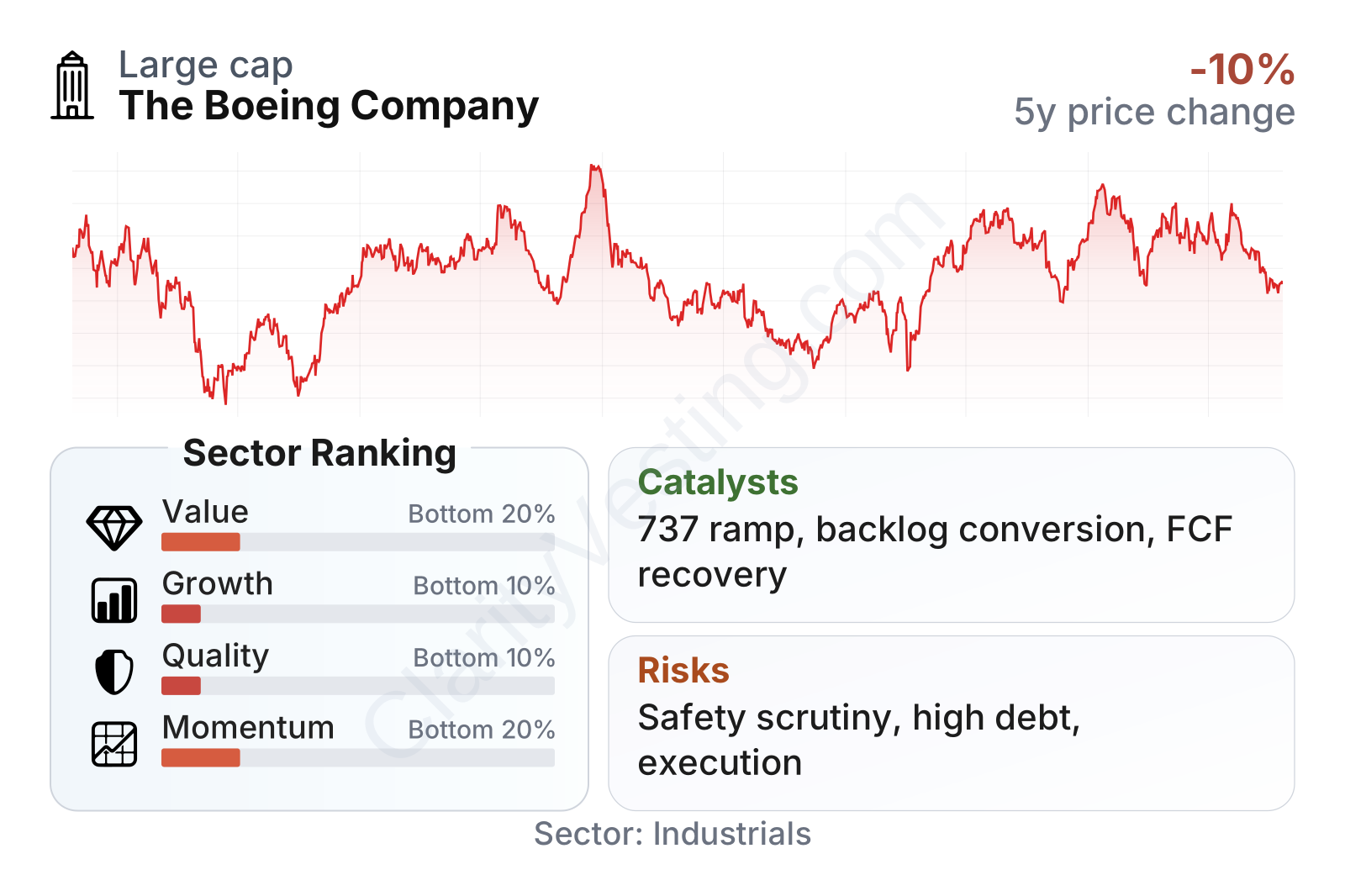
Boeing is a very large industrial company with above-average share price volatility. The overall metric profile is weak relative to much of the Industrials sector: value ranks in the bottom 20%, while growth and quality rank in the bottom 10%. That combination reflects a business still in recovery mode. Profitability has improved from prior losses, but cash generation remains fragile, leverage is high, and valuation multiples remain elevated compared with sector norms.
The stock price history also shows how sensitive sentiment is to production progress, safety oversight, and cash flow expectations. Over the last several years, the shares have gone through large swings rather than a smooth compounding pattern.
Growth
Boeing operates in a sector with solid long-term demand. Global air traffic has historically grown over time, and airlines eventually need more planes to replace older fleets, expand capacity, and improve fuel efficiency. Defense spending also remains important in many countries, which supports demand for military aircraft, systems, and services. In that sense, Boeing is positioned in end markets that still have structural relevance for the coming decade.
The company’s strategy for future growth is straightforward: stabilize manufacturing, increase aircraft deliveries, improve quality control, and convert its large order backlog into revenue and cash flow. That logic makes sense because Boeing does not need to create an entirely new market to grow; it mainly needs to execute better in markets where demand already exists. For a company of this scale, production discipline is the key growth lever.
Revenue growth has been uneven rather than linear. Boeing moved from strong rebounds in parts of 2023 and 2025 to significant contractions during 2024, then back to modest positive growth in the most recent periods. That pattern suggests demand has not disappeared, but operational disruption has repeatedly interrupted the company’s ability to translate demand into reported sales.
Cash flow tells a similar story. Boeing has shown that it can swing back toward meaningful cash generation when deliveries improve, but the recent history is still volatile, with free cash flow moving from strongly positive to sharply negative and then closer to break-even. For a long-term case, this is important because the business ultimately depends on producing aircraft on schedule and collecting cash at scale.
Several catalysts could support future growth. A large installed fleet supports recurring services demand. The commercial aircraft backlog remains substantial, giving Boeing years of potential production visibility once operations normalize. Airlines also continue to prioritize newer, more fuel-efficient aircraft, which supports replacement demand. In defense, the company retains exposure to major U.S. and allied programs, although this segment is generally steadier than high-growth.
Recent company updates have also pointed to efforts to strengthen manufacturing oversight, simplify operations, and move production systems back toward a more predictable cadence. If those efforts lead to higher delivery rates without new disruptions, the impact on revenue and cash flow could be meaningful because small production changes have large financial consequences at Boeing’s scale.
Risks
This article is for informational purposes only and does not constitute financial advice. Some content is AI-generated. See Disclaimer


