Stock Analysis · Barrick Mining Corporation (B)
Overview
Barrick Mining Corporation is one of the world’s largest gold producers. The company operates large, long-life mines and also develops new projects that can extend production over many years. Its business is centered on finding, mining, processing, and selling gold, with copper as a smaller but increasingly important second pillar. Barrick’s mines and projects are spread across North America, Africa, the Middle East, and Latin America, which gives it geographic diversification but also exposes it to a wide range of political and operating environments.
Revenue comes mainly from metal sales. Based on Barrick’s recent annual reporting, the mix is still dominated by gold, while copper provides a meaningful but smaller contribution.
- Gold: approximately 85% to 90% of revenue. This includes output from core mines such as Nevada Gold Mines, Pueblo Viejo, Kibali, Loulo-Gounkoto, and others. Gold remains the main driver of earnings, cash flow, and valuation.
- Copper: approximately 10% to 15% of revenue. This mainly comes from operations such as Lumwana and Jabal Sayid, and it matters because copper has stronger links to electrification, grid expansion, and industrial growth.
- Other items: a small residual share from by-product sales and other revenue categories when applicable.
Barrick’s business model is relatively simple to understand: produce ounces of gold and pounds of copper at costs low enough to generate strong margins, then use that cash to sustain mines, develop new deposits, pay dividends, and maintain a conservative balance sheet. The company’s scale is a major feature. It is not a speculative single-mine operator but a global mining group with multiple producing assets.
The financial picture over the last several years shows a clear improvement. Revenue and operating income recovered strongly after a weaker period in 2022 and 2023, while costs did not rise at the same pace. That matters because it suggests Barrick has recently benefited from both stronger metal prices and better operating leverage, with more revenue flowing through to profit and cash generation.
Key Figures
| Metric | Value | Sector ⓘ |
|---|---|---|
| Date | Oct 17, 2026 | |
| Context | ||
| Sector | Basic Materials | |
| Industry | Gold | |
| Market Cap ⓘ | $66.69B | |
| Beta ⓘ | 1.14 | |
Value (Cheapness) | ||
| P/E Ratio ⓘ | 10.47 | 16.90 |
| P/B Ratio ⓘ | 3.65 | 1.65 |
| FCF Yield ⓘ | 8.33% | 5.76% |
| Dividend Yield ⓘ | 1.59% | 2.13% |
| EBIT / EV ⓘ | 15.66% | 6.30% |
| PEG ⓘ | 2.04 | |
Growth (Business expansion) | ||
| Revenue Growth ⓘ | 43.80% | 11.10% |
| RPS Growth (5Y CAGR) ⓘ | 10.19% | 4.49% |
| EPS Growth (5Y CAGR) ⓘ | 25.87% | -13.47% |
| BVPS Growth (5Y CAGR) ⓘ | -6.97% | 5.51% |
| Margin Growth (5Y Trend) ⓘ | 10.93% | -1.54% |
| FCF Growth (5Y CAGR) ⓘ | 21.21% | 0.37% |
| DPS Growth (5Y CAGR) ⓘ | 10.70% | 6.08% |
Quality (Business durability) | ||
| ROIC (Latest) ⓘ | 26.49% | 9.26% |
| ROA (Latest) ⓘ | 12.97% | 4.91% |
| ROIC (5Y Median) ⓘ | N/A | 7.70% |
| ROA (5Y Median) ⓘ | 4.33% | 3.86% |
| Net Debt / EBIT (Latest) ⓘ | -0.12 | 1.40 |
| Net Debt / EBIT (5Y Median) ⓘ | 0.25 | 1.70 |
| Net Debt / EBITDA (Latest) ⓘ | -0.10 | 0.95 |
| Net Debt / Assets ⓘ | -2.38% | 13.69% |
| EBITDA / Interest ⓘ | 49.18 | 12.34 |
| Operating Margin (Latest) ⓘ | 52.15% | 13.20% |
| Operating Margin (5Y Median) ⓘ | 35.75% | 11.80% |
| Debt to Equity (Latest) ⓘ | 17.15% | 40.56% |
| Profit Margin (Latest) ⓘ | 31.60% | 6.43% |
| Free Cash Flow (Latest) ⓘ | $5.55B | |
Momentum (Price trend) | ||
| 3Y Return ⓘ | +171.81% | +68.89% |
| 12M Return (excl. last month) ⓘ | +49.22% | +30.21% |
| 6M Return ⓘ | -10.53% | -4.16% |
| Price vs. 200-Day MA ⓘ | -7.97% | -1.27% |
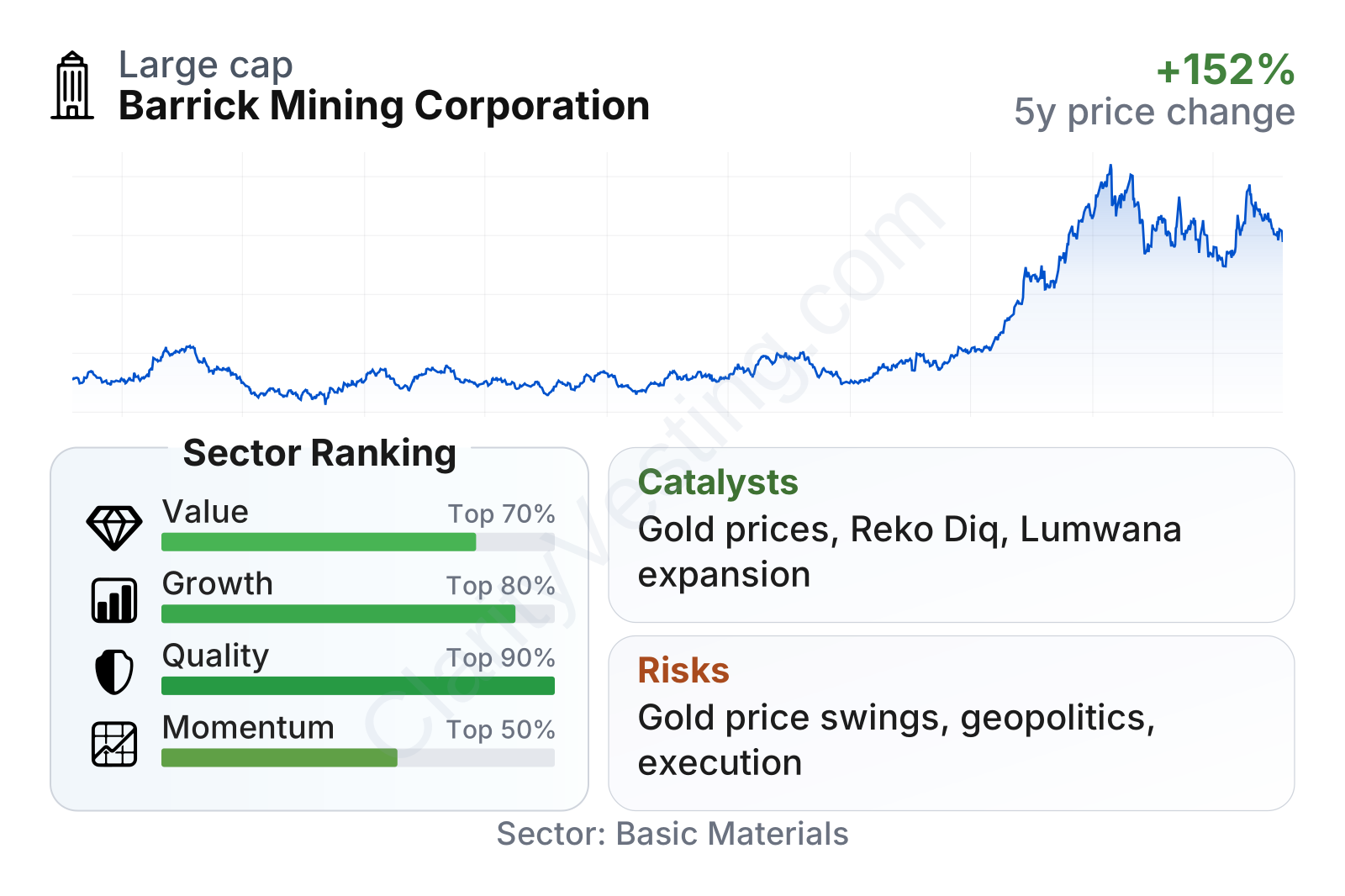
Barrick stands out as a very large company in the gold industry, with share-price volatility that is somewhat above the broader market but not unusual for a major miner. The overall profile is strongest in quality and growth. Profitability, returns on capital, and balance-sheet strength are well above sector norms, while recent revenue and free cash flow trends have also been materially better than the industry median. On valuation, the picture is mixed but still favorable: earnings and operating value multiples look moderate relative to peers, although the price-to-book ratio is somewhat richer. Momentum remains positive over multi-year and 12-month periods, even after the stock pulled back from its recent highs.
Growth
Barrick operates in a sector that can remain relevant for a long time, but it is not a classic growth industry in the way software or biotech might be. Gold demand is supported by jewelry, investment demand, and especially central bank purchases, while copper demand has stronger structural links to electrification, power networks, electric vehicles, and industrial infrastructure. That gives Barrick a useful mix: gold brings scale and cash flow today, while copper can provide more direct exposure to long-term industrial demand.
The company’s strategy for future growth is coherent. Barrick has focused on large, long-life assets, disciplined capital allocation, reserve replacement, and expansion projects around existing operations. That approach reduces the need to constantly acquire short-life mines just to stand still. It also gives the company more control over future production visibility. In mining, that discipline matters because poor acquisitions and overbuilding during high-price periods have historically destroyed value across the sector.
Recent top-line growth has been especially strong. After a soft period in 2022, revenue growth turned positive in 2023 and accelerated meaningfully through 2024 and 2025, with very strong year-over-year gains continuing into 2026. Part of that comes from higher gold prices, but the magnitude also suggests improved production mix and stronger operating performance. For a mining company, this kind of acceleration is important because it can dramatically improve cash generation when fixed infrastructure is already in place.
Free cash flow has improved sharply as well, moving from a weak level in 2023 to a much stronger run rate more recently. This is one of the most encouraging changes in Barrick’s profile. Strong free cash flow gives management more flexibility to fund project development, support shareholder returns, and absorb commodity-price volatility without putting stress on the balance sheet.
One of the most important catalysts is Barrick’s copper pipeline, especially its efforts to expand exposure through projects such as Lumwana and the long-developing Reko Diq project in Pakistan. Reko Diq is particularly notable because it is considered a very large copper-gold deposit with long mine life potential. If execution stays on track, it could become a major source of future production and help diversify Barrick beyond gold over time.
Another favorable factor is the macro backdrop for gold. Persistent central bank demand, geopolitical uncertainty, inflation concerns, and government debt trends have all supported interest in gold. Barrick does not control these external forces, but it can benefit directly from them because higher realized metal prices tend to flow through strongly to margins and cash flow when operating performance is stable.
Risks
This article is for informational purposes only and does not constitute financial advice. Some content is AI-generated. See Disclaimer


