Stock Analysis · Azenta Inc (AZTA)
Overview
Azenta Inc is a life sciences company focused on helping drug developers, research labs, and healthcare organizations store, manage, and analyze valuable biological samples. In simple terms, it operates in areas that support modern medical research: preserving samples such as cells, tissues, blood, and DNA; automating laboratory workflows; and providing genomic analysis services used in research and clinical development.
The business is built around two main operating segments. Based on the latest annual filing for fiscal 2025, revenue is primarily generated from:
- Sample Management Solutions: about 64% of total revenue. This includes biostorage, sample repository services, cold-chain logistics, and laboratory automation instruments and consumables used to handle and preserve biological materials.
- Multiomics: about 36% of total revenue. This segment provides genomic sequencing, gene synthesis, and related sample analysis services that support research, drug discovery, and clinical programs.
That mix matters because Sample Management Solutions is generally tied to recurring customer needs such as storage and ongoing logistics, while Multiomics is more exposed to research budgets and project timing. Over the past few years, Azenta has also been reshaping its portfolio after exiting noncore operations, making the company more concentrated on life sciences tools and services.
The company is relatively small compared with the largest healthcare tools groups, but it serves specialized parts of the research infrastructure market where reliability, compliance, and global handling capabilities matter. The financial flow also shows a business with solid gross profit generation, but one that has struggled to turn that into consistent operating profit because overhead and selling costs remain high.
Revenue recovered after a volatile period, and gross profit has held up reasonably well, but operating expenses have continued to absorb most of that gross profit. The central issue is not demand alone; it is whether Azenta can convert revenue into durable earnings.
Key Figures
| Metric | Value | Sector ⓘ |
|---|---|---|
| Date | Oct 17, 2026 | |
| Context | ||
| Sector | Healthcare | |
| Industry | Medical Instruments & Supplies | |
| Market Cap ⓘ | $1.63B | |
| Beta ⓘ | 1.52 | |
Value (Cheapness) | ||
| P/E Ratio ⓘ | N/A | 24.79 |
| P/B Ratio ⓘ | 1.10 | 3.08 |
| FCF Yield ⓘ | 0.61% | 3.15% |
| Dividend Yield ⓘ | N/A | 1.94% |
| EBIT / EV ⓘ | -12.45% | 0.57% |
| PEG ⓘ | 0.53 | |
Growth (Business expansion) | ||
| Revenue Growth ⓘ | 12.00% | 7.45% |
| RPS Growth (5Y CAGR) ⓘ | 17.02% | 8.61% |
| EPS Growth (5Y CAGR) ⓘ | -20.28% | -17.81% |
| BVPS Growth (5Y CAGR) ⓘ | 20.58% | 3.72% |
| Margin Growth (5Y Trend) ⓘ | N/A | -0.62% |
| FCF Growth (5Y CAGR) ⓘ | -20.73% | 1.04% |
| DPS Growth (5Y CAGR) ⓘ | N/A | 6.77% |
Quality (Business durability) | ||
| ROIC (Latest) ⓘ | -4.56% | 3.24% |
| ROA (Latest) ⓘ | -6.25% | 3.01% |
| ROIC (5Y Median) ⓘ | -0.69% | 4.60% |
| ROA (5Y Median) ⓘ | -2.68% | 1.89% |
| Net Debt / EBIT (Latest) ⓘ | N/A | 1.34 |
| Net Debt / EBIT (5Y Median) ⓘ | N/A | 1.84 |
| Net Debt / EBITDA (Latest) ⓘ | N/A | 1.00 |
| Net Debt / Assets ⓘ | -7.23% | 5.45% |
| EBITDA / Interest ⓘ | N/A | 9.64 |
| Operating Margin (Latest) ⓘ | -24.81% | 9.27% |
| Operating Margin (5Y Median) ⓘ | -3.34% | 7.38% |
| Debt to Equity (Latest) ⓘ | 3.57% | 28.58% |
| Profit Margin (Latest) ⓘ | -20.02% | 3.59% |
| Free Cash Flow (Latest) ⓘ | $9.88M | |
Momentum (Price trend) | ||
| 3Y Return ⓘ | -26.70% | +42.80% |
| 12M Return (excl. last month) ⓘ | +10.32% | +18.50% |
| 6M Return ⓘ | +46.37% | +7.57% |
| Price vs. 200-Day MA ⓘ | +28.95% | +5.12% |
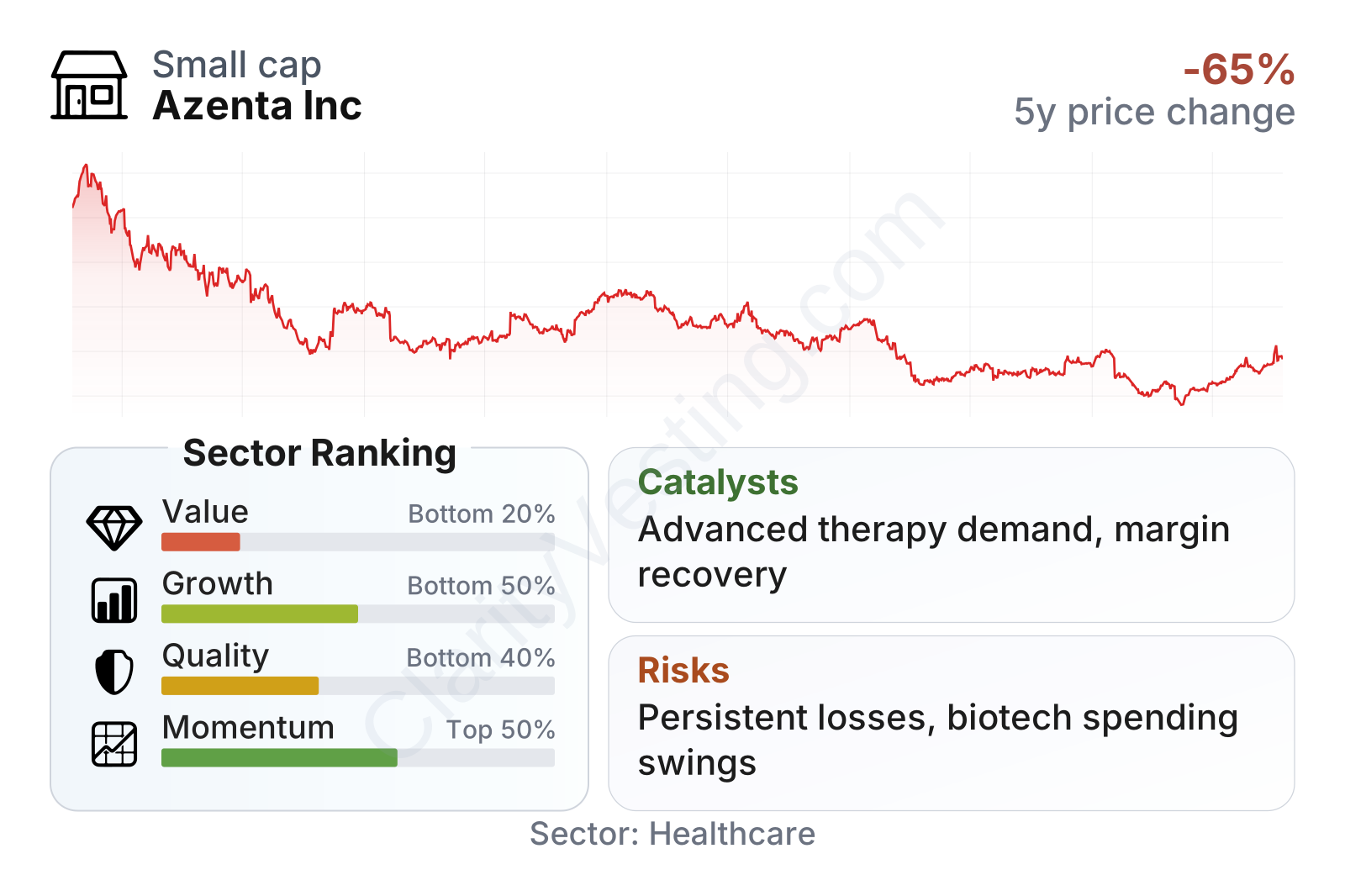
Azenta sits in the smaller-cap range and its share price has been highly volatile, with a long decline from 2021 levels followed by a sharp rebound over the last six months. In the factor summary, growth metrics are mixed, quality remains below much of the sector because profitability is still weak, and balance-sheet strength stands out positively. The valuation profile looks inexpensive on book value, but earnings-based measures are less useful while profitability remains negative.
Growth
Azenta operates in parts of healthcare that still have favorable long-term drivers. Biobanking, cell and gene therapy support, laboratory automation, and genomics all benefit from rising biological data generation, greater use of precision medicine, and the need for secure sample handling across global research programs. These are not short-lived trends; they reflect how modern drug development and diagnostics are increasingly organized.
The company’s strategy is logical on paper. It is concentrating on businesses tied to life sciences research infrastructure rather than spreading itself across unrelated activities. That focus can help management direct capital and sales efforts toward services where customers may stay for years once samples are stored, validated, and integrated into regulated workflows.
Recent revenue growth has improved again, including a latest year-over-year growth rate of roughly 12%, which is ahead of the sector median. Even so, the path has been uneven. Azenta moved from strong expansion in 2023 to contraction in parts of 2024 before returning to modest growth. For long-term analysis, this points to a business that still has demand but has not yet demonstrated steady execution quarter after quarter.
Cash generation has improved meaningfully from the deep outflow seen earlier in the cycle. Free cash flow turned positive in 2024 and remained positive afterward, although at a fairly modest level relative to the company’s size. This is an important signal: even before earnings fully recover, sustained positive cash flow would strengthen the case that restructuring and operating discipline are working.
A notable potential catalyst is the buildout of advanced therapies and biologic drug development, which require specialized sample handling, ultra-cold storage, and traceable logistics. Azenta’s global storage and transport network is aligned with those needs. Another opportunity is broader adoption of automation in labs seeking efficiency and error reduction, especially when research organizations are under pressure to do more with constrained budgets.
Recent company updates have also emphasized cost actions, operational streamlining, and a continued focus on core life sciences services. If those efforts improve margin conversion while the market backdrop stabilizes, growth could become more valuable because it would no longer be offset by persistent losses.
Risks
This article is for informational purposes only and does not constitute financial advice. Some content is AI-generated. See Disclaimer


