Stock Analysis · AstraZeneca PLC (AZN)
Overview
AstraZeneca is a global biopharmaceutical company that researches, develops, manufactures, and sells prescription medicines. Its business is centered on treating serious diseases, with a particularly strong presence in cancer, rare diseases, cardiovascular and kidney conditions, respiratory illness, immunology, and vaccines. The company operates globally, with the United States as its largest single market, but it also has meaningful exposure to Europe, China, and other emerging markets.
Its revenue base is diversified across several therapy areas, although oncology remains the largest contributor. Based on the company’s recent annual reporting structure, the main sources of revenue are approximately:
- Oncology: about 41% — cancer medicines such as Tagrisso, Imfinzi, Lynparza, Calquence, Enhertu alliance revenue, and other tumor-focused treatments.
- BioPharmaceuticals: about 38% — cardiovascular, renal and metabolism medicines, plus respiratory and immunology products such as Farxiga and related chronic disease treatments.
- Rare Disease: about 19% — largely the Alexion portfolio, including therapies for rare blood, kidney, neurologic, and metabolic disorders.
- Other revenue: about 2% — includes smaller product lines, collaborations, and miscellaneous operating revenue.
This mix matters for long-term analysis because AstraZeneca is not dependent on one single drug category. Oncology drives growth, while chronic disease and rare disease franchises add resilience and longer product life cycles.
The business has also been scaling efficiently. Over the last several years, revenue has risen from roughly $37 billion to nearly $59 billion, while gross profit and operating income expanded even faster. Research spending has also climbed materially, showing that management is still reinvesting heavily into future products rather than merely harvesting existing brands.
The operating picture has improved meaningfully: revenue, gross profit, and net income have all moved higher over time, and profitability has widened even as research and commercial spending increased. That usually points to a portfolio gaining scale rather than growth being bought at the expense of margins.
Key Figures
| Metric | Value | Sector ⓘ |
|---|---|---|
| Date | Oct 24, 2026 | |
| Context | ||
| Sector | Healthcare | |
| Industry | Drug Manufacturers - General | |
| Market Cap ⓘ | $261.25B | |
| Beta ⓘ | 0.21 | |
Value (Cheapness) | ||
| P/E Ratio ⓘ | 25.18 | 25.42 |
| P/B Ratio ⓘ | 5.37 | 3.08 |
| FCF Yield ⓘ | 3.35% | 3.12% |
| Dividend Yield ⓘ | 1.91% | 1.85% |
| EBIT / EV ⓘ | 4.94% | 0.56% |
| PEG ⓘ | 1.18 | |
Growth (Business expansion) | ||
| Revenue Growth ⓘ | 6.40% | 7.50% |
| RPS Growth (5Y CAGR) ⓘ | 9.43% | 8.60% |
| EPS Growth (5Y CAGR) ⓘ | 23.25% | -17.73% |
| BVPS Growth (5Y CAGR) ⓘ | 3.13% | 3.72% |
| Margin Growth (5Y Trend) ⓘ | 21.30% | -0.57% |
| FCF Growth (5Y CAGR) ⓘ | 23.20% | 0.96% |
| DPS Growth (5Y CAGR) ⓘ | 4.17% | 6.69% |
Quality (Business durability) | ||
| ROIC (Latest) ⓘ | 15.25% | 3.17% |
| ROA (Latest) ⓘ | 9.08% | 2.98% |
| ROIC (5Y Median) ⓘ | N/A | 4.56% |
| ROA (5Y Median) ⓘ | 6.03% | 1.87% |
| Net Debt / EBIT (Latest) ⓘ | 1.91 | 1.34 |
| Net Debt / EBIT (5Y Median) ⓘ | 2.68 | 1.86 |
| Net Debt / EBITDA (Latest) ⓘ | 1.32 | 1.00 |
| Net Debt / Assets ⓘ | 23.61% | 5.06% |
| EBITDA / Interest ⓘ | 11.93 | 9.55 |
| Operating Margin (Latest) ⓘ | 23.34% | 9.25% |
| Operating Margin (5Y Median) ⓘ | 18.53% | 7.33% |
| Debt to Equity (Latest) ⓘ | 64.10% | 26.68% |
| Profit Margin (Latest) ⓘ | 17.02% | 3.34% |
| Free Cash Flow (Latest) ⓘ | $8.74B | |
Momentum (Price trend) | ||
| 3Y Return ⓘ | +45.25% | +51.61% |
| 12M Return (excl. last month) ⓘ | +10.50% | +19.90% |
| 6M Return ⓘ | -10.83% | +10.10% |
| Price vs. 200-Day MA ⓘ | -3.82% | +6.44% |
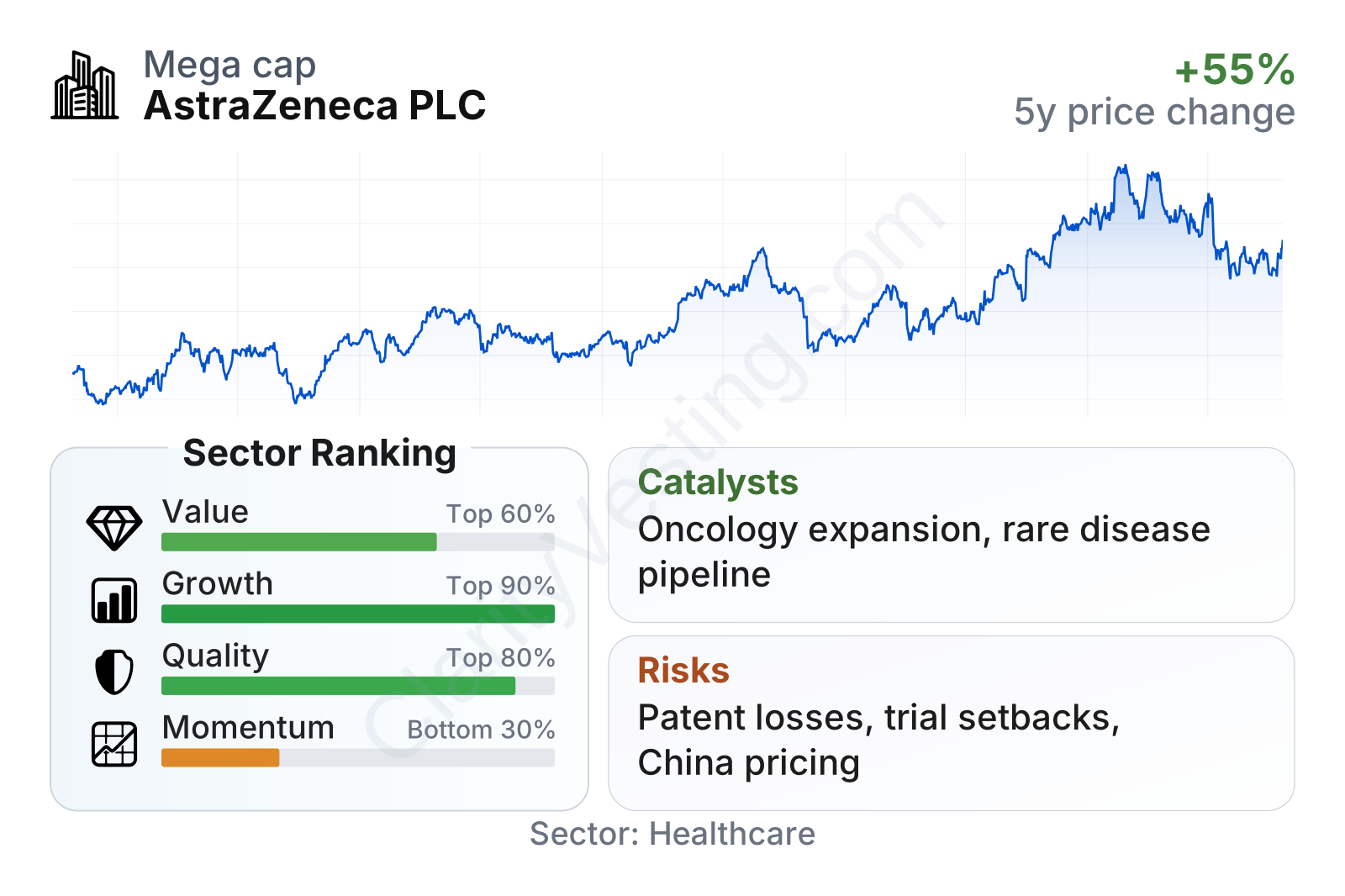
AstraZeneca stands out as a very large pharmaceutical company with unusually low share-price volatility for an equity, reflected by a beta near 0.2. On fundamentals, the strongest areas are growth and quality: profitability, returns on capital, and cash generation compare well with much of the healthcare sector. Value metrics look broadly in line with the sector on earnings, though not especially cheap on book value. One weaker area is recent share-price momentum, which has lagged despite solid business execution.
The stock-price history shows a strong multi-year advance, although not in a straight line. That pattern is common in large drug makers: business progress tends to be steadier than market sentiment, and valuation shifts can create periods where the shares pause even while earnings continue to climb.
Growth
AstraZeneca operates in a sector with durable long-term demand. Aging populations, rising cancer incidence, broader access to specialty medicines, and greater diagnosis of chronic and rare diseases all support continued pharmaceutical spending. This is not a rapid-cycling industry, but it can produce long growth runways when a company has a deep pipeline and strong intellectual property.
AstraZeneca’s strategy is coherent for that environment. The company has built scale in oncology, reinforced its position in rare disease through the Alexion acquisition, and maintained meaningful exposure to large chronic disease markets through cardiovascular, renal, metabolism, respiratory, and immunology medicines. That creates a mix of high-growth specialty products and broader recurring demand categories.
Revenue growth has normalized from the extraordinary swings seen earlier in the decade, but the broader trend still looks healthy. Recent year-over-year expansion has remained positive, and the longer-term record is more important: revenue per share has compounded at roughly 9% annually over five years, while earnings per share have grown much faster. That suggests AstraZeneca has not only added sales, but also improved the economics of the business.
Free cash flow has also trended upward, reaching roughly $9 billion to $10 billion on a trailing basis. That is important because drug development can absorb large amounts of capital and still fail; rising cash generation gives AstraZeneca more flexibility to fund research, support manufacturing, pursue licensing deals, and manage debt without depending too heavily on outside financing.
Several catalysts support future growth. Oncology remains the clearest one, especially as AstraZeneca continues expanding approved uses for established cancer drugs and benefits from partnered products with growing adoption. Rare disease is another important contributor because these medicines often target highly specialized patient groups with strong pricing power and relatively lower direct competition. In chronic diseases, products such as Farxiga have shown how one medicine can expand across multiple indications, increasing the commercial life of a single asset.
Recent company updates have also highlighted continued pipeline progress across cancer, obesity-related metabolic disease, rare disease, and cell therapy platforms. For a company of AstraZeneca’s size, the ability to generate new approvals and label expansions matters more than a single breakthrough headline. The opportunity is less about one product transforming the company and more about a steady flow of launches, broader indications, and geographic expansion supporting growth over many years.
Risks
This article is for informational purposes only and does not constitute financial advice. Some content is AI-generated. See Disclaimer


