Stock Analysis · Ayala Corporation (AYYLF)
Overview
Ayala Corporation is one of the Philippines’ oldest and largest diversified business groups. Rather than operating as a single-product company, it acts as a holding company with major stakes in businesses tied to everyday economic activity: property development, banking, telecommunications, energy, water infrastructure, healthcare, and digital services. That structure gives it exposure to several parts of the Philippine economy at once, which can reduce dependence on any one market but also makes the business more complex to assess.
The largest earnings and value drivers are its listed and controlled subsidiaries, especially BPI in banking, Ayala Land in real estate, Globe Telecom in telecom, ACEN in renewable energy, and Manila Water in utilities. Based on recent annual reporting by Ayala and its core subsidiaries, the group’s economic exposure is spread across a few major pillars rather than one dominant business line.
Main sources of revenue and economic contribution are broadly distributed as follows:
- Real estate and property development: approximately 30% to 40% of consolidated revenue in recent years through Ayala Land. This includes residential sales, commercial leasing, offices, malls, hotels, and industrial lots.
- Banking and financial services: approximately 20% to 30% of group earnings contribution, primarily through Bank of the Philippine Islands. This business includes loans, deposits, payments, wealth management, and corporate banking.
- Telecommunications: approximately 20% to 30% of group earnings contribution through Globe Telecom, covering mobile services, broadband, enterprise connectivity, and digital platforms.
- Energy and renewables: approximately 10% to 20% of revenue contribution through ACEN and related energy operations. This segment is increasingly centered on solar, wind, and other renewable generation assets.
- Water and infrastructure: usually less than 10% of group revenue, mainly via Manila Water and other infrastructure assets, including regulated water distribution and related services.
- Healthcare, logistics, and digital businesses: currently a smaller share, generally under 10% combined, but these areas are part of Ayala’s long-term expansion agenda.
Because Ayala is a conglomerate, revenue alone does not tell the full story. Some subsidiaries contribute more through earnings, asset value, or future optionality than through top-line sales. That is especially true for banking, telecom, and infrastructure, where recurring cash generation and strategic market position matter as much as reported consolidated revenue.
Over the last several years, the group’s revenue has steadily expanded, while net income has improved more meaningfully than sales. The most notable change is that operating income appears to have grown faster than revenue, pointing to better profitability at the operating level. At the same time, interest expense remains substantial, which is important for a capital-intensive group with meaningful debt.
Key Figures
| Metric | Value | Sector ⓘ |
|---|---|---|
| Date | Nov 21, 2026 | |
| Context | ||
| Sector | Industrials | |
| Industry | Conglomerates | |
| Market Cap ⓘ | $5.37B | |
| Beta ⓘ | 0.33 | |
Value (Cheapness) | ||
| P/E Ratio ⓘ | 6.55 | 20.77 |
| P/B Ratio ⓘ | N/A | 3.20 |
| FCF Yield ⓘ | -7.18% | 4.98% |
| Dividend Yield ⓘ | 1.87% | 1.88% |
| EBIT / EV ⓘ | 11.75% | 6.24% |
| PEG ⓘ | N/A | |
Growth (Business expansion) | ||
| Revenue Growth ⓘ | 6.00% | 9.60% |
| RPS Growth (5Y CAGR) ⓘ | 10.74% | 7.69% |
| EPS Growth (5Y CAGR) ⓘ | -62.86% | -5.74% |
| BVPS Growth (5Y CAGR) ⓘ | -12.22% | 6.13% |
| Margin Growth (5Y Trend) ⓘ | 20.47% | 0.72% |
| FCF Growth (5Y CAGR) ⓘ | -1.07% | 11.01% |
| DPS Growth (5Y CAGR) ⓘ | 10.89% | 9.09% |
Quality (Business durability) | ||
| ROIC (Latest) ⓘ | 8.55% | 10.48% |
| ROA (Latest) ⓘ | 2.61% | 5.38% |
| ROIC (5Y Median) ⓘ | 5.09% | 9.45% |
| ROA (5Y Median) ⓘ | 2.48% | 4.91% |
| Net Debt / EBIT (Latest) ⓘ | 6.08 | 2.12 |
| Net Debt / EBIT (5Y Median) ⓘ | 9.41 | 2.28 |
| Net Debt / EBITDA (Latest) ⓘ | 6.29 | 1.42 |
| Net Debt / Assets ⓘ | 37.59% | 19.19% |
| EBITDA / Interest ⓘ | 2.93 | 10.09 |
| Operating Margin (Latest) ⓘ | 34.48% | 10.44% |
| Operating Margin (5Y Median) ⓘ | 20.31% | 10.29% |
| Debt to Equity (Latest) ⓘ | 151.57% | 66.48% |
| Profit Margin (Latest) ⓘ | 12.93% | 6.98% |
| Free Cash Flow (Latest) ⓘ | -$385.26M | |
Momentum (Price trend) | ||
| 3Y Return ⓘ | -21.37% | +48.25% |
| 12M Return (excl. last month) ⓘ | +2.52% | +10.31% |
| 6M Return ⓘ | +19.02% | +0.15% |
| Price vs. 200-Day MA ⓘ | -8.36% | 0.00% |
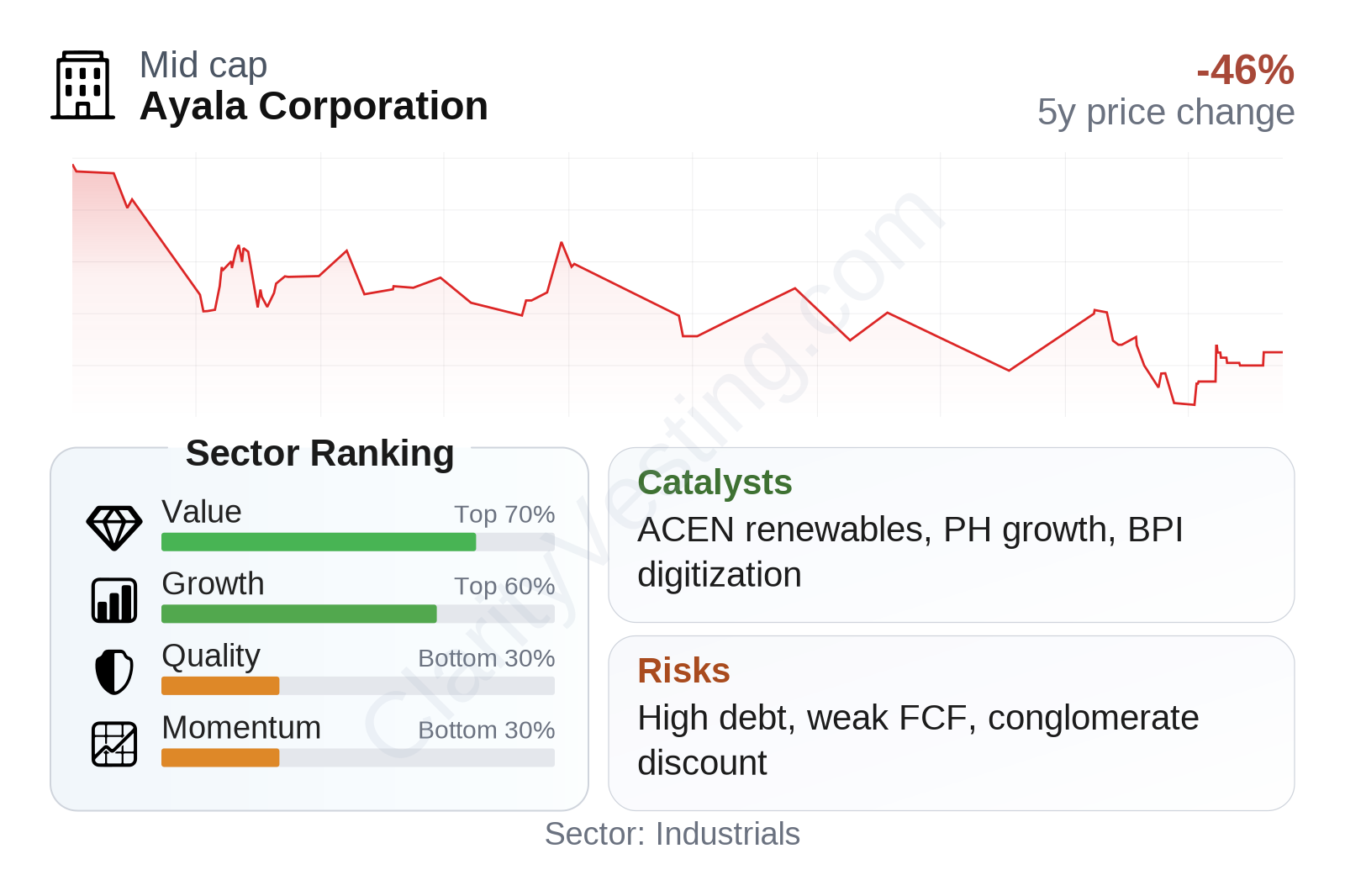
Ayala currently screens as inexpensive on earnings-based valuation, with a P/E far below the sector median and a solid EBIT-to-enterprise-value ratio. That said, the low multiple comes with trade-offs: free cash flow is still negative, balance-sheet leverage is elevated, and share-price momentum has lagged much of the broader industrial universe. On growth, the picture is mixed. Revenue expansion over five years has been respectable, but earnings per share and book value trends have been weaker, reflecting the complexity of the portfolio, capital needs, and financing costs. Profitability margins are stronger than the sector median, yet overall quality ranks lower because debt and interest coverage weigh on the profile.
Growth
Ayala is positioned in sectors that remain relevant for long-term economic development in the Philippines: urban housing, office and retail property, banking penetration, mobile data usage, electricity demand, renewable power, and water infrastructure. These are not niche activities. They are basic services that tend to grow with population, urbanization, rising incomes, and business formation.
The company’s strategy is coherent for future growth because it combines mature cash-generating assets with expansion platforms. Banking and telecom provide scale and recurring demand. Real estate offers exposure to urban development and land value creation. The most important future-oriented leg is energy, especially renewables through ACEN, where Ayala has been building capacity in the Philippines and abroad. That gives the group exposure to a structural theme that is likely to remain important for years: the buildout of cleaner power systems.
Revenue growth has not been perfectly smooth, but the broader pattern has been positive. After stronger growth periods in 2022 through 2024, the pace softened in parts of 2025 before reaccelerating sharply in mid-2026. That suggests Ayala is still capable of producing growth across its portfolio, although timing can vary depending on property sales recognition, banking activity, and contributions from energy projects.
Free cash flow remains the main area where the growth profile looks less comfortable. Recent periods have stayed negative, although the cash burn appears less severe than earlier troughs. For a conglomerate expanding in infrastructure, energy, and property, negative free cash flow is not unusual by itself, but it does mean growth depends on continued execution, asset monetization, financing access, and disciplined capital allocation.
One of the more visible catalysts is the continued scaling of ACEN’s renewable portfolio. New project completions, higher operating capacity, and stronger electricity demand can gradually increase the weight of recurring energy earnings inside the group. Another support comes from the normalization and expansion of Philippine domestic activity, which can benefit Ayala Land, BPI, and Globe at the same time. In healthcare and digital ventures, the upside is smaller today but could become more material if these platforms reach scale.
Recent corporate updates from Ayala and its major subsidiaries have continued to emphasize investment in energy transition, property launches, banking digitization, and connectivity infrastructure. None of these alone transforms the group overnight, but together they reinforce the idea that Ayala is trying to align its portfolio with long-duration demand trends rather than short-term cyclical themes.
Risks
This article is for informational purposes only and does not constitute financial advice. Some content is AI-generated. See Disclaimer