Stock Analysis · Aya Gold & Silver Inc. Common Shares (AYA)
Overview
Aya Gold & Silver is a precious-metals mining company focused on Morocco. Its core business is producing silver and expanding mineral resources through exploration and mine development. The company is best known for the Zgounder silver mine, which has been the engine of production, and for the Boumadine project, a large exploration asset that could become an important growth pillar if development advances as planned.
For a simple way to think about the business, Aya turns ore from its mining properties into silver and then sells that metal into the market. That makes the company highly exposed to two big drivers: how much silver it can produce at good costs, and what silver prices are at the time of sale. Compared with diversified miners, Aya is much more concentrated, which can create stronger upside when operations go well, but also more volatility when production or pricing moves the wrong way.
Based on recent annual results, revenue is overwhelmingly tied to silver production, with only limited contributions from by-products and other items.
- Silver sales: approximately 90% to 95% of revenue. This is the company’s main economic driver and comes primarily from output at the Zgounder mine.
- By-product and other mining-related revenue: approximately 5% to 10% of revenue. This can include sales linked to other recovered metals or operational items, but it remains secondary.
- Exploration assets: 0% of current operating revenue. Projects such as Boumadine are strategically important, but they are not yet material revenue contributors.
The recent financial flow shows a business that moved from relatively modest revenue and thin profitability a few years ago to a much larger operation with sharply stronger earnings in 2025, after a difficult 2024. That swing highlights both the scale potential and the uneven nature of mining results during expansion phases.
Key Figures
| Metric | Value | Sector ⓘ |
|---|---|---|
| Date | Oct 24, 2026 | |
| Context | ||
| Sector | Basic Materials | |
| Industry | Silver | |
| Market Cap ⓘ | $3.78B | |
| Beta ⓘ | 1.68 | |
Value (Cheapness) | ||
| P/E Ratio ⓘ | 34.12 | 16.92 |
| P/B Ratio ⓘ | 8.25 | 1.66 |
| FCF Yield ⓘ | 2.59% | 5.83% |
| Dividend Yield ⓘ | N/A | 2.07% |
| EBIT / EV ⓘ | 4.78% | 6.38% |
| PEG ⓘ | N/A | |
Growth (Business expansion) | ||
| Revenue Growth ⓘ | 150.70% | 11.25% |
| RPS Growth (5Y CAGR) ⓘ | 57.36% | 4.49% |
| EPS Growth (5Y CAGR) ⓘ | 275.43% | -15.24% |
| BVPS Growth (5Y CAGR) ⓘ | 34.93% | 5.49% |
| Margin Growth (5Y Trend) ⓘ | 27.24% | -1.54% |
| FCF Growth (5Y CAGR) ⓘ | -49.85% | 0.37% |
| DPS Growth (5Y CAGR) ⓘ | N/A | 5.91% |
Quality (Business durability) | ||
| ROIC (Latest) ⓘ | 22.20% | 9.59% |
| ROA (Latest) ⓘ | 17.39% | 4.92% |
| ROIC (5Y Median) ⓘ | N/A | 7.91% |
| ROA (5Y Median) ⓘ | 2.25% | 3.92% |
| Net Debt / EBIT (Latest) ⓘ | -0.51 | 1.36 |
| Net Debt / EBIT (5Y Median) ⓘ | N/A | 1.69 |
| Net Debt / EBITDA (Latest) ⓘ | -0.45 | 0.93 |
| Net Debt / Assets ⓘ | -13.74% | 13.69% |
| EBITDA / Interest ⓘ | 14.78 | 12.38 |
| Operating Margin (Latest) ⓘ | 55.57% | 13.24% |
| Operating Margin (5Y Median) ⓘ | 17.16% | 11.82% |
| Debt to Equity (Latest) ⓘ | 17.63% | 40.30% |
| Profit Margin (Latest) ⓘ | 32.79% | 6.38% |
| Free Cash Flow (Latest) ⓘ | $98.06M | |
Momentum (Price trend) | ||
| 3Y Return ⓘ | +368.96% | +73.47% |
| 12M Return (excl. last month) ⓘ | +145.13% | +27.59% |
| 6M Return ⓘ | +54.50% | -4.02% |
| Price vs. 200-Day MA ⓘ | +29.43% | -0.65% |
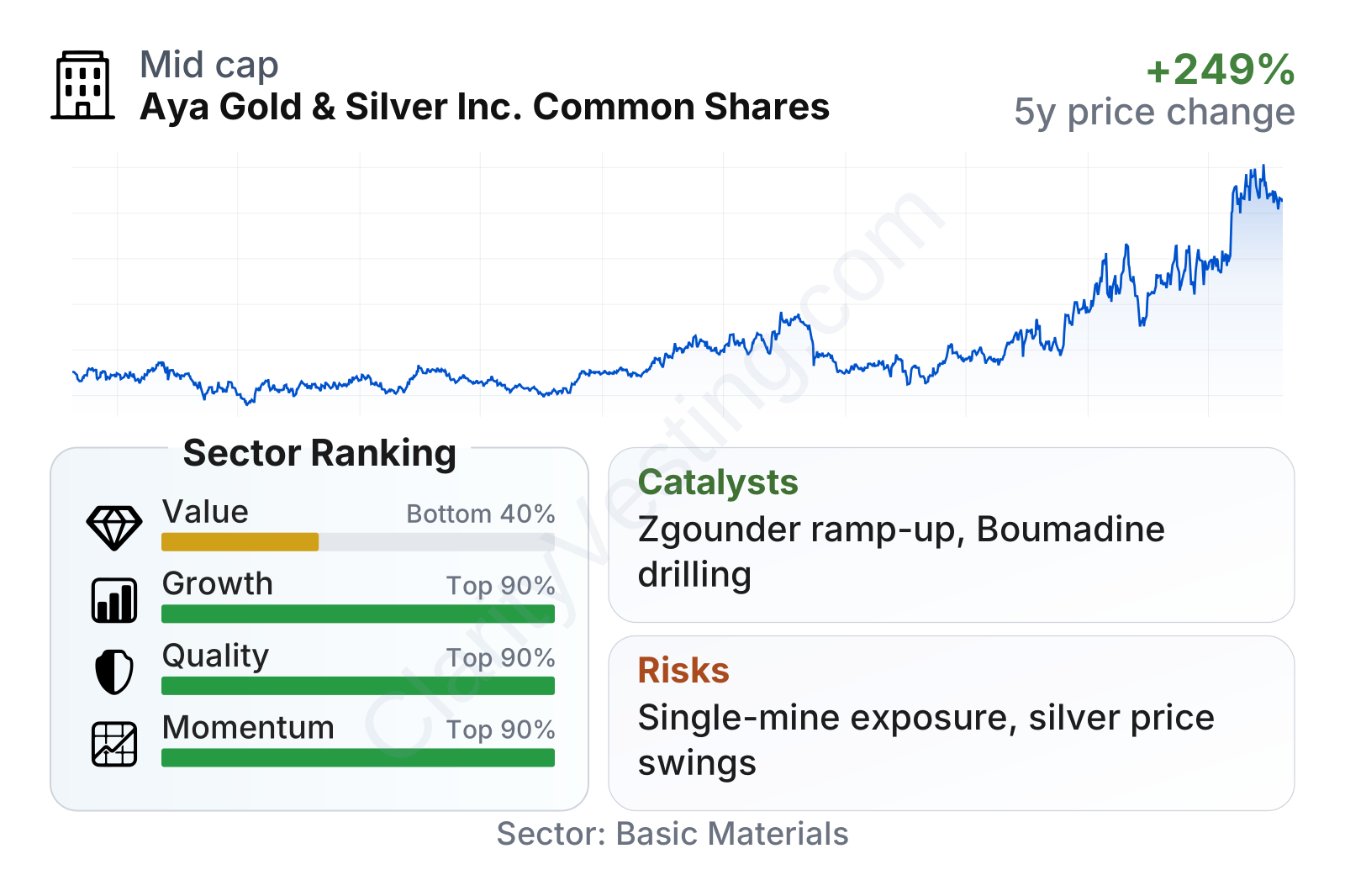
Aya is now a mid-sized silver company by market value, with a share price that has been very strong over the last three years but also volatile along the way. The metrics table points to a business with standout growth and quality characteristics relative to most companies in its sector, while the value profile looks less attractive. In plain terms, the market is already recognizing the company’s improved profitability, balance-sheet strength, and expansion potential, so the stock is not being priced like a cheap cyclical miner. The higher beta also confirms that the shares can move more sharply than the broader market.
Growth
The company operates in a sector with favorable long-term support. Silver benefits from two demand channels at once: it is a precious metal with monetary and investment appeal, and it also has industrial uses in areas such as solar panels, electronics, and electrification. That does not guarantee steady prices, but it does create a broader demand base than many single-purpose commodities.
Aya’s strategy is straightforward and easy to follow: increase output at Zgounder, improve operating efficiency, and keep advancing exploration assets that could support a larger future production base. That strategy makes industrial sense because scale matters in mining. If a producer can spread fixed costs over more ounces while maintaining ore quality and recovery, margins can improve quickly.
Recent revenue growth has been exceptionally strong, far above the sector median, although that growth is coming off a lower historical base and reflects a period of operational ramp-up rather than a smooth linear trend. The important takeaway is that Aya has already shown it can move from a small producer into a meaningfully larger one. Over five years, revenue per share and earnings growth have also been far ahead of most peers.
Cash generation has also improved materially. Free cash flow was negative during part of the buildout period, which is common when a miner is investing heavily in expansion, but it turned clearly positive more recently. That change matters because it suggests the company is moving from spending on growth toward harvesting returns from that investment.
One of the clearest catalysts is the company’s operational scaling after the Zgounder expansion. Another is continued drilling success at Boumadine, where resource growth could support a larger long-term development case. Recent company updates have also pointed to stronger operating and financial performance in 2026, reinforcing the idea that 2025 was not only a recovery year on paper but part of a broader step change in the business.
Risks
This article is for informational purposes only and does not constitute financial advice. Some content is AI-generated. See Disclaimer


