Stock Analysis · Axsome Therapeutics Inc (AXSM)
Overview
Axsome Therapeutics is a biotechnology company focused on treatments for central nervous system, or CNS, disorders. In simple terms, it develops and sells medicines for conditions such as major depressive disorder, migraine, Alzheimer’s disease agitation, narcolepsy, fibromyalgia, smoking cessation, and other hard-to-treat brain and nervous system conditions. The business has moved beyond being only a research company: it already has marketed products and is now trying to scale commercial sales while advancing a broader pipeline.
The company’s revenue is still concentrated in product sales, with licensing and collaboration revenue playing a much smaller role. Based on recent annual results, the main sources of revenue can be summarized as follows:
- Auvelity product sales: approximately 65% to 75% of total revenue. Auvelity is the company’s antidepressant for major depressive disorder and is currently the largest commercial asset.
- Sunosi product sales: approximately 20% to 30% of total revenue. Sunosi is used to improve wakefulness in adults with excessive daytime sleepiness linked to narcolepsy or obstructive sleep apnea.
- License, royalty, and other revenue: approximately 5% to 10% of total revenue. This includes partnership-related income and smaller non-product items.
What stands out in the business model is that gross profit has grown quickly as revenue expanded, but operating expenses have also climbed sharply. Selling, general, and administrative costs have risen especially fast as Axsome built a larger commercial organization, while research and development spending remained high to support multiple late-stage and regulatory programs. That creates a business with real revenue momentum, but one that is still not translating sales growth into net profit.
The multi-year picture shows a company transitioning from early commercial scale to a broader branded pharmaceutical platform. Revenue has increased dramatically since 2021, and gross margins are strong, but the cost base remains heavy enough that profitability has not yet arrived.
Key Figures
| Metric | Value | Sector ⓘ |
|---|---|---|
| Date | Oct 24, 2026 | |
| Context | ||
| Sector | Healthcare | |
| Industry | Biotechnology | |
| Market Cap ⓘ | $8.19B | |
| Beta ⓘ | 0.85 | |
Value (Cheapness) | ||
| P/E Ratio ⓘ | N/A | 25.42 |
| P/B Ratio ⓘ | 96.49 | 3.08 |
| FCF Yield ⓘ | -0.87% | 3.12% |
| Dividend Yield ⓘ | N/A | 1.85% |
| EBIT / EV ⓘ | -1.85% | 0.56% |
| PEG ⓘ | N/A | |
Growth (Business expansion) | ||
| Revenue Growth ⓘ | 45.50% | 7.50% |
| RPS Growth (5Y CAGR) ⓘ | 172.01% | 8.60% |
| EPS Growth (5Y CAGR) ⓘ | -17.23% | -17.73% |
| BVPS Growth (5Y CAGR) ⓘ | 43.76% | 3.72% |
| Margin Growth (5Y Trend) ⓘ | N/A | -0.57% |
| FCF Growth (5Y CAGR) ⓘ | -3.56% | 0.96% |
| DPS Growth (5Y CAGR) ⓘ | N/A | 6.69% |
Quality (Business durability) | ||
| ROIC (Latest) ⓘ | -55.23% | 3.17% |
| ROA (Latest) ⓘ | -26.79% | 2.98% |
| ROIC (5Y Median) ⓘ | -72.13% | 4.56% |
| ROA (5Y Median) ⓘ | -52.02% | 1.87% |
| Net Debt / EBIT (Latest) ⓘ | N/A | 1.34 |
| Net Debt / EBIT (5Y Median) ⓘ | N/A | 1.86 |
| Net Debt / EBITDA (Latest) ⓘ | N/A | 1.00 |
| Net Debt / Assets ⓘ | -13.22% | 5.06% |
| EBITDA / Interest ⓘ | N/A | 9.55 |
| Operating Margin (Latest) ⓘ | -23.96% | 9.25% |
| Operating Margin (5Y Median) ⓘ | -85.67% | 7.33% |
| Debt to Equity (Latest) ⓘ | 263.14% | 26.68% |
| Profit Margin (Latest) ⓘ | -24.68% | 3.34% |
| Free Cash Flow (Latest) ⓘ | -$71.39M | |
Momentum (Price trend) | ||
| 3Y Return ⓘ | +151.69% | +51.61% |
| 12M Return (excl. last month) ⓘ | +72.87% | +19.90% |
| 6M Return ⓘ | -16.28% | +10.10% |
| Price vs. 200-Day MA ⓘ | -22.04% | +6.44% |
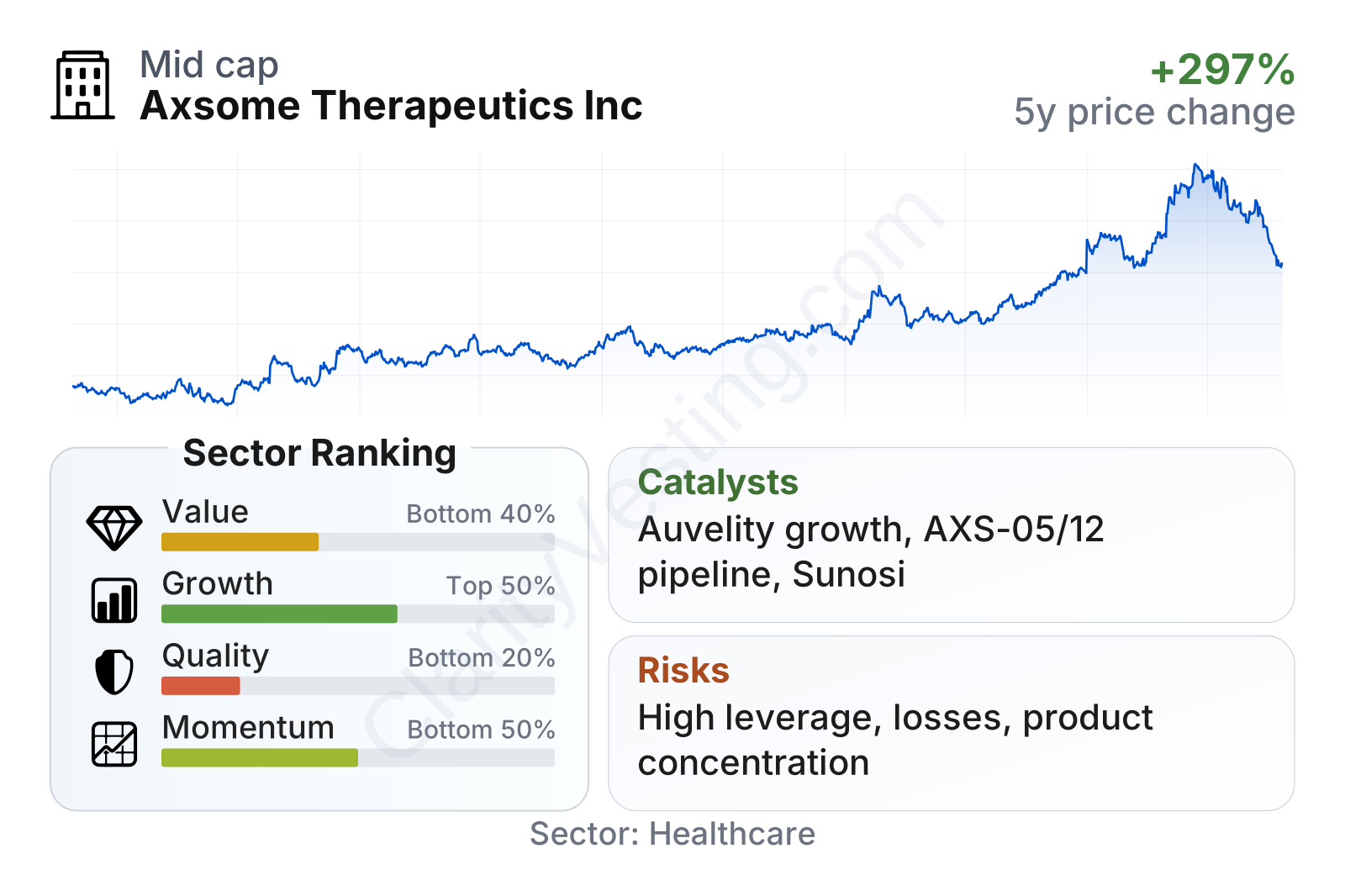
Axsome is now a large mid-cap biotech name with a market value around $10 billion and a beta below 1, which suggests the shares have historically moved somewhat less violently than many biotech peers. In the factor breakdown, growth and momentum look strong relative to the healthcare sector, while value and quality rank weakly. That combination usually describes a company the market is rewarding for future expectations rather than present-day profitability or balance sheet strength.
The underlying pattern is easy to read: sales are expanding much faster than the sector median, but returns on capital, operating margin, and free cash flow remain clearly below typical healthcare levels. This is not unusual for an emerging commercial biotech, but it does mean the investment case depends heavily on execution over the next several years.
Growth
Axsome operates in a large and growing part of healthcare. CNS disorders remain one of the biggest unmet-need areas in medicine, and many conditions in this category are chronic, underdiagnosed, or poorly served by existing treatments. That creates room for successful products to scale for many years if they can show meaningful benefits and win physician adoption. Depression, migraine, sleep disorders, and neurodegenerative symptoms all represent markets with large patient populations.
The company’s strategy for future expansion is coherent. It is building around a commercial base led by Auvelity and Sunosi, while using that infrastructure to support additional launches and label expansions. This is important because commercial biotechs often become more efficient as they spread sales and marketing costs over more products. If Axsome can keep adding approved medicines or expanded indications without a similar increase in overhead, operating leverage could improve materially.
Revenue growth has remained strong even after the early launch surge. Recent year-over-year growth has generally stayed in the mid-double-digit range, well above the sector median. That matters because it suggests demand is still expanding from a larger base rather than fading after an initial launch period. Over a five-year period, revenue per share has also grown at an unusually fast pace for the sector, reinforcing the idea that Axsome is still in an aggressive build-out phase.
Cash generation is also moving in a better direction, even though it remains negative. Free cash outflow has narrowed substantially from earlier periods, which suggests the business is absorbing its spending more efficiently as product revenue grows. The company is not yet self-funding in a durable way, but the trend has become less demanding than it was during heavier launch and development years.
Several catalysts could shape the next stage. The most important are continued Auvelity prescription growth, further scaling of Sunosi, and progress in late-stage or regulatory pipeline assets such as AXS-05 in Alzheimer’s disease agitation and AXS-12 in narcolepsy, along with additional programs in migraine and fibromyalgia. Positive regulatory decisions or successful launches in these areas could broaden revenue sources and reduce the current dependence on two marketed products.
Recent company updates have also pointed to ongoing regulatory and clinical progress across the pipeline, which is a meaningful opportunity because CNS products that reach approval often face less direct generic-style competition in the early years than more crowded primary care categories. In other words, Axsome is not relying on a single binary event anymore; it has a growing base business plus several shots at expansion.
Risks
This article is for informational purposes only and does not constitute financial advice. Some content is AI-generated. See Disclaimer


