Stock Analysis · AXIS Capital Holdings Ltd (AXS)
Overview
AXIS Capital Holdings Ltd is a specialty insurer and reinsurer. In simple terms, it helps businesses transfer the financial risk of large or unusual events, from property damage and liability claims to professional risks, marine, aviation, cyber, and other complex exposures. The company operates globally and focuses on areas where underwriting expertise matters more than scale alone.
Its revenue comes mainly from insurance premiums, reinsurance premiums, and income earned from investing the float generated by those insurance operations. Based on recent company reporting, the business mix is broadly organized into two main underwriting segments, with investment income as an important support to profit rather than a separate operating segment.
- Insurance: approximately 60% to 65% of gross premiums written. This includes specialty commercial lines such as professional lines, cyber, liability, property, marine, aviation, accident and health, and other niche risks written for corporate clients.
- Reinsurance: approximately 35% to 40% of gross premiums written. This business sells protection to other insurers, mainly across property catastrophe, specialty, casualty, and credit or surety-related exposures.
- Net investment income: a smaller share of total revenue than underwriting activity, but still meaningful for earnings. It comes from the bond portfolio and other invested assets that back insurance liabilities.
The recent business pattern has been favorable: total revenue has moved up over the last several years, while profitability improved sharply after a weaker 2022. The biggest change has been a stronger spread between revenue and claims-related costs, which suggests better pricing, underwriting discipline, and more support from investment income.
The multi-year picture shows a clear recovery in earnings power. Revenue has climbed from a little above $5.3 billion in 2021 to about $6.6 billion in 2025, while net income rebounded strongly after 2022 and remained above $1.0 billion in 2024 and 2025. That matters for an insurer because long-term value creation depends less on raw premium volume than on writing business at attractive terms and converting it into durable book value growth.
Key Figures
| Metric | Value | Sector ⓘ |
|---|---|---|
| Date | Oct 17, 2026 | |
| Context | ||
| Sector | Financial Services | |
| Industry | Insurance - Specialty | |
| Market Cap ⓘ | $7.16B | |
| Beta ⓘ | 0.46 | |
Value (Cheapness) | ||
| P/E Ratio ⓘ | 6.97 | 12.26 |
| P/B Ratio ⓘ | 1.12 | 1.23 |
| FCF Yield ⓘ | 32.15% | 10.40% |
| Dividend Yield ⓘ | 1.80% | 3.02% |
| EBIT / EV ⓘ | 16.84% | 8.14% |
| PEG ⓘ | 1.18 | |
Growth (Business expansion) | ||
| Revenue Growth ⓘ | 7.40% | 9.35% |
| RPS Growth (5Y CAGR) ⓘ | 7.33% | 12.19% |
| EPS Growth (5Y CAGR) ⓘ | 1.44% | -9.53% |
| BVPS Growth (5Y CAGR) ⓘ | 8.91% | 4.99% |
| Margin Growth (5Y Trend) ⓘ | 6.32% | -3.86% |
| FCF Growth (5Y CAGR) ⓘ | N/A | 4.81% |
| DPS Growth (5Y CAGR) ⓘ | 1.43% | 8.79% |
Quality (Business durability) | ||
| ROIC (Latest) ⓘ | 17.55% | 9.49% |
| ROE (Latest) ⓘ | 18.87% | 13.90% |
| ROA (Latest) ⓘ | 3.47% | 1.55% |
| ROIC (5Y Median) ⓘ | 10.57% | 7.86% |
| ROE (5Y Median) ⓘ | 12.25% | 12.17% |
| ROA (5Y Median) ⓘ | 2.32% | 1.30% |
| Net Debt / EBIT (Latest) ⓘ | 0.51 | 0.96 |
| Net Debt / EBIT (5Y Median) ⓘ | 0.82 | 0.73 |
| Net Debt / EBITDA (Latest) ⓘ | 0.47 | 0.92 |
| Operating Margin (Latest) ⓘ | 20.26% | 22.30% |
| Operating Margin (5Y Median) ⓘ | 13.37% | 24.63% |
| Debt to Equity (Latest) ⓘ | 22.86% | 58.56% |
| Profit Margin (Latest) ⓘ | 16.23% | 26.57% |
| Free Cash Flow (Latest) ⓘ | $2.30B | |
Momentum (Price trend) | ||
| 3Y Return ⓘ | +78.59% | +88.33% |
| 12M Return (excl. last month) ⓘ | +6.57% | +19.38% |
| 6M Return ⓘ | -1.94% | +4.75% |
| Price vs. 200-Day MA ⓘ | -3.25% | +3.50% |
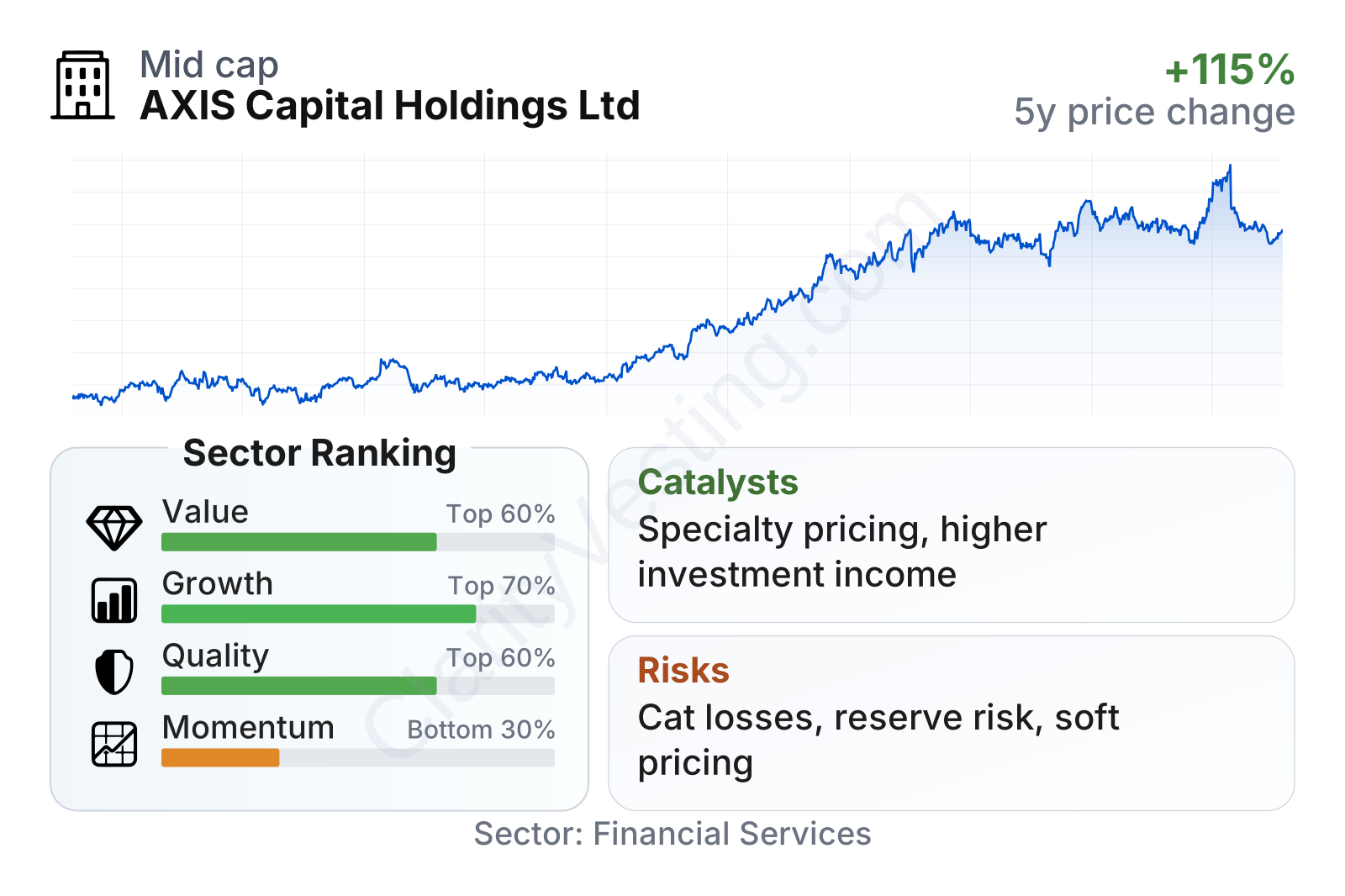
AXIS Capital is a mid-sized specialty insurer with a stock that has risen strongly over the past several years, although recent share performance has cooled versus the broader financial sector. The table points to a business with solid quality and acceptable growth, but weaker recent momentum. Valuation metrics stand out more favorably: the earnings multiple is well below the sector median, the price-to-book ratio is also below the sector median, and cash generation looks unusually strong. Profitability measures such as return on equity and return on assets are above typical sector levels, while leverage appears moderate for the industry.
The tradeoff is that growth has been steady rather than fast. Revenue growth is positive, book value per share has compounded well, and margins have improved, but the stock’s recent momentum ranks toward the lower end of the sector. That usually means the market has already recognized some progress, yet still remains cautious about how sustainable current profitability will be through the insurance cycle.
Growth
AXIS Capital operates in a part of the insurance market that has attractive long-term relevance. Specialty insurance and reinsurance are supported by structural demand drivers: more complex business risks, greater cyber exposure, high insured values, and the need for corporations and insurers to protect themselves from large losses. Climate-related volatility also increases demand for risk transfer, even though it makes underwriting harder.
The company’s strategy is logical for this environment. Management has spent recent years reshaping the portfolio toward lines with better margins and reducing exposure where returns were less attractive. For a specialty insurer, this can be more important than simply expanding premium volume. If pricing remains disciplined and reserve quality stays sound, AXIS can continue growing intrinsic value even without very high top-line expansion.
Earnings per share have improved materially since 2021, with a particularly strong step-up from 2023 through 2025. That pattern suggests the business is benefiting from both better underwriting conditions and stronger investment income. In insurance, earnings can move around from year to year because catastrophe losses are unpredictable, so the more important point is the direction of normalized earnings power. On that basis, AXIS looks stronger today than it did a few years ago.
Book value per share has also increased at a healthy pace, especially after the dip in 2022. For insurers, book value is one of the clearest long-term markers because it reflects how effectively management compounds capital after claims, expenses, and shareholder distributions. AXIS has outpaced the sector median on five-year book value growth, which supports the case that recent gains are not only accounting noise.
A notable catalyst is the continued favorable pricing environment in specialty lines and selected reinsurance markets. When insurers can renew policies at higher rates while keeping underwriting standards tight, margins can expand quickly. Another support is higher recurring investment income from fixed-income portfolios built during a period of elevated interest rates. Together, these two levers can keep returns above historical averages if loss experience remains manageable.
Recent company updates have also emphasized capital returns and portfolio optimization. Those actions do not create growth by themselves, but they can improve per-share results when combined with rising book value and disciplined underwriting. For a company in a mature financial industry, that is often a practical path to compounding value over time.
Risks
This article is for informational purposes only and does not constitute financial advice. Some content is AI-generated. See Disclaimer


