Stock Analysis · Axon Enterprise Inc (AXON)
Overview
Axon Enterprise develops technology used mainly by public safety agencies. The company is best known for TASER conducted energy devices, body-worn cameras, in-car cameras, and cloud software that helps police departments store, manage, and review digital evidence. Over time, Axon has expanded from a hardware maker into a broader platform company built around connected devices, recurring software subscriptions, and workflow tools for law enforcement.
Its business is organized around two main segments: TASER and Software & Sensors. TASER includes conducted energy devices, cartridges, and related accessories. Software & Sensors includes body cameras, vehicle cameras, cloud evidence management, productivity applications, real-time operations tools, and newer AI-enabled features.
Based on the company’s latest annual reporting and recent quarterly mix, revenue is primarily driven by the following sources:
- Software & Sensors: about 70% to 75% of total revenue. This includes body cameras, in-car systems, subscriptions to Evidence.com, records and productivity software, drone-related offerings, and other connected public safety tools. This segment has become the largest part of the company because it combines device sales with recurring cloud and service revenue.
- TASER: about 25% to 30% of total revenue. This includes TASER devices, cartridges, and accessories. The cartridge stream is especially important because it creates repeat purchases after the initial device sale.
Geographically, the United States remains the core market, but Axon has been increasing its international presence as more agencies modernize policing technology and digital evidence systems.
The business model has also become more durable over time. A larger share of revenue now comes from multi-year subscriptions and ecosystem-based contracts rather than one-time equipment purchases. That matters because recurring revenue tends to be more predictable and can support higher long-term profitability if customer retention stays strong.
The long-term trend shows a business that expanded rapidly from 2021 through 2025, with gross profit rising strongly alongside revenue. It also shows a meaningful increase in research and development and selling expenses, especially in 2025, which helps explain why profit growth has recently been less smooth than revenue growth.
Key Figures
| Metric | Value | Sector ⓘ |
|---|---|---|
| Date | Oct 24, 2026 | |
| Context | ||
| Sector | Industrials | |
| Industry | Aerospace & Defense | |
| Market Cap ⓘ | $31.90B | |
| Beta ⓘ | 1.44 | |
Value (Cheapness) | ||
| P/E Ratio ⓘ | 162.92 | 22.29 |
| P/B Ratio ⓘ | 9.04 | 1.98 |
| FCF Yield ⓘ | 0.42% | 6.26% |
| Dividend Yield ⓘ | N/A | 1.92% |
| EBIT / EV ⓘ | 0.96% | 4.83% |
| PEG ⓘ | 2.11 | |
Growth (Business expansion) | ||
| Revenue Growth ⓘ | 35.30% | 9.30% |
| RPS Growth (5Y CAGR) ⓘ | 20.82% | 7.76% |
| EPS Growth (5Y CAGR) ⓘ | -0.12% | -13.17% |
| BVPS Growth (5Y CAGR) ⓘ | 19.63% | 6.13% |
| Margin Growth (5Y Trend) ⓘ | 20.45% | 0.74% |
| FCF Growth (5Y CAGR) ⓘ | 0.29% | 10.79% |
| DPS Growth (5Y CAGR) ⓘ | N/A | 9.41% |
Quality (Business durability) | ||
| ROIC (Latest) ⓘ | 5.05% | 10.75% |
| ROA (Latest) ⓘ | 2.82% | 5.41% |
| ROIC (5Y Median) ⓘ | 9.84% | 9.37% |
| ROA (5Y Median) ⓘ | 5.62% | 4.95% |
| Net Debt / EBIT (Latest) ⓘ | 3.36 | 2.04 |
| Net Debt / EBIT (5Y Median) ⓘ | 2.13 | 2.27 |
| Net Debt / EBITDA (Latest) ⓘ | 2.59 | 1.39 |
| Net Debt / Assets ⓘ | 16.52% | 19.27% |
| EBITDA / Interest ⓘ | 4.17 | 9.58 |
| Operating Margin (Latest) ⓘ | 11.43% | 10.49% |
| Operating Margin (5Y Median) ⓘ | 10.51% | 10.30% |
| Debt to Equity (Latest) ⓘ | 49.90% | 64.82% |
| Profit Margin (Latest) ⓘ | 6.19% | 6.67% |
| Free Cash Flow (Latest) ⓘ | $133.19M | |
Momentum (Price trend) | ||
| 3Y Return ⓘ | +90.93% | +67.77% |
| 12M Return (excl. last month) ⓘ | -41.63% | +12.05% |
| 6M Return ⓘ | -0.57% | 0.00% |
| Price vs. 200-Day MA ⓘ | -17.15% | +0.67% |
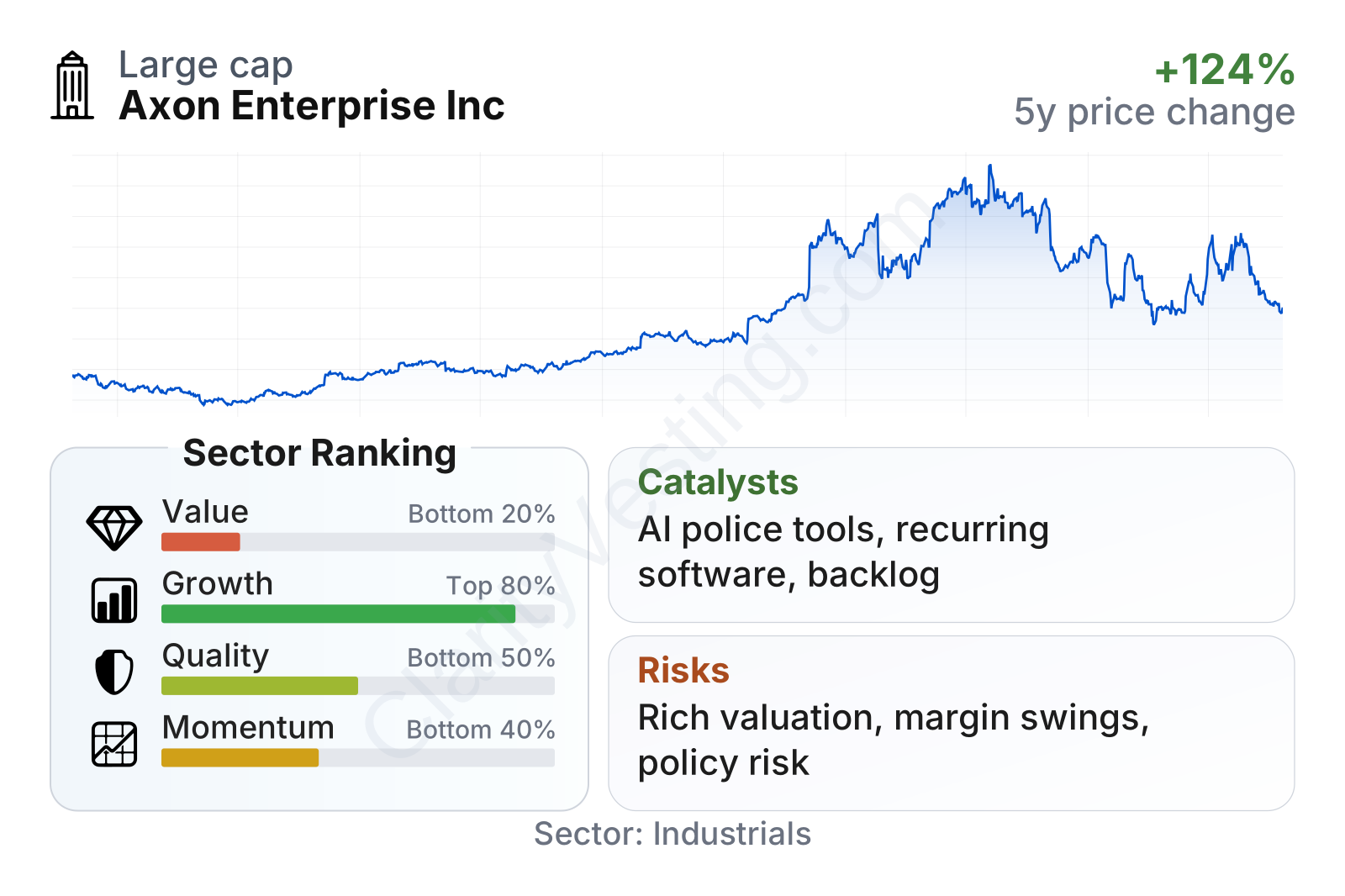
Axon stands out as a large public safety technology company with strong growth characteristics relative to much of the industrial sector. Revenue growth, revenue per share growth, and long-term margin improvement compare well with sector norms. On the other hand, the valuation profile is clearly demanding, with earnings and book value multiples far above sector medians. The quality profile looks decent rather than exceptional: leverage is manageable, but recent profitability and interest coverage are not as strong as the headline growth might suggest. Share price performance over several years has been powerful, although the shorter-term trend has been more volatile.
The stock’s historical movement has been unusually wide. The shares climbed dramatically over the past several years, but they also experienced sharp pullbacks. That pattern is typical of companies priced for substantial future growth: when expectations rise, the stock can rerate quickly, and when growth or margins disappoint, the decline can be just as fast.
Growth
Axon operates in a sector with attractive structural tailwinds. Public safety agencies are still in the middle of a long technology upgrade cycle that includes body-worn cameras, digital evidence storage, records modernization, real-time awareness tools, and less-lethal weapons. These are not short-lived spending themes. They are tied to accountability requirements, officer training, data management needs, and pressure to improve policing outcomes while reducing lethal-force incidents.
The company’s strategy makes sense for long-term expansion because it connects hardware, software, and services into one system. A police department that starts with TASER devices may later add body cameras, then digital evidence management, then records software, then AI-assisted reporting tools. This cross-selling structure can increase customer lifetime value and make the platform harder to replace once deployed across an agency.
Revenue growth has remained remarkably strong and consistent, generally running in the low-30% to high-30% range in recent periods. That is well above the sector median and suggests Axon is still gaining adoption rather than simply benefiting from a one-time demand spike.
One of the strongest catalysts is the company’s push into higher-value software and AI tools. Axon has been investing heavily in products that automate report writing, accelerate evidence review, and improve officer productivity. If these tools gain wide adoption, they could deepen customer dependence on the platform and raise recurring revenue per user.
Another growth support is the company’s expanding product breadth. Beyond TASER and cameras, Axon has built offerings in fleet systems, real-time operations, records management, and drones. That broadens its addressable market within the same customer base. Large agencies often prefer integrated systems, and Axon is positioning itself to be a single-vendor platform for multiple mission-critical workflows.
Recent company updates have also pointed to a substantial contracted backlog and growing annual recurring revenue base. Those indicators matter because they suggest that a meaningful portion of future sales is already supported by signed agreements rather than depending entirely on new procurement wins.
Cash generation has been more uneven than revenue growth. Free cash flow improved sharply through 2025, then dropped significantly on a trailing basis in early 2026. That does not automatically signal a broken model, but it does show that rapid expansion, working capital needs, and investment spending can create short-term swings even when sales remain strong.
Risks
This article is for informational purposes only and does not constitute financial advice. Some content is AI-generated. See Disclaimer


