Stock Analysis · Axogen Inc (AXGN)
Overview
Axogen is a medical device company focused on peripheral nerve repair. In simple terms, it develops and sells products that help surgeons repair damaged nerves outside the brain and spinal cord. These injuries can happen after trauma, tumor removal, breast reconstruction, oral and maxillofacial procedures, and other surgeries where nerve function matters for movement, feeling, or pain reduction.
The company’s business is built around a specialized product portfolio used in surgical nerve repair and protection. Based on company filings, revenue is overwhelmingly generated from product sales, with a smaller contribution from services and other items. The product mix changes over time, but the main commercial categories are:
- Avance Nerve Graft – processed human nerve allograft used to bridge nerve gaps; this is generally the company’s largest revenue driver.
- AxoGuard products – porcine submucosa-based nerve protection products, including nerve connectors, protectors, and wraps.
- AxoGen nerve conduits and related products – devices used to support nerve repair in selected cases.
- Processing and distribution services, education, and other revenue – a much smaller contribution than core product sales.
Recent annual reporting indicates that product revenue represents well above 95% of total revenue, while service and other revenue remains a low-single-digit share but is not consistently broken out in a way that supports a precise current percentage for each product family. What is clear is that Avance remains the central product, and the broader AxoGuard line is the second major pillar of revenue.
The business model is fairly straightforward: Axogen works with surgeons and hospitals, trains clinicians, expands reimbursement coverage, and tries to increase the number of procedures where its products are used. Revenue therefore depends mainly on procedure volume, surgeon adoption, hospital purchasing, and payer support rather than on consumer demand.
The operating picture has improved meaningfully over the last several years. Revenue has advanced from roughly $125 million-$130 million levels in 2021 to more than $225 million in 2025, while gross profit has also risen. The weak point is that operating expenses have stayed high enough to keep earnings below break-even, even though losses narrowed substantially before becoming more pressured again more recently.
Key Figures
| Metric | Value | Sector ⓘ |
|---|---|---|
| Date | Oct 24, 2026 | |
| Context | ||
| Sector | Healthcare | |
| Industry | Medical Devices | |
| Market Cap ⓘ | $2.14B | |
| Beta ⓘ | 1.17 | |
Value (Cheapness) | ||
| P/E Ratio ⓘ | N/A | 25.42 |
| P/B Ratio ⓘ | 7.63 | 3.08 |
| FCF Yield ⓘ | 0.12% | 3.12% |
| Dividend Yield ⓘ | N/A | 1.85% |
| EBIT / EV ⓘ | -0.88% | 0.56% |
| PEG ⓘ | 99.04 | |
Growth (Business expansion) | ||
| Revenue Growth ⓘ | 23.10% | 7.50% |
| RPS Growth (5Y CAGR) ⓘ | 12.16% | 8.60% |
| EPS Growth (5Y CAGR) ⓘ | N/A | -17.73% |
| BVPS Growth (5Y CAGR) ⓘ | 0.61% | 3.72% |
| Margin Growth (5Y Trend) ⓘ | N/A | -0.57% |
| FCF Growth (5Y CAGR) ⓘ | -48.53% | 0.96% |
| DPS Growth (5Y CAGR) ⓘ | N/A | 6.69% |
Quality (Business durability) | ||
| ROIC (Latest) ⓘ | -7.94% | 3.17% |
| ROA (Latest) ⓘ | -12.87% | 2.98% |
| ROIC (5Y Median) ⓘ | -10.19% | 4.56% |
| ROA (5Y Median) ⓘ | -11.07% | 1.87% |
| Net Debt / EBIT (Latest) ⓘ | N/A | 1.34 |
| Net Debt / EBIT (5Y Median) ⓘ | N/A | 1.86 |
| Net Debt / EBITDA (Latest) ⓘ | N/A | 1.00 |
| Net Debt / Assets ⓘ | -24.44% | 5.06% |
| EBITDA / Interest ⓘ | N/A | 9.55 |
| Operating Margin (Latest) ⓘ | -8.59% | 9.25% |
| Operating Margin (5Y Median) ⓘ | -11.87% | 7.33% |
| Debt to Equity (Latest) ⓘ | 7.83% | 26.68% |
| Profit Margin (Latest) ⓘ | -13.36% | 3.34% |
| Free Cash Flow (Latest) ⓘ | $2.53M | |
Momentum (Price trend) | ||
| 3Y Return ⓘ | +842.93% | +51.61% |
| 12M Return (excl. last month) ⓘ | +153.07% | +19.90% |
| 6M Return ⓘ | -0.86% | +10.10% |
| Price vs. 200-Day MA ⓘ | -6.49% | +6.44% |
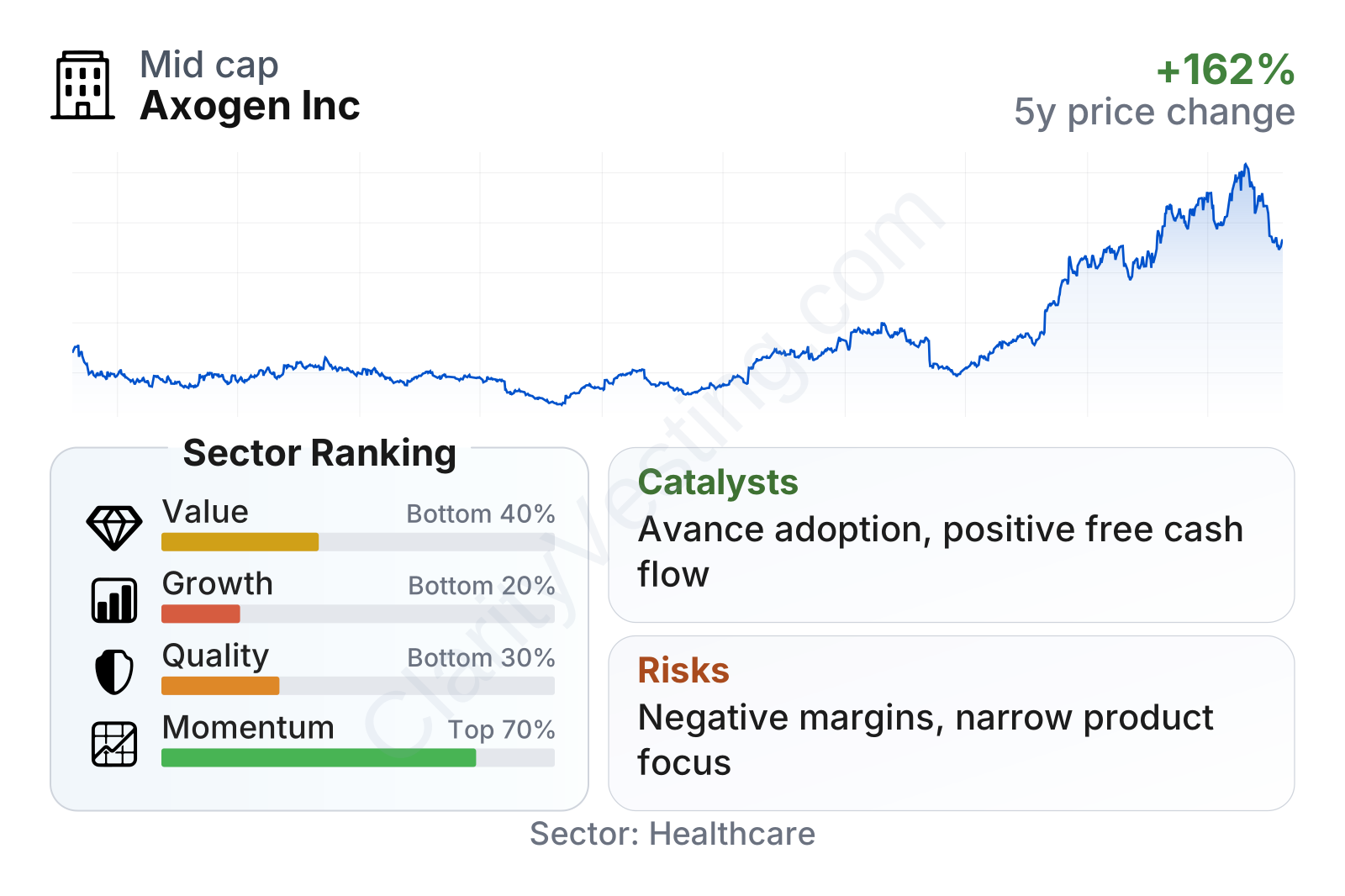
Axogen is now a mid-sized medical device company by market value, with share price momentum that has been much stronger than much of the healthcare sector over the last one to three years. At the same time, the valuation profile is demanding: price-to-book is well above the sector median, free cash flow yield is thin, and current profitability measures remain below industry norms. Growth in revenue has been strong, but quality and valuation metrics still reflect a business that has not yet translated expansion into consistently solid returns.
The stock’s path has also been volatile. After a deep decline through 2022 and 2023, performance turned sharply upward from late 2024 into 2026. That kind of move usually signals that the market has become more confident in the company’s growth outlook, but it also means expectations have risen.
Growth
Axogen operates in a part of healthcare with attractive long-term characteristics. Peripheral nerve injuries are often underdiagnosed or undertreated, and successful repair can improve quality of life in ways that are easy for surgeons and patients to appreciate. This is not a fad-driven market. It is tied to real surgical need, trauma care, reconstruction, and broader awareness that nerve function should be preserved or restored whenever possible.
The company’s strategy is logical for this kind of market. It is not trying to compete across every orthopedic or surgical device category. Instead, it stays focused on a narrow field where surgeon education, clinical evidence, reimbursement, and specialized sales execution can matter a lot. That focus can be powerful if the company keeps expanding procedure adoption and strengthening evidence for its products.
Recent revenue trends have been one of the clearest positives. Year-over-year growth has stayed strong for multiple quarters, and the latest pace remains above 20%, well ahead of the broader healthcare sector median. That suggests the company is still gaining traction rather than simply rebounding from a weak base. Over a five-year period, revenue per share growth has also outpaced the sector median.
Cash generation has improved as well. Free cash flow was deeply negative a few years ago, moved close to break-even, and has recently turned positive. That shift matters because it suggests growth is becoming less dependent on external financing. For a company that is still not producing strong accounting profits, moving into positive cash flow is an important operational milestone.
A notable catalyst is the company’s effort to expand the clinical and reimbursement foundation around its core products, especially Avance. In medical devices, wider use often depends on payer confidence and surgeon comfort as much as product quality. More clinical data, broader reimbursement support, and deeper penetration in breast reconstruction, extremity trauma, and oral-maxillofacial procedures could all increase procedure volume over time.
Another meaningful development is the strengthening balance sheet. Debt levels have dropped sharply relative to equity, giving the company more flexibility to fund commercialization and product development. In a growth-stage medical device business, financial flexibility can be nearly as important as top-line growth.
Risks
This article is for informational purposes only and does not constitute financial advice. Some content is AI-generated. See Disclaimer


