Stock Analysis · American States Water Company (AWR)
Overview
American States Water Company is a regulated utility focused mainly on water service. Through its main subsidiary, Golden State Water Company, it provides water and electric utility service in California. Through American States Utility Services and related subsidiaries, it also runs water and wastewater systems on U.S. military bases under long-term privatization contracts. This makes AWR a utility business with a defensive core, but with an added infrastructure-services component that is different from many pure-play water utilities.
The company’s revenue mix is led by regulated water service, with military base utility operations as the second largest contributor and electric service as the smallest segment. Based on recent annual reporting, the mix is approximately as follows:
- Water utility operations: about 70% to 75% — residential, commercial, industrial, and public-authority water delivery in California, plus related tariff-based charges.
- Contracted services on military bases: about 20% to 25% — operation, maintenance, construction, and renewal of water and wastewater systems under long-duration agreements with the U.S. government.
- Electric utility operations: about 3% to 5% — regulated electric distribution service in California, mainly serving the Bear Valley Electric Service area.
The business model is relatively easy to understand: utilities invest in pipes, treatment, storage, and grid assets, then seek to recover those costs plus an authorized return through rates approved by regulators or through contract structures. That tends to make revenue steadier than in most industries, although growth is usually gradual rather than explosive.
The profit profile has also stayed solid in recent years. Revenue has moved higher overall since 2021, while margins remained strong for a utility. One notable change is that interest expense has risen as borrowing costs and infrastructure needs increased, which is common across the sector.
Key Figures
| Metric | Value | Sector ⓘ |
|---|---|---|
| Date | Oct 04, 2026 | |
| Context | ||
| Sector | Utilities | |
| Industry | Utilities - Regulated Water | |
| Market Cap ⓘ | $3.28B | |
| Beta ⓘ | 0.56 | |
Value (Cheapness) | ||
| P/E Ratio ⓘ | 22.63 | 16.83 |
| P/B Ratio ⓘ | 2.92 | 1.48 |
| FCF Yield ⓘ | 0.63% | 0.63% |
| Dividend Yield ⓘ | 2.48% | 3.91% |
| EBIT / EV ⓘ | 5.02% | 5.01% |
| PEG ⓘ | 2.98 | |
Growth (Business expansion) | ||
| Revenue Growth ⓘ | 11.20% | 6.00% |
| RPS Growth (5Y CAGR) ⓘ | 6.00% | 4.14% |
| EPS Growth (5Y CAGR) ⓘ | -7.72% | -11.39% |
| BVPS Growth (5Y CAGR) ⓘ | 9.90% | 4.29% |
| Margin Growth (5Y Trend) ⓘ | 3.32% | 3.55% |
| FCF Growth (5Y CAGR) ⓘ | -29.64% | -9.10% |
| DPS Growth (5Y CAGR) ⓘ | 8.43% | 4.51% |
Quality (Business durability) | ||
| ROIC (Latest) ⓘ | 8.09% | 6.53% |
| ROA (Latest) ⓘ | 5.27% | 3.19% |
| ROIC (5Y Median) ⓘ | 8.86% | 6.12% |
| ROA (5Y Median) ⓘ | 5.03% | 2.76% |
| Net Debt / EBIT (Latest) ⓘ | 3.69 | 7.15 |
| Net Debt / EBIT (5Y Median) ⓘ | 4.32 | 7.24 |
| Net Debt / EBITDA (Latest) ⓘ | 2.97 | 4.40 |
| Net Debt / Assets ⓘ | 27.99% | 39.16% |
| EBITDA / Interest ⓘ | 5.58 | 4.41 |
| Operating Margin (Latest) ⓘ | 30.21% | 20.93% |
| Operating Margin (5Y Median) ⓘ | 32.91% | 20.18% |
| Debt to Equity (Latest) ⓘ | 71.20% | 140.88% |
| Profit Margin (Latest) ⓘ | 20.52% | 11.32% |
| Free Cash Flow (Latest) ⓘ | $20.75M | |
Momentum (Price trend) | ||
| 3Y Return ⓘ | +16.65% | +49.22% |
| 12M Return (excl. last month) ⓘ | +23.31% | +11.22% |
| 6M Return ⓘ | +8.12% | -4.08% |
| Price vs. 200-Day MA ⓘ | +5.75% | -1.77% |
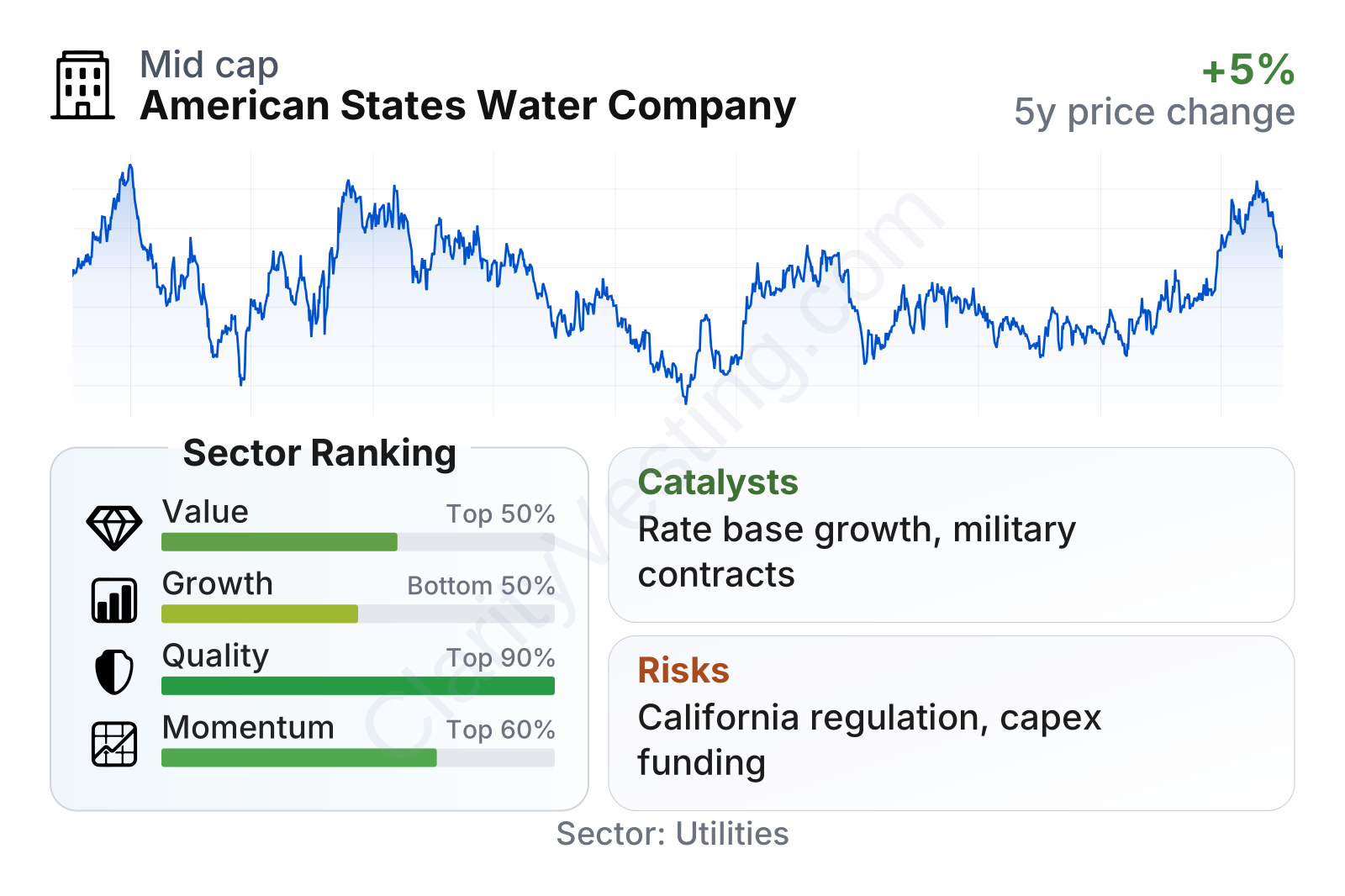
AWR stands out for business quality more than for fast expansion. Profitability, returns on assets, and leverage metrics compare well with much of the utility sector, while growth is more mixed. The stock has also been less volatile than the broader market, with a beta near 0.6, which fits the company’s regulated utility profile. On valuation measures, the shares trade above typical sector multiples, suggesting the market places a premium on stability and execution.
Growth
Water utility service is part of a sector with long-term structural support. Population needs, aging infrastructure, water quality requirements, wildfire resilience, drought management, and stricter environmental rules all push utilities to invest more over time. In regulated businesses, those investments can become future rate base, which is important because rate base growth is often the engine behind earnings growth.
For AWR, the strategy for growth makes sense because it combines two sources of expansion. First, the California utility operations can grow through capital spending that supports future authorized returns. Second, the contracted military-base business can add projects and new construction work under long-duration agreements. That second piece is useful because it brings a federal counterparty and recurring infrastructure activity outside the company’s standard regulated utility footprint.
Revenue per share has moved upward over the past five years, despite some year-to-year variation. That supports the view that growth has been real and not driven only by issuing more shares. Recent year-over-year revenue growth also ran ahead of the sector median, even though the company still ranks in the lower half of the sector on growth overall because cash generation has been uneven and earnings growth has not been consistently strong.
Free cash flow has been a weak point for much of the last several years, which is common when utilities are in a heavier investment phase. More recently, free cash flow has turned positive again, which matters because it can ease financing pressure if sustained. That shift is worth watching closely: a utility can tolerate temporary negative free cash flow during large capital programs, but a lasting improvement would strengthen the broader growth case.
A visible catalyst is the company’s ability to continue winning and executing infrastructure work tied to military-base systems while also moving regulated capital spending into rates in California. In practical terms, growth here is less about sudden disruption and more about steady asset expansion, authorized returns, and disciplined project execution.
Risks
This article is for informational purposes only and does not constitute financial advice. Some content is AI-generated. See Disclaimer