Stock Analysis · Avi Ltd (AVSFY)
Overview
Avi Ltd is an Israeli food company best known for packaged food sold mainly in its home market. The business operates across staples that many households purchase regularly, which places it in the defensive side of consumer goods rather than in highly cyclical categories. Its portfolio spans dairy, spreads, chilled and shelf-stable products, snacks, and other everyday grocery items distributed through supermarkets and retail channels.
Revenue is primarily generated from selling branded food products. Public company materials indicate that activity is concentrated in Israel, with a smaller contribution from international operations. Exact segment percentages are not always disclosed in a simple way for the U.S. OTC line, but the business mix can be summarized as follows:
- Core food products in Israel: the large majority of sales, including dairy, refrigerated foods, spreads, and packaged grocery products sold under local brands.
- Other food and related categories: a smaller share coming from adjacent packaged-food activities and additional branded products.
- International activity: a limited contribution relative to domestic operations, mainly through exports or overseas brand distribution where applicable.
The company’s earnings profile has improved over the last several years. Sales have grown from roughly $13.8 billion in local reporting currency terms in fiscal 2022 to about $15.9 billion in fiscal 2026, while operating income and net income have risen faster than revenue. That pattern suggests the business has recently benefited not only from scale but also from firmer margins, better product mix, or improved operating discipline. Gross profit has expanded meaningfully over that period, and selling and administrative costs have not grown as quickly as profit, which is a positive sign for a mature food manufacturer.
The financial flow also points to a business that has become more efficient. Revenue has been broadly stable lately, but operating profit and net income continued to edge up, implying better cost control and stronger profitability per dollar of sales rather than growth driven only by volume.
Key Figures
| Metric | Value | Sector ⓘ |
|---|---|---|
| Date | Oct 17, 2026 | |
| Context | ||
| Sector | Consumer Defensive | |
| Industry | Packaged Foods | |
| Market Cap ⓘ | $1.65B | |
| Beta ⓘ | 0.20 | |
Value (Cheapness) | ||
| P/E Ratio ⓘ | 12.75 | 17.88 |
| P/B Ratio ⓘ | 0.28 | 1.29 |
| FCF Yield ⓘ | 316.30% | 12.39% |
| Dividend Yield ⓘ | 6.72% | 2.85% |
| EBIT / EV ⓘ | N/A | 6.43% |
| PEG ⓘ | N/A | |
Growth (Business expansion) | ||
| Revenue Growth ⓘ | -2.60% | 4.10% |
| RPS Growth (5Y CAGR) ⓘ | 3.07% | 6.18% |
| EPS Growth (5Y CAGR) ⓘ | 46.06% | -13.59% |
| BVPS Growth (5Y CAGR) ⓘ | 4.96% | 3.20% |
| Margin Growth (5Y Trend) ⓘ | 5.06% | -0.15% |
| FCF Growth (5Y CAGR) ⓘ | 11.60% | 4.10% |
| DPS Growth (5Y CAGR) ⓘ | 9.37% | 6.79% |
Quality (Business durability) | ||
| ROIC (Latest) ⓘ | N/A | 12.34% |
| ROA (Latest) ⓘ | 47.84% | 6.30% |
| ROIC (5Y Median) ⓘ | 39.46% | 10.49% |
| ROA (5Y Median) ⓘ | 22.01% | 5.44% |
| Net Debt / EBIT (Latest) ⓘ | N/A | 1.96 |
| Net Debt / EBIT (5Y Median) ⓘ | 0.63 | 2.35 |
| Net Debt / EBITDA (Latest) ⓘ | 0.20 | 1.38 |
| Net Debt / Assets ⓘ | 16.04% | 21.51% |
| EBITDA / Interest ⓘ | 19.10 | 9.46 |
| Operating Margin (Latest) ⓘ | N/A | 8.87% |
| Operating Margin (5Y Median) ⓘ | 20.78% | 9.53% |
| Debt to Equity (Latest) ⓘ | 31.95% | 72.35% |
| Profit Margin (Latest) ⓘ | 15.78% | 5.40% |
| Free Cash Flow (Latest) ⓘ | $5.22B | |
Momentum (Price trend) | ||
| 3Y Return ⓘ | +50.52% | +20.92% |
| 12M Return (excl. last month) ⓘ | +3.05% | +2.13% |
| 6M Return ⓘ | 0.00% | +1.26% |
| Price vs. 200-Day MA ⓘ | +1.08% | +1.39% |
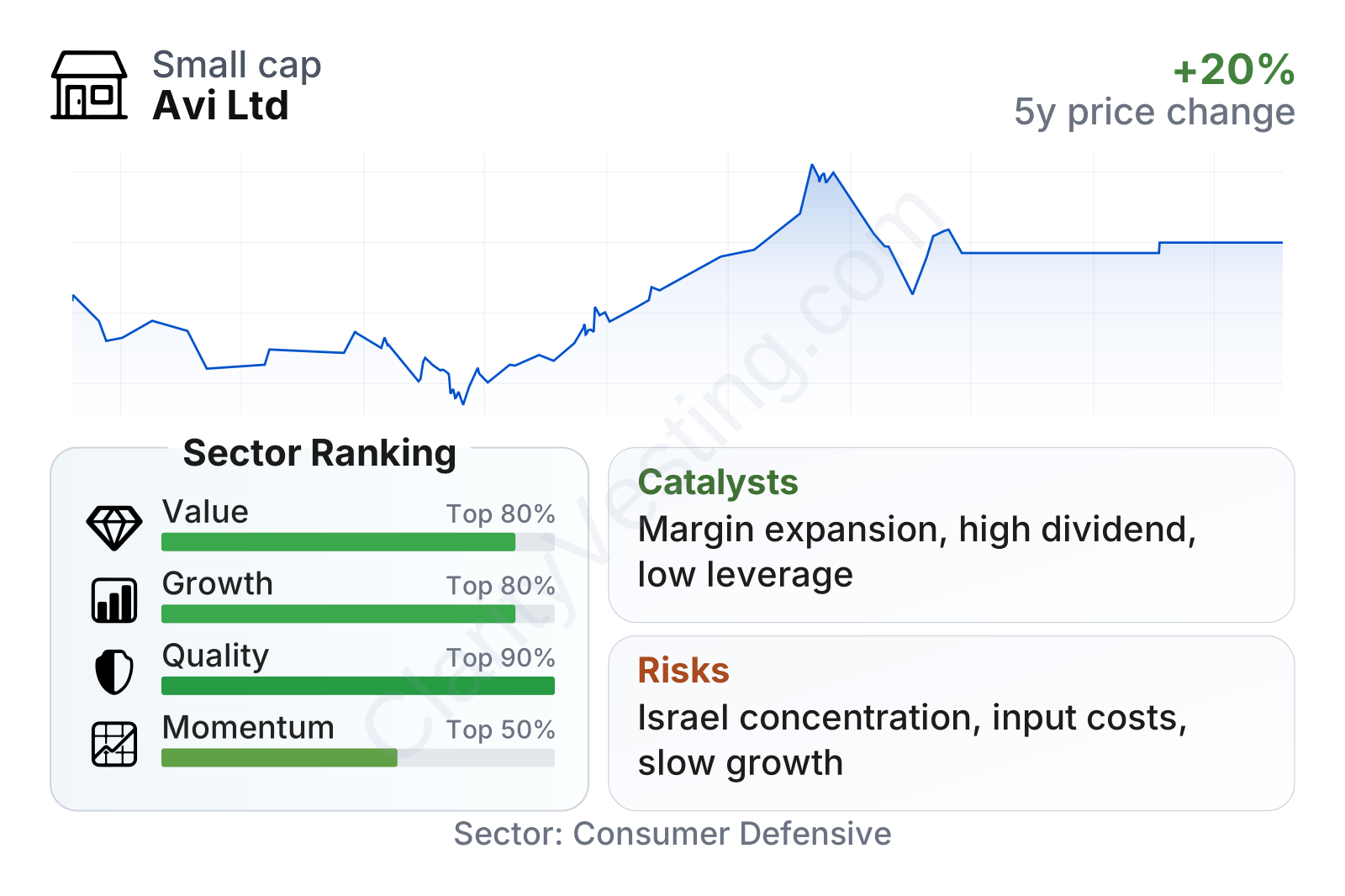
Avi is a mid-sized packaged-food company by market value, with unusually low share-price volatility for a public stock. On valuation measures, it screens cheaper than many peers in consumer staples, with a price-to-earnings ratio around 12 versus a sector median closer to 18, and a price-to-book ratio that is far below the sector norm. Cash generation also stands out: free-cash-flow yield is well above the sector median, and the dividend yield is around 6.7%, notably above the broader packaged-food peer group.
Quality metrics are particularly strong. Profit margin is around 15.8%, well ahead of the sector median near 5.4%, while leverage remains modest. Net debt relative to earnings is low, interest coverage is solid, and long-term returns on assets and invested capital are strong for a food business. Growth measures are more mixed: recent year-over-year revenue dipped about 2.6%, and five-year revenue-per-share growth trails the sector median, but earnings, free cash flow, and dividends have compounded at a healthy pace over five years. In short, the figures describe a company that looks more like a cash-generative and efficient staple producer than a rapid top-line grower.
Growth
Packaged food is usually not a high-growth industry, but it is a resilient one. Demand tends to hold up even when economic conditions weaken, because consumers continue buying basic food products. For a long-term view, that makes growth less dependent on macro optimism and more dependent on pricing power, brand strength, product mix, and execution. Avi appears to fit that pattern well: recent performance shows that while sales growth has moderated, profitability has kept improving.
The company’s strategy makes sense for this kind of sector. In mature food categories, long-term progress often comes from protecting shelf space, managing input costs, refreshing product ranges, and defending brand relevance rather than expanding at technology-sector rates. Avi’s margin expansion over the last several years suggests it has been reasonably successful on those fronts. The business also benefits from recurring consumption, which can support steadier cash flow and dividend capacity.
A notable catalyst is the combination of stable revenue and rising earnings. When a food company can expand profits while sales are roughly flat, it may indicate pricing discipline, manufacturing efficiency, or a more favorable product mix. Another positive factor is the balance sheet: relatively low leverage gives the company more flexibility to absorb volatility in commodity costs, pursue selective investment, or maintain shareholder distributions without excessive financial strain.
There is also a market-position catalyst tied to defensiveness. In periods when investors favor predictable businesses, packaged-food producers with steady cash generation and above-average dividends can attract attention. Avi’s recent operating trend, low beta, and improving earnings profile place it in that conversation, even if it does not offer dramatic top-line expansion.
Risks
This article is for informational purposes only and does not constitute financial advice. Some content is AI-generated. See Disclaimer


