Stock Analysis · Mission Produce Inc (AVO)
Overview
Mission Produce is a produce company best known for avocados. It sources, packs, ripens, markets, and distributes fruit to retailers, wholesalers, and foodservice customers in North America, Europe, and other international markets. The company also owns and operates farming assets, which gives it some control over supply in a business that is usually exposed to sharp swings in crop availability and pricing.
The business is centered on avocados, with a smaller but expanding blueberry operation. Based on recent annual filings, revenue is heavily concentrated in avocados, while blueberries remain a much smaller contributor.
- Avocados: approximately 95% to 97% of revenue. This includes sourcing fruit from growers, company-owned farms, ripening, packing, and distribution to supermarket and foodservice customers.
- Blueberries: approximately 3% to 5% of revenue. This segment is tied mainly to the company’s farming operations in Peru and is still small relative to the core avocado business.
Geographically, Mission Produce sells broadly, but the United States remains the main end market. The company’s model is not just about moving produce from farms to stores; it also includes value-added services such as ripening and logistics, which can help deepen relationships with major retail customers.
One notable financial pattern in recent years is that revenue has climbed meaningfully from 2021 through 2025, but profitability has been much more volatile. That reflects how produce distributors can see strong sales growth while still dealing with unstable margins due to fruit costs, harvest conditions, freight, and pricing shifts.
The longer-term picture shows a business that has expanded its sales base, with gross profit recovering strongly after the difficult 2022-2023 period. Even so, the company still operates in a low-margin category where small changes in cost or pricing can have an outsized effect on earnings.
Key Figures
| Metric | Value | Sector ⓘ |
|---|---|---|
| Date | Oct 17, 2026 | |
| Context | ||
| Sector | Consumer Defensive | |
| Industry | Food Distribution | |
| Market Cap ⓘ | $1.01B | |
| Beta ⓘ | 0.43 | |
Value (Cheapness) | ||
| P/E Ratio ⓘ | 385.33 | 17.88 |
| P/B Ratio ⓘ | 1.34 | 1.29 |
| FCF Yield ⓘ | -0.23% | 12.39% |
| Dividend Yield ⓘ | N/A | 2.85% |
| EBIT / EV ⓘ | 1.65% | 6.43% |
| PEG ⓘ | N/A | |
Growth (Business expansion) | ||
| Revenue Growth ⓘ | 25.80% | 4.10% |
| RPS Growth (5Y CAGR) ⓘ | 11.66% | 6.18% |
| EPS Growth (5Y CAGR) ⓘ | N/A | -13.59% |
| BVPS Growth (5Y CAGR) ⓘ | 0.85% | 3.20% |
| Margin Growth (5Y Trend) ⓘ | -2.69% | -0.15% |
| FCF Growth (5Y CAGR) ⓘ | N/A | 4.10% |
| DPS Growth (5Y CAGR) ⓘ | -63.47% | 6.79% |
Quality (Business durability) | ||
| ROIC (Latest) ⓘ | 1.54% | 12.34% |
| ROA (Latest) ⓘ | 0.12% | 6.30% |
| ROIC (5Y Median) ⓘ | 6.89% | 10.49% |
| ROA (5Y Median) ⓘ | 3.86% | 5.44% |
| Net Debt / EBIT (Latest) ⓘ | 18.07 | 1.96 |
| Net Debt / EBIT (5Y Median) ⓘ | 2.05 | 2.35 |
| Net Debt / EBITDA (Latest) ⓘ | 7.00 | 1.38 |
| Net Debt / Assets ⓘ | 29.34% | 21.51% |
| EBITDA / Interest ⓘ | 6.13 | 9.46 |
| Operating Margin (Latest) ⓘ | 1.95% | 8.87% |
| Operating Margin (5Y Median) ⓘ | 5.13% | 9.53% |
| Debt to Equity (Latest) ⓘ | 67.88% | 72.35% |
| Profit Margin (Latest) ⓘ | 0.12% | 5.40% |
| Free Cash Flow (Latest) ⓘ | -$2.30M | |
Momentum (Price trend) | ||
| 3Y Return ⓘ | +30.79% | +20.92% |
| 12M Return (excl. last month) ⓘ | +2.12% | +2.13% |
| 6M Return ⓘ | -19.77% | +1.26% |
| Price vs. 200-Day MA ⓘ | -8.43% | +1.39% |
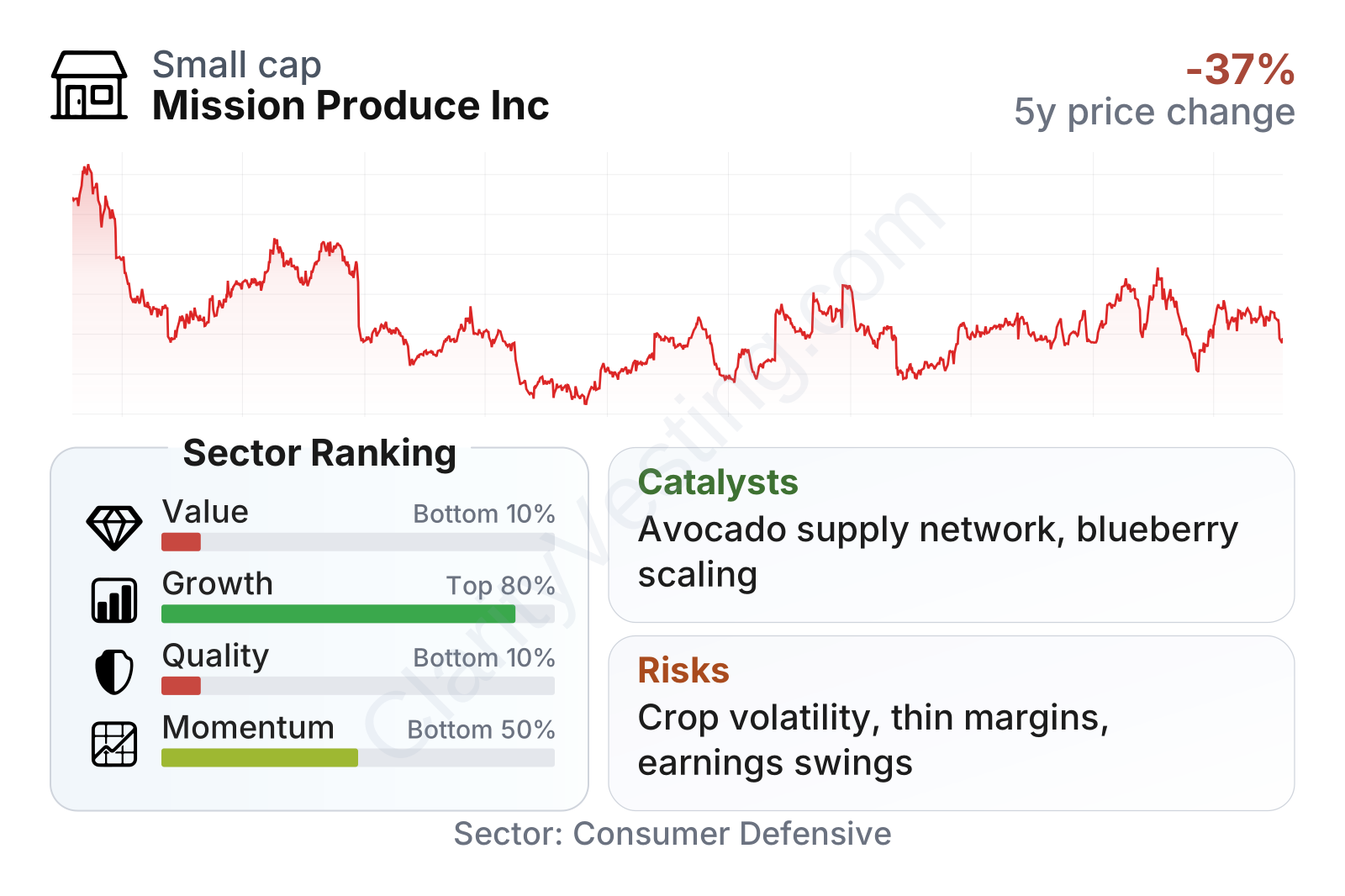
Mission Produce is a small-cap consumer staples company with relatively low share-price volatility, as reflected by a beta below 1. On growth, it stands above much of its sector, with recent year-over-year revenue expansion well ahead of the median and a solid multi-year increase in revenue per share. The weak spot is profitability and capital efficiency: returns on assets and invested capital are far below typical sector levels, and free cash flow has recently turned slightly negative. Valuation screens also look demanding because earnings are very thin, which makes the price-to-earnings ratio appear unusually high and less useful than usual on its own.
Growth
Mission Produce operates in a category with favorable long-term demand characteristics. Avocados have benefited for years from rising household penetration, broader use in foodservice, and consumer interest in fresh and convenient foods. Blueberries also fit the same broader trend toward fresh produce consumption. This does not guarantee smooth expansion, but it does mean the company is exposed to product categories that have structural demand support rather than declining consumption patterns.
The company’s strategy is logical for that environment. It combines global sourcing with owned farming, ripening infrastructure, and distribution capabilities. That approach can matter because avocado supply is seasonal and geographically diverse. By building a network across Mexico, Peru, Guatemala, Colombia, and other producing regions, Mission Produce can try to keep product flowing more consistently than a simpler trading model would allow.
Recent revenue growth has been uneven quarter to quarter, which is normal in produce, but the broader pattern has still shown the ability to rebound sharply after weaker periods. The latest annual sales level is far above where it stood a few years ago, even though individual quarters have swung between contraction and strong double-digit growth. That variability says more about the agricultural nature of the business than about demand disappearing.
Cash generation has also been mixed. Mission Produce has shown it can produce healthy free cash flow in stronger periods, but that has not been steady enough yet to describe as firmly established. For a company in expansion mode, the key question is whether higher scale and supply-chain investments will translate into more consistent cash conversion over time.
A practical catalyst is the company’s ability to keep increasing avocado availability through its sourcing network and owned farms while growing value-added services for large customers. Another potential driver is the blueberry platform in Peru, which is still small today but could become a more meaningful second leg if volumes and execution improve. Recent company updates have also emphasized supply conditions and seasonal transitions, both of which can create periods of stronger pricing and volume when harvest timing is favorable.
Risks
This article is for informational purposes only and does not constitute financial advice. Some content is AI-generated. See Disclaimer


