Stock Analysis · Avalyn Pharma Inc (AVLN)
Overview
Avalyn Pharma is a clinical-stage biotechnology company focused on treatments for serious lung disease. Its lead programs are built around inhaled formulations designed to deliver medicine directly into the lungs, with the goal of improving local drug exposure while limiting side effects elsewhere in the body. The company’s main focus is pulmonary fibrosis, including idiopathic pulmonary fibrosis and progressive fibrosing interstitial lung diseases, areas with high unmet medical need and limited treatment options.
At this stage, Avalyn does not yet operate like a commercial pharmaceutical company. It is still developing its product candidates and has not reported product sales. That means the business is currently centered on research, clinical trials, regulatory preparation, and funding its pipeline rather than generating recurring revenue from marketed drugs.
The company’s revenue sources are therefore very limited at the moment.
- Product revenue: 0% based on the latest full-year figures available, because Avalyn has no approved commercial product.
- Collaboration, licensing, or other operating revenue: no meaningful recurring contribution disclosed in the latest annual figures.
- Non-operating income: small amounts may come from interest earned on cash and investments, but this is not the core business and does not represent commercial traction.
In practical terms, Avalyn is a pipeline company: its economic value depends mainly on whether its drug candidates can advance through clinical development and eventually reach approval and commercialization.
The operating profile reflects that stage clearly. There was still no revenue in 2025, while operating expenses rose sharply year over year. Research and development represented the large majority of spending, which is typical for a biotech company pushing lead programs deeper into clinical trials. Administrative costs also increased, but far less than R&D, showing that most of the cash burn is tied to development rather than a broad commercial overhead structure.
Key Figures
| Metric | Value | Sector ⓘ |
|---|---|---|
| Date | Oct 03, 2026 | |
| Context | ||
| Sector | Healthcare | |
| Industry | Biotechnology | |
| Market Cap ⓘ | $1.26B | |
| Beta ⓘ | N/A | |
Value (Cheapness) | ||
| P/E Ratio ⓘ | N/A | 24.06 |
| P/B Ratio ⓘ | 3.05 | 3.08 |
| FCF Yield ⓘ | -7.64% | 3.07% |
| Dividend Yield ⓘ | N/A | 2.05% |
| EBIT / EV ⓘ | -9.75% | 0.63% |
| PEG ⓘ | N/A | |
Growth (Business expansion) | ||
| Revenue Growth ⓘ | N/A | 7.50% |
| RPS Growth (5Y CAGR) ⓘ | N/A | 8.70% |
| EPS Growth (5Y CAGR) ⓘ | N/A | -18.20% |
| BVPS Growth (5Y CAGR) ⓘ | N/A | 3.95% |
| Margin Growth (5Y Trend) ⓘ | N/A | -0.58% |
| FCF Growth (5Y CAGR) ⓘ | N/A | 0.88% |
| DPS Growth (5Y CAGR) ⓘ | N/A | 6.80% |
Quality (Business durability) | ||
| ROIC (Latest) ⓘ | N/A | 3.29% |
| ROA (Latest) ⓘ | N/A | 3.02% |
| ROIC (5Y Median) ⓘ | N/A | 4.75% |
| ROA (5Y Median) ⓘ | N/A | 1.93% |
| Net Debt / EBIT (Latest) ⓘ | N/A | 1.33 |
| Net Debt / EBIT (5Y Median) ⓘ | N/A | 1.83 |
| Net Debt / EBITDA (Latest) ⓘ | N/A | 0.99 |
| Net Debt / Assets ⓘ | -58.08% | 5.33% |
| EBITDA / Interest ⓘ | N/A | 9.63 |
| Operating Margin (Latest) ⓘ | N/A | 9.25% |
| Operating Margin (5Y Median) ⓘ | N/A | 7.80% |
| Debt to Equity (Latest) ⓘ | 4.30% | 28.99% |
| Profit Margin (Latest) ⓘ | N/A | 3.60% |
| Free Cash Flow (Latest) ⓘ | -$96.53M | |
Momentum (Price trend) | ||
| 3Y Return ⓘ | N/A | +37.48% |
| 12M Return (excl. last month) ⓘ | N/A | +20.85% |
| 6M Return ⓘ | N/A | +9.73% |
| Price vs. 200-Day MA ⓘ | N/A | +4.69% |
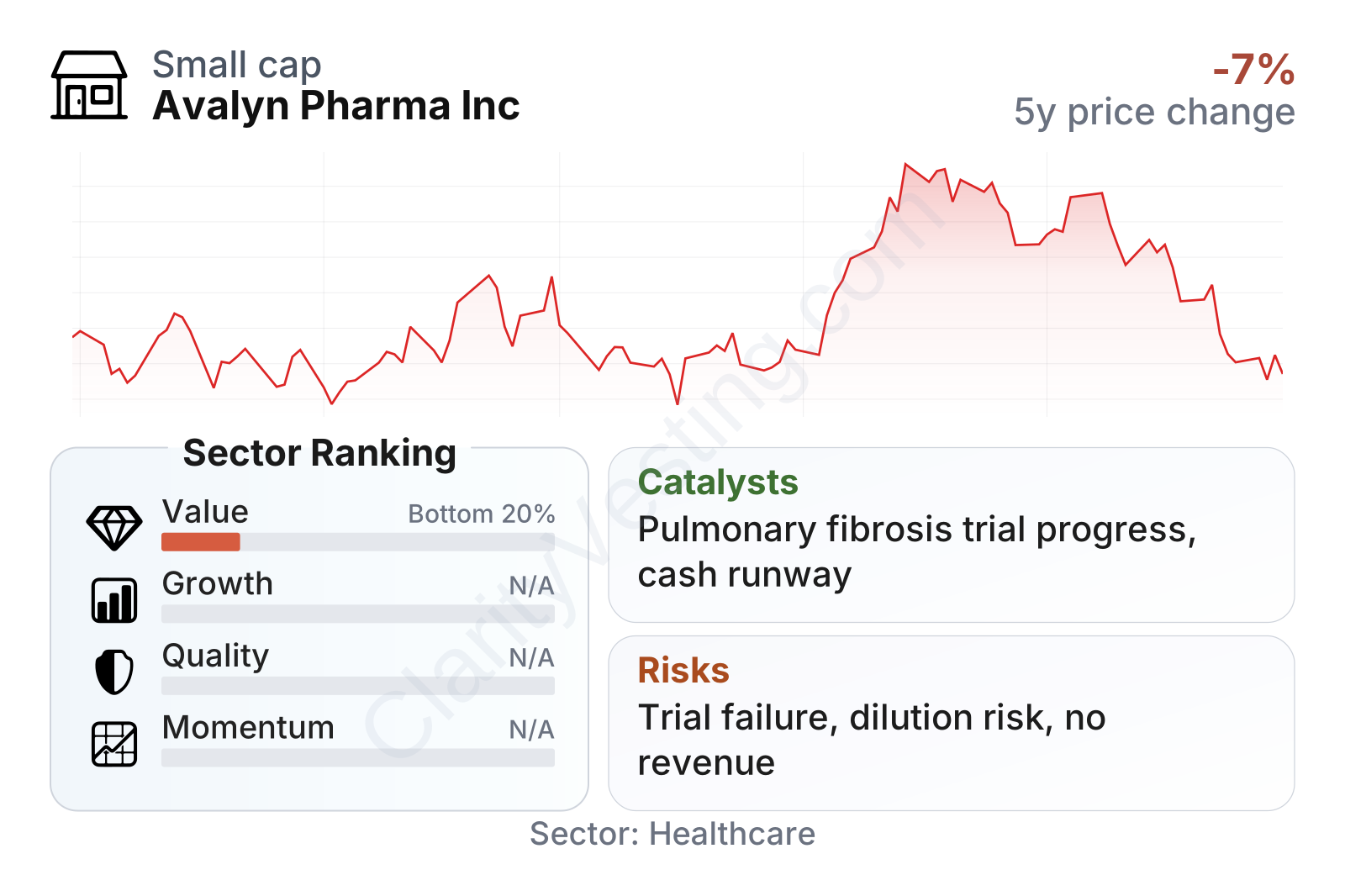
The market capitalization places Avalyn in the small-cap biotech range, where outcomes can be heavily influenced by clinical milestones. The valuation profile ranks in the weaker part of the healthcare sector, but that is largely because traditional valuation tools such as earnings, free cash flow, and EBIT are not very useful for a company with no product revenue and ongoing losses. Price-to-book sits close to the sector median, suggesting the market is valuing the company more on its balance sheet and development potential than on current business output.
Financial quality metrics also need to be read with caution. Profitability is absent, free cash flow remains deeply negative, and operating margins are far below sector norms because the company is still in the investment phase. On the more reassuring side, leverage appears low, debt-to-equity is modest, and net debt is negative relative to assets, which indicates that cash holdings exceed debt. For a clinical-stage biotech, that balance sheet flexibility matters more than earnings multiples.
The recent stock-price movement shown here looks fairly stable over the last few months rather than strongly trending. For a company like Avalyn, market sentiment can shift much more from trial updates or financing news than from quarter-to-quarter operating changes.
Growth
Avalyn operates in a segment with meaningful long-term demand drivers. Fibrotic lung disease remains an area of significant medical need, supported by aging populations, better diagnosis, and continued interest in therapies that may improve tolerability or convenience compared with existing standard treatments. That does not guarantee success, but it does mean the company is targeting a market where a differentiated product could attract attention from physicians, larger drugmakers, and regulators.
The strategy is coherent. Instead of trying to invent an entirely new disease category, Avalyn is working on inhaled approaches for conditions where treatment already matters clinically, but current options leave room for improvement. If inhaled delivery can preserve efficacy while reducing systemic side effects, that would be a meaningful differentiator. This is especially relevant in pulmonary fibrosis, where tolerability can limit long-term use of available therapies.
The strongest catalyst is clinical execution. For Avalyn, future growth is not tied to gradual sales expansion; it is tied to trial results, regulatory interactions, and the possibility of moving its lead candidate into later-stage development. Positive data could improve the company’s strategic position quickly because small biotech valuations often re-rate around proof-of-concept and pivotal-stage milestones.
Recent company communications in 2026 have continued to emphasize advancement of its inhaled pulmonary fibrosis programs and cash resources to support planned development activities. That combination matters: progress without funding is fragile, while funding without clinical momentum does not create much value. Avalyn’s opportunity rests on keeping both aligned over the next several quarters.
Risks
This article is for informational purposes only and does not constitute financial advice. Some content is AI-generated. See Disclaimer