Stock Analysis · AviChina Industry & Technology Co Ltd (AVIJF)
Overview
AviChina Industry & Technology Co. Ltd. is a Chinese aerospace and defense manufacturer focused on aviation equipment. The company operates within the AVIC group ecosystem and is mainly involved in helicopters, trainer aircraft, general aviation aircraft, avionics, aviation parts, and engineering services tied to aircraft manufacturing. In simple terms, AviChina sits in the middle of China’s domestic aerospace supply chain: it helps design, build, equip, and support aircraft and related systems used in defense and civil markets.
Its revenue base is diversified across several aviation activities, although aircraft-related manufacturing and aviation supply chain businesses dominate. Based on the company’s annual reporting structure and subsidiary mix, the main sources of revenue are approximately the following:
- Aviation whole aircraft: roughly 35% to 45% of revenue. This includes helicopters, trainer aircraft, and other complete aircraft platforms produced through key subsidiaries.
- Aviation ancillary systems and parts: roughly 30% to 40%. This includes avionics, connectors, electrical systems, components, and other onboard equipment sold into aircraft programs.
- Engineering and aviation-related services: roughly 10% to 20%. This usually includes manufacturing support, system integration, and technical services.
- Other businesses: generally below 10%. This can include non-core industrial activities and smaller commercial lines.
The company’s scale is meaningful but not huge by global aerospace standards. Revenue has risen materially over the last several years, moving from about CNY 60 billion in 2021 to about CNY 87 billion in 2025. At the same time, the business mix appears to require heavy production spending and sustained research and development, which is typical for aerospace suppliers.
A notable feature of the business is its strong commitment to development spending. Research and development has remained very large in absolute terms, reaching several billion yuan annually. That suggests AviChina is not simply harvesting mature programs; it is still investing to support aircraft upgrades, new platforms, and subsystem competitiveness.
The broad financial flow shows a company that has expanded revenue over time, but with uneven profitability. Gross profit improved from 2021 through 2024 before softening in 2025, while operating income and net income became more volatile. Research and development remains a major use of cash, which supports long-term capability but also helps explain why cash generation has recently been under pressure.
Key Figures
| Metric | Value | Sector ⓘ |
|---|---|---|
| Date | Oct 24, 2026 | |
| Context | ||
| Sector | Industrials | |
| Industry | Aerospace & Defense | |
| Market Cap ⓘ | $2.95B | |
| Beta ⓘ | 0.70 | |
Value (Cheapness) | ||
| P/E Ratio ⓘ | 12.33 | 22.29 |
| P/B Ratio ⓘ | 0.08 | 1.98 |
| FCF Yield ⓘ | -591.32% | 6.26% |
| Dividend Yield ⓘ | 18.11% | 1.92% |
| EBIT / EV ⓘ | N/A | 4.83% |
| PEG ⓘ | N/A | |
Growth (Business expansion) | ||
| Revenue Growth ⓘ | 0.90% | 9.30% |
| RPS Growth (5Y CAGR) ⓘ | 8.71% | 7.76% |
| EPS Growth (5Y CAGR) ⓘ | 32.45% | -13.17% |
| BVPS Growth (5Y CAGR) ⓘ | 5.91% | 6.13% |
| Margin Growth (5Y Trend) ⓘ | -3.04% | 0.74% |
| FCF Growth (5Y CAGR) ⓘ | N/A | 10.79% |
| DPS Growth (5Y CAGR) ⓘ | -22.24% | 9.41% |
Quality (Business durability) | ||
| ROIC (Latest) ⓘ | N/A | 10.75% |
| ROA (Latest) ⓘ | 1.52% | 5.41% |
| ROIC (5Y Median) ⓘ | 13.18% | 9.37% |
| ROA (5Y Median) ⓘ | 1.48% | 4.95% |
| Net Debt / EBIT (Latest) ⓘ | -0.36 | 2.04 |
| Net Debt / EBIT (5Y Median) ⓘ | -1.53 | 2.27 |
| Net Debt / EBITDA (Latest) ⓘ | -0.21 | 1.39 |
| Net Debt / Assets ⓘ | -1.45% | 19.27% |
| EBITDA / Interest ⓘ | N/A | 9.58 |
| Operating Margin (Latest) ⓘ | 5.79% | 10.49% |
| Operating Margin (5Y Median) ⓘ | 8.13% | 10.30% |
| Debt to Equity (Latest) ⓘ | 80.74% | 64.82% |
| Profit Margin (Latest) ⓘ | 1.74% | 6.67% |
| Free Cash Flow (Latest) ⓘ | -$17.44B | |
Momentum (Price trend) | ||
| 3Y Return ⓘ | -19.51% | +67.77% |
| 12M Return (excl. last month) ⓘ | -27.24% | +12.05% |
| 6M Return ⓘ | -19.91% | 0.00% |
| Price vs. 200-Day MA ⓘ | -11.60% | +0.67% |
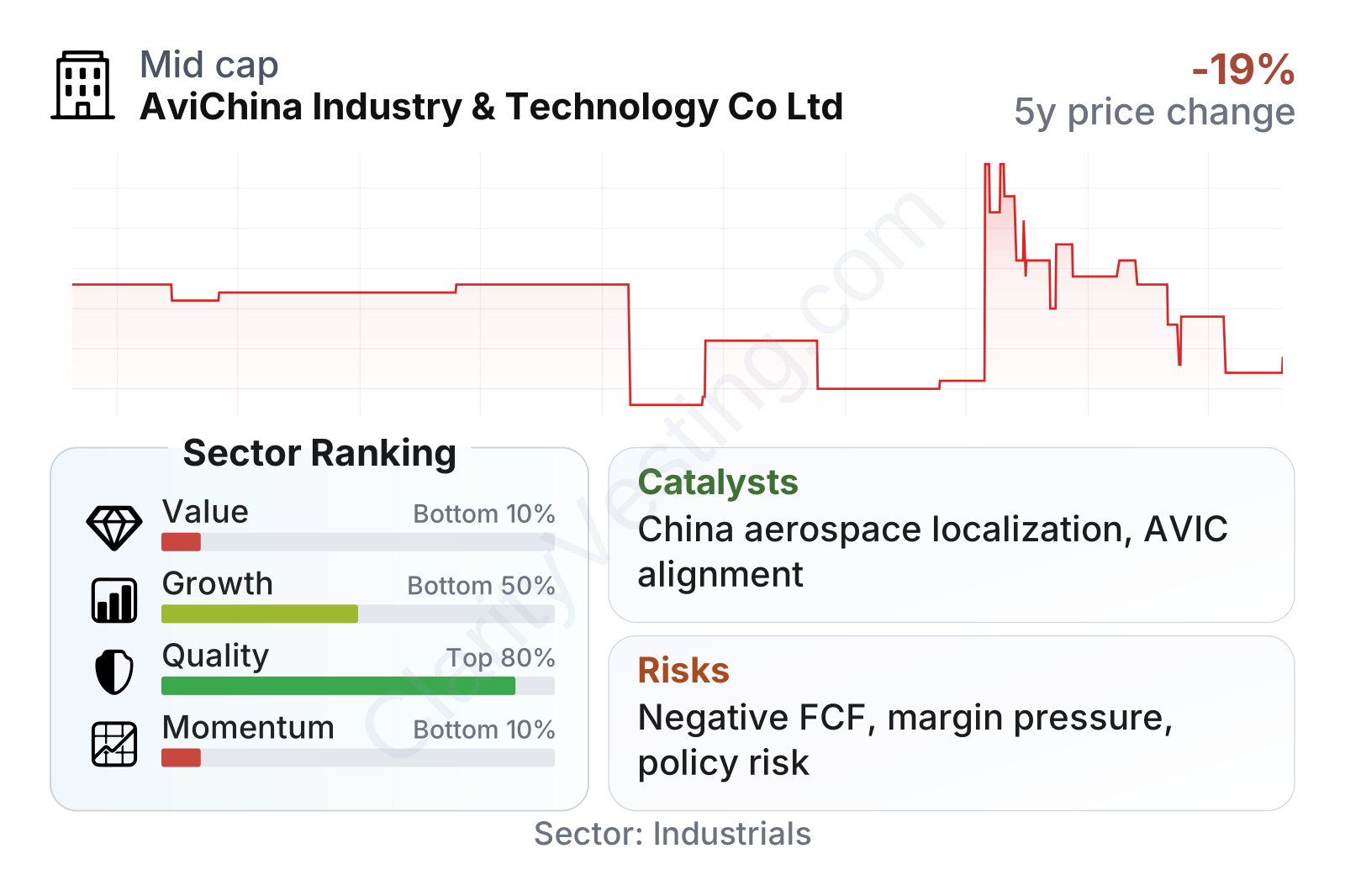
AviChina’s profile is mixed. It screens as inexpensive on earnings and book value versus much of the aerospace and defense sector, and it also carries a relatively low beta, which points to lower share-price sensitivity than the average stock. On the other hand, recent free cash flow is negative, profitability is modest, and recent share-price momentum has been weak. The table also shows a contrast between short-term softness and stronger longer-term earnings growth, with five-year EPS growth standing out more positively than the latest yearly revenue trend.
Another important point is balance-sheet quality. Despite pressure on margins and cash flow, net debt metrics remain favorable, with the company appearing to hold more cash than debt on some measures. That helps offset part of the operational pressure visible elsewhere.
Growth
AviChina operates in a sector with long-duration structural support. China continues to build domestic aerospace capabilities across military aviation, helicopters, trainer aircraft, and aviation systems. This matters because aerospace programs are not short-cycle consumer products; they often run for many years, creating room for recurring production, maintenance demand, and follow-on upgrades.
The company’s strategy broadly makes sense for that environment. It is positioned across both complete aircraft and high-value subsystems, which gives it multiple ways to participate in sector growth. Being embedded in China’s aviation manufacturing system can be a meaningful advantage because it aligns the company with domestic procurement, industrial policy, and localization efforts in strategic technologies.
One of the clearest growth supports is the continued push for Chinese self-sufficiency in aerospace and defense manufacturing. In a world of export controls and supply-chain friction, domestic sourcing becomes more valuable. For AviChina, that can translate into more content per aircraft, more development work, and a stronger role in future programs.
Another catalyst is the underlying demand for helicopters and training aircraft. Helicopters serve defense, emergency response, transport, and civil utility markets, while trainer aircraft are linked to pilot training capacity. As fleets expand or modernize, demand does not only come from the initial aircraft sale; it also extends to onboard systems, replacement parts, upgrades, and technical support.
Recent corporate developments have also kept attention on portfolio positioning inside the broader AVIC network. Changes in asset structure, subsidiary alignment, or internal consolidation can create opportunities to sharpen business focus, improve industrial coordination, or concentrate more value inside listed entities. Even when these moves do not change revenue immediately, they can matter for long-term efficiency and strategic relevance.
Risks
This article is for informational purposes only and does not constitute financial advice. Some content is AI-generated. See Disclaimer


