Stock Analysis · AeroVironment Inc (AVAV)
Overview
AeroVironment is a U.S. aerospace and defense company focused on uncrewed systems and related technologies. In simple terms, it designs products that let military and government users see farther, strike targets without putting pilots at risk, and operate more effectively with connected sensors, software, and autonomy tools. The company is best known for small tactical drones and loitering munition systems such as Switchblade, but its business has become broader through acquisitions and expansion into larger uncrewed aircraft, ground systems, and autonomous solutions.
Its revenue is largely tied to defense and government spending, especially U.S. programs and allied military demand. Based on the company’s recent reporting structure following its expanded portfolio, revenue is mainly generated from the following activities:
- Loitering munition systems and tactical missile-related products: a major revenue driver, including Switchblade systems and related support, training, and accessories. This category has been one of the most visible growth engines as battlefield demand for low-cost precision systems has increased.
- Uncrewed aircraft systems: small and medium drones used for reconnaissance, surveillance, targeting, and operational support. This includes hand-launched and tactical aircraft sold with ground control stations, spare parts, and services.
- Autonomy, sensors, and software-enabled solutions: technologies that improve navigation, mission control, situational awareness, and integration of robotic platforms. This area became more important as AeroVironment broadened its product base beyond airframes alone.
- Services and support: training, sustainment, engineering support, and other follow-on work tied to deployed systems.
The exact mix can shift sharply from year to year because defense contracts are often lumpy, but the broad picture is clear: AeroVironment is increasingly a defense robotics and precision systems company rather than only a small-drone manufacturer.
The business has also changed in scale very quickly. Revenue rose from roughly $446 million in fiscal 2022 to about $1.98 billion in fiscal 2026, showing how much the company has expanded. At the same time, the latest year also shows that rapid scaling and acquisition-related integration came with much heavier costs, especially in cost of goods and operating expenses.
The long-term pattern is impressive on the top line, but the latest year also shows a less favorable split between sales and profitability. Revenue jumped sharply, while operating costs and production costs grew even faster, pushing the company into a loss despite its much larger size.
Key Figures
| Metric | Value | Sector ⓘ |
|---|---|---|
| Date | Oct 24, 2026 | |
| Context | ||
| Sector | Industrials | |
| Industry | Aerospace & Defense | |
| Market Cap ⓘ | $5.98B | |
| Beta ⓘ | 1.36 | |
Value (Cheapness) | ||
| P/E Ratio ⓘ | N/A | 22.29 |
| P/B Ratio ⓘ | 1.33 | 1.98 |
| FCF Yield ⓘ | 0.04% | 6.26% |
| Dividend Yield ⓘ | N/A | 1.92% |
| EBIT / EV ⓘ | -3.04% | 4.83% |
| PEG ⓘ | 1.57 | |
Growth (Business expansion) | ||
| Revenue Growth ⓘ | 5.70% | 9.30% |
| RPS Growth (5Y CAGR) ⓘ | 22.21% | 7.76% |
| EPS Growth (5Y CAGR) ⓘ | -13.68% | -13.17% |
| BVPS Growth (5Y CAGR) ⓘ | 38.14% | 6.13% |
| Margin Growth (5Y Trend) ⓘ | -1.55% | 0.74% |
| FCF Growth (5Y CAGR) ⓘ | N/A | 10.79% |
| DPS Growth (5Y CAGR) ⓘ | N/A | 9.41% |
Quality (Business durability) | ||
| ROIC (Latest) ⓘ | -3.81% | 10.75% |
| ROA (Latest) ⓘ | -3.57% | 5.41% |
| ROIC (5Y Median) ⓘ | 1.26% | 9.37% |
| ROA (5Y Median) ⓘ | -0.45% | 4.95% |
| Net Debt / EBIT (Latest) ⓘ | N/A | 2.04 |
| Net Debt / EBIT (5Y Median) ⓘ | 0.37 | 2.27 |
| Net Debt / EBITDA (Latest) ⓘ | 26.37 | 1.39 |
| Net Debt / Assets ⓘ | 9.99% | 19.27% |
| EBITDA / Interest ⓘ | N/A | 9.58 |
| Operating Margin (Latest) ⓘ | -12.43% | 10.49% |
| Operating Margin (5Y Median) ⓘ | 2.21% | 10.30% |
| Debt to Equity (Latest) ⓘ | 19.35% | 64.82% |
| Profit Margin (Latest) ⓘ | -10.13% | 6.67% |
| Free Cash Flow (Latest) ⓘ | $2.19M | |
Momentum (Price trend) | ||
| 3Y Return ⓘ | +0.55% | +67.77% |
| 12M Return (excl. last month) ⓘ | -42.24% | +12.05% |
| 6M Return ⓘ | -44.06% | 0.00% |
| Price vs. 200-Day MA ⓘ | -39.22% | +0.67% |
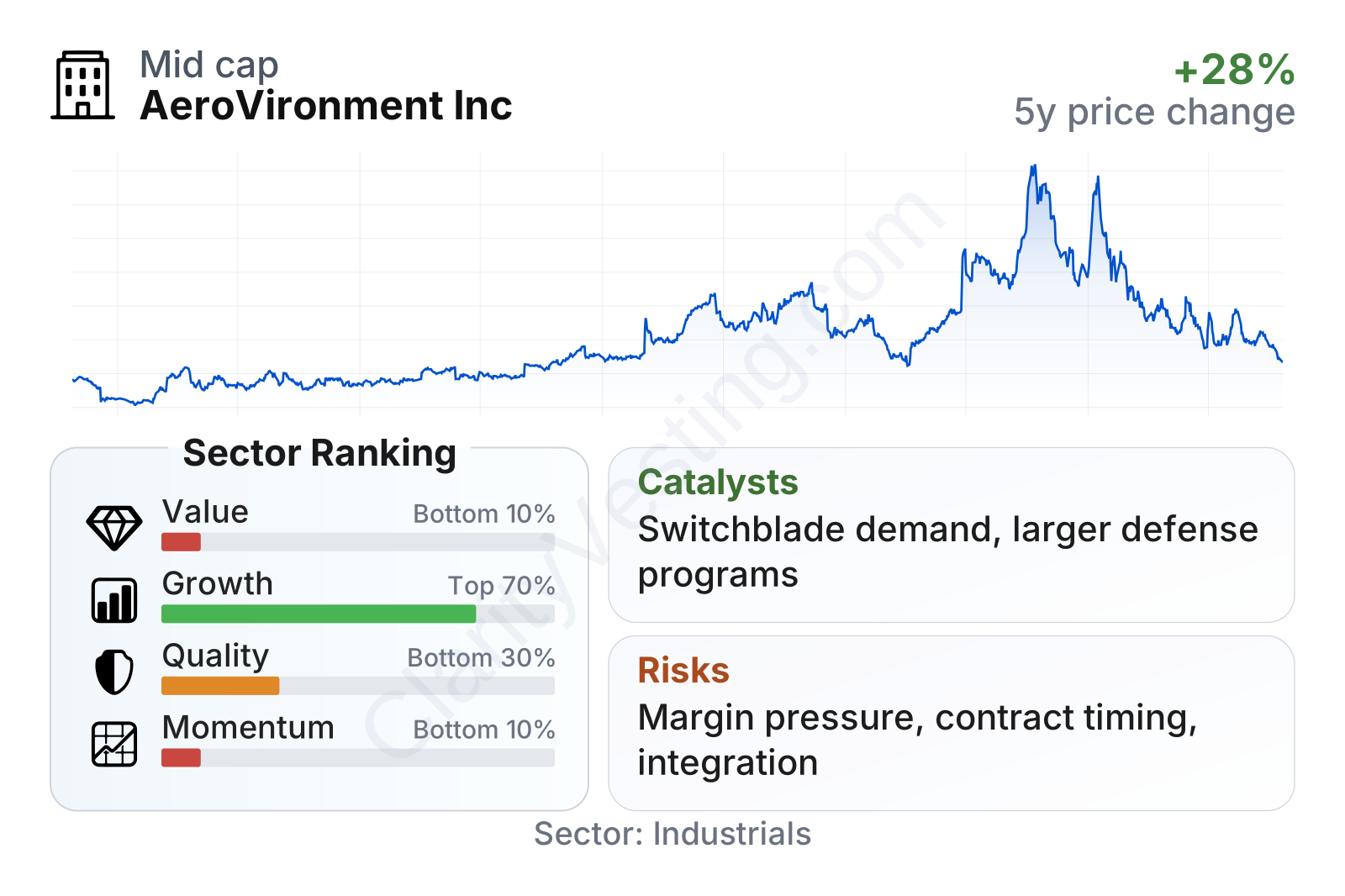
AeroVironment is now a mid-sized defense technology company by market value, but its profile is unusual. Growth has been strong over several years, balance-sheet leverage remains low, and book value has expanded quickly. On the other hand, profitability, free cash flow generation, and recent share-price momentum currently look weaker than the typical company in its sector. The table reflects that contrast: solid long-term expansion and conservative debt levels, but weak recent returns on capital and margins.
Growth
AeroVironment operates in a part of defense that is benefiting from a structural shift rather than a short-lived trend. Militaries increasingly want lower-cost, more flexible, and more expendable systems that can be deployed quickly in contested environments. Small drones, loitering munitions, autonomous reconnaissance tools, and robotic systems have become more important in modern conflict, and that supports long-term demand for the company’s core products.
The company’s strategy also makes industrial sense. Instead of relying on a narrow niche, AeroVironment has been building a broader autonomous systems platform. That can make it more relevant to defense buyers that prefer integrated solutions combining aircraft, munitions, software, sensors, command-and-control tools, and support. A wider portfolio can also improve its ability to compete for larger programs, not just one-off equipment orders.
Revenue growth has been highly uneven from quarter to quarter, which is common in defense contracting, but the bigger trend is strong expansion. Several periods showed very high year-over-year growth, and the latest annual revenue level is far above where the business stood only a few years ago. That said, the most recent quarterly reading cooled materially, which suggests that extraordinary growth rates are unlikely to remain smooth from one period to the next.
Cash generation is a more cautious part of the picture. Free cash flow has moved between modestly positive and clearly negative levels over the last few years, including a deeply negative period recently before improving again. For a company in expansion mode, that does not automatically invalidate the growth case, but it does show that revenue growth has not yet translated into consistently strong cash conversion.
A major catalyst has been the global defense environment. Continued demand from the U.S. Department of Defense and allied nations for tactical drones and loitering munitions supports a favorable backdrop. The company has also highlighted large opportunities tied to newer product families and integration across its expanded portfolio. In practical terms, the strongest opportunities appear to be continued replenishment demand for expendable systems, follow-on orders from existing defense customers, and the possibility that autonomous systems take a larger share of future military procurement budgets.
Recent company communications also indicate that AeroVironment is positioning itself to address larger and more complex defense missions than it could in the past. If that transition works operationally, it could lift average contract size and make revenue less dependent on a small number of flagship products.
Risks
This article is for informational purposes only and does not constitute financial advice. Some content is AI-generated. See Disclaimer