Stock Analysis · Aveanna Healthcare Holdings Inc (AVAH)
Overview
Aveanna Healthcare Holdings is a U.S. healthcare services company focused on care delivered outside the hospital. Its main activities are private duty nursing for medically complex children and adults, home health and hospice visits, and medical solutions such as enteral nutrition and medical supplies. The company operates in a part of healthcare that is closely tied to long-term patient needs, physician referrals, payer relationships, and state and federal reimbursement programs.
The business is built around recurring care needs rather than one-time procedures. That gives Aveanna a relatively steady demand base, especially in pediatric patients who may need nursing support over long periods. The company has also been working to improve branch productivity, clinician retention, referral conversion, and reimbursement mix, which matters because labor availability and payer rates are major drivers of profitability in home-based care.
Based on the company’s recent annual reporting structure, revenue is mainly generated from three segments:
- Private Duty Services: approximately 65% to 70% of revenue. This includes in-home nursing services, largely for medically fragile children, as well as adult private duty nursing in certain markets.
- Home Health & Hospice: approximately 20% to 25% of revenue. This covers home health episodes, nursing and therapy visits, and end-of-life hospice care.
- Medical Solutions: approximately 10% to 15% of revenue. This includes nutritional support, medical supplies, and related services delivered to patients at home.
The revenue mix is important because Private Duty Services is the strategic core of the company. It is also an area where scale, recruiting infrastructure, local licenses, and payer relationships can create barriers for smaller rivals.
The long-term earnings pattern shows a meaningful turnaround. Revenue has climbed steadily over the last several years, while operating income moved from losses to a solid profit by 2024 and improved further in 2025. Gross profit has also expanded faster than overhead, suggesting that pricing, mix, and branch execution have been improving.
Key Figures
| Metric | Value | Sector ⓘ |
|---|---|---|
| Date | Oct 24, 2026 | |
| Context | ||
| Sector | Healthcare | |
| Industry | Medical Care Facilities | |
| Market Cap ⓘ | $2.84B | |
| Beta ⓘ | 1.95 | |
Value (Cheapness) | ||
| P/E Ratio ⓘ | 10.31 | 25.42 |
| P/B Ratio ⓘ | 10.43 | 3.08 |
| FCF Yield ⓘ | 5.85% | 3.12% |
| Dividend Yield ⓘ | N/A | 1.85% |
| EBIT / EV ⓘ | 6.64% | 0.56% |
| PEG ⓘ | N/A | |
Growth (Business expansion) | ||
| Revenue Growth ⓘ | 13.70% | 7.50% |
| RPS Growth (5Y CAGR) ⓘ | 5.64% | 8.60% |
| EPS Growth (5Y CAGR) ⓘ | 165.76% | -17.73% |
| BVPS Growth (5Y CAGR) ⓘ | -28.46% | 3.72% |
| Margin Growth (5Y Trend) ⓘ | 13.49% | -0.57% |
| FCF Growth (5Y CAGR) ⓘ | N/A | 0.96% |
| DPS Growth (5Y CAGR) ⓘ | N/A | 6.69% |
Quality (Business durability) | ||
| ROIC (Latest) ⓘ | 31.53% | 3.17% |
| ROA (Latest) ⓘ | 14.03% | 2.98% |
| ROIC (5Y Median) ⓘ | -3.88% | 4.56% |
| ROA (5Y Median) ⓘ | -5.60% | 1.87% |
| Net Debt / EBIT (Latest) ⓘ | 5.05 | 1.34 |
| Net Debt / EBIT (5Y Median) ⓘ | 9.08 | 1.86 |
| Net Debt / EBITDA (Latest) ⓘ | 4.57 | 1.00 |
| Net Debt / Assets ⓘ | 66.85% | 5.06% |
| EBITDA / Interest ⓘ | 2.47 | 9.55 |
| Operating Margin (Latest) ⓘ | 10.71% | 9.25% |
| Operating Margin (5Y Median) ⓘ | 0.48% | 7.33% |
| Debt to Equity (Latest) ⓘ | 523.99% | 26.68% |
| Profit Margin (Latest) ⓘ | 10.56% | 3.34% |
| Free Cash Flow (Latest) ⓘ | $165.83M | |
Momentum (Price trend) | ||
| 3Y Return ⓘ | +965.60% | +51.61% |
| 12M Return (excl. last month) ⓘ | +57.38% | +19.90% |
| 6M Return ⓘ | +105.87% | +10.10% |
| Price vs. 200-Day MA ⓘ | +46.35% | +6.44% |
Aveanna is now a mid-sized healthcare provider with unusually strong recent improvement in growth, profitability, and share price momentum relative to much of the healthcare sector. The table points to a mixed profile: valuation based on earnings and cash flow looks moderate, and recent operating performance looks strong, but the balance sheet remains stretched. That combination often describes a company in the middle of a recovery rather than a fully settled mature business.
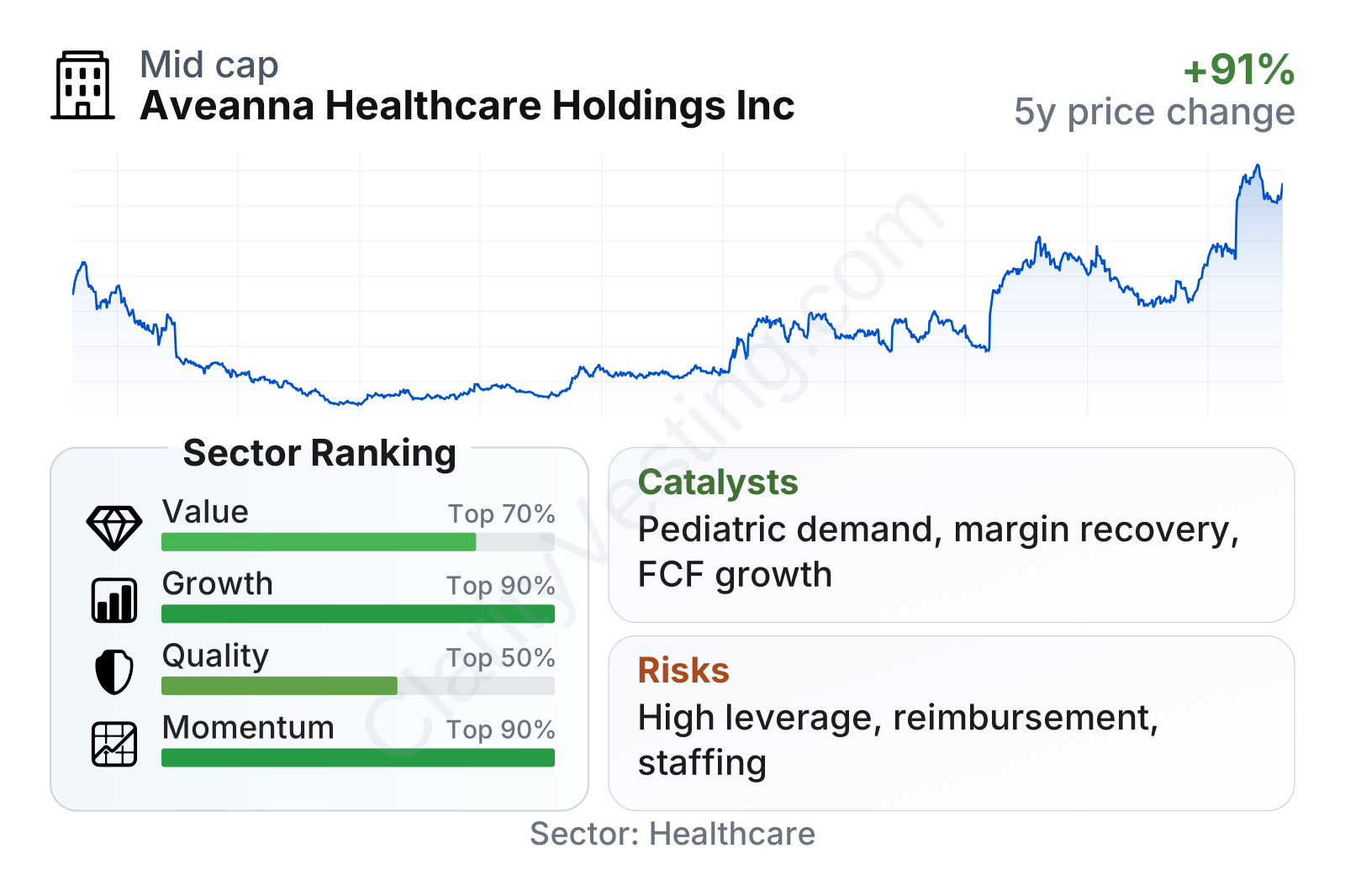
The stock history also reflects that recovery pattern. Shares collapsed after 2021, then rebounded sharply as the company returned to positive earnings and stronger cash generation. That kind of move can signal real business progress, but it also shows that market expectations for the company can change very quickly.
Growth
Home-based care is supported by favorable long-term industry conditions. The U.S. population is aging, healthcare systems continue pushing lower-cost treatment settings, and many families prefer care at home when possible. Pediatric complex care is also a specialized niche where demand can remain resilient because the need is medical rather than discretionary. These trends create a durable backdrop for companies that can recruit clinicians and keep authorization and reimbursement flowing.
Aveanna’s strategy appears coherent for that environment. The company has been emphasizing its core higher-acuity home care operations, payer discipline, clinician hiring and retention, and operating efficiency. In simple terms, it is trying to grow the parts of the business where it has stronger local positions and better economics, while making sure each branch can convert demand into staffed patient hours. That matters more than headline demand alone, because in home care the key bottleneck is often labor supply, not patient need.
Recent revenue growth has clearly accelerated. After several years of mostly mid-single-digit to high-single-digit expansion, growth moved into the low-to-mid teens in the most recent periods, well above the healthcare sector median. That suggests the company is not just benefiting from industry demand, but also from better execution, reimbursement support, and capacity utilization.
Cash generation has also improved materially. Free cash flow moved from negative territory to a clearly positive level over the past year, which is one of the most important developments for a company with meaningful debt. For a long-term business assessment, this is more important than a short-term share price move because sustained free cash flow can support debt reduction, technology investment, and operational flexibility.
A notable catalyst is the company’s continued progress in turning revenue growth into margin expansion. Another is the policy backdrop: home- and community-based care remains attractive to payers because it is typically less expensive than institutional care. If Aveanna continues to win authorizations, fill nursing hours, and improve reimbursement capture, the business could keep gaining operating leverage. Recent company updates have also highlighted demand strength in pediatric services and ongoing efforts to improve staffing, both of which are directly linked to future growth capacity.
Risks
This article is for informational purposes only and does not constitute financial advice. Some content is AI-generated. See Disclaimer


