Stock Analysis · Avista Corporation (AVA)
Overview
Avista Corporation is a regulated electric and natural gas utility serving customers mainly in the Pacific Northwest and parts of Alaska. Its core business is straightforward: it delivers electricity and natural gas to homes, businesses, and industrial users, and it earns most of its profit through rates approved by state regulators. That makes Avista a relatively predictable business compared with cyclical industries, although growth is usually moderate rather than fast.
The company operates primarily through Avista Utilities, which is the main earnings engine, while a smaller share comes from other energy-related and legacy operations. Based on recent company reporting, the revenue mix is heavily tilted toward utility operations, with electricity representing the largest source, followed by natural gas. A practical breakdown is:
- Electric utility revenue: about 60% to 70% — retail and wholesale electricity sales, transmission-related activity, and regulated electric service.
- Natural gas utility revenue: about 25% to 35% — regulated natural gas distribution to residential, commercial, and industrial customers.
- Other businesses: under 10% — smaller non-core and legacy activities, including other energy-related operations that are not the main driver of valuation.
What matters most for long-term analysis is that Avista is not trying to build a broad national platform. It is a regional utility with an established service territory, and its economics depend largely on customer growth, infrastructure investment, regulatory outcomes, and its ability to recover costs through approved rates.
Over the last several years, revenue has generally trended higher, and operating income has improved more clearly than sales, which suggests that rate recovery and operating execution have helped offset inflation and financing pressure. Net income has also moved upward, although the business remains capital-intensive.
The business has expanded revenue and operating profit since 2021, but cash generation has been more uneven because utilities spend heavily on grid upgrades, generation, and system maintenance before those investments are fully reflected in future rates.
Key Figures
| Metric | Value | Sector ⓘ |
|---|---|---|
| Date | Oct 17, 2026 | |
| Context | ||
| Sector | Utilities | |
| Industry | Utilities - Diversified | |
| Market Cap ⓘ | $3.03B | |
| Beta ⓘ | 0.21 | |
Value (Cheapness) | ||
| P/E Ratio ⓘ | 12.94 | 17.28 |
| P/B Ratio ⓘ | 1.08 | 1.51 |
| FCF Yield ⓘ | -3.43% | 0.65% |
| Dividend Yield ⓘ | 5.49% | 3.77% |
| EBIT / EV ⓘ | 6.00% | 5.01% |
| PEG ⓘ | 2.27 | |
Growth (Business expansion) | ||
| Revenue Growth ⓘ | 0.50% | 6.10% |
| RPS Growth (5Y CAGR) ⓘ | 4.23% | 3.87% |
| EPS Growth (5Y CAGR) ⓘ | -12.59% | -11.30% |
| BVPS Growth (5Y CAGR) ⓘ | 2.11% | 4.23% |
| Margin Growth (5Y Trend) ⓘ | 2.82% | 3.57% |
| FCF Growth (5Y CAGR) ⓘ | -12.54% | -8.84% |
| DPS Growth (5Y CAGR) ⓘ | 3.85% | 4.84% |
Quality (Business durability) | ||
| ROIC (Latest) ⓘ | N/A | 6.53% |
| ROA (Latest) ⓘ | 2.72% | 3.20% |
| ROIC (5Y Median) ⓘ | 5.64% | 5.95% |
| ROA (5Y Median) ⓘ | 2.26% | 2.75% |
| Net Debt / EBIT (Latest) ⓘ | 8.64 | 7.13 |
| Net Debt / EBIT (5Y Median) ⓘ | 10.82 | 7.23 |
| Net Debt / EBITDA (Latest) ⓘ | 4.95 | 4.31 |
| Net Debt / Assets ⓘ | 38.25% | 38.42% |
| EBITDA / Interest ⓘ | 4.34 | 4.58 |
| Operating Margin (Latest) ⓘ | 19.70% | 20.83% |
| Operating Margin (5Y Median) ⓘ | 15.83% | 20.08% |
| Debt to Equity (Latest) ⓘ | 116.63% | 137.69% |
| Profit Margin (Latest) ⓘ | 11.83% | 11.37% |
| Free Cash Flow (Latest) ⓘ | -$104.00M | |
Momentum (Price trend) | ||
| 3Y Return ⓘ | +29.81% | +52.37% |
| 12M Return (excl. last month) ⓘ | +5.70% | +8.84% |
| 6M Return ⓘ | -10.20% | -3.95% |
| Price vs. 200-Day MA ⓘ | -6.62% | -0.79% |
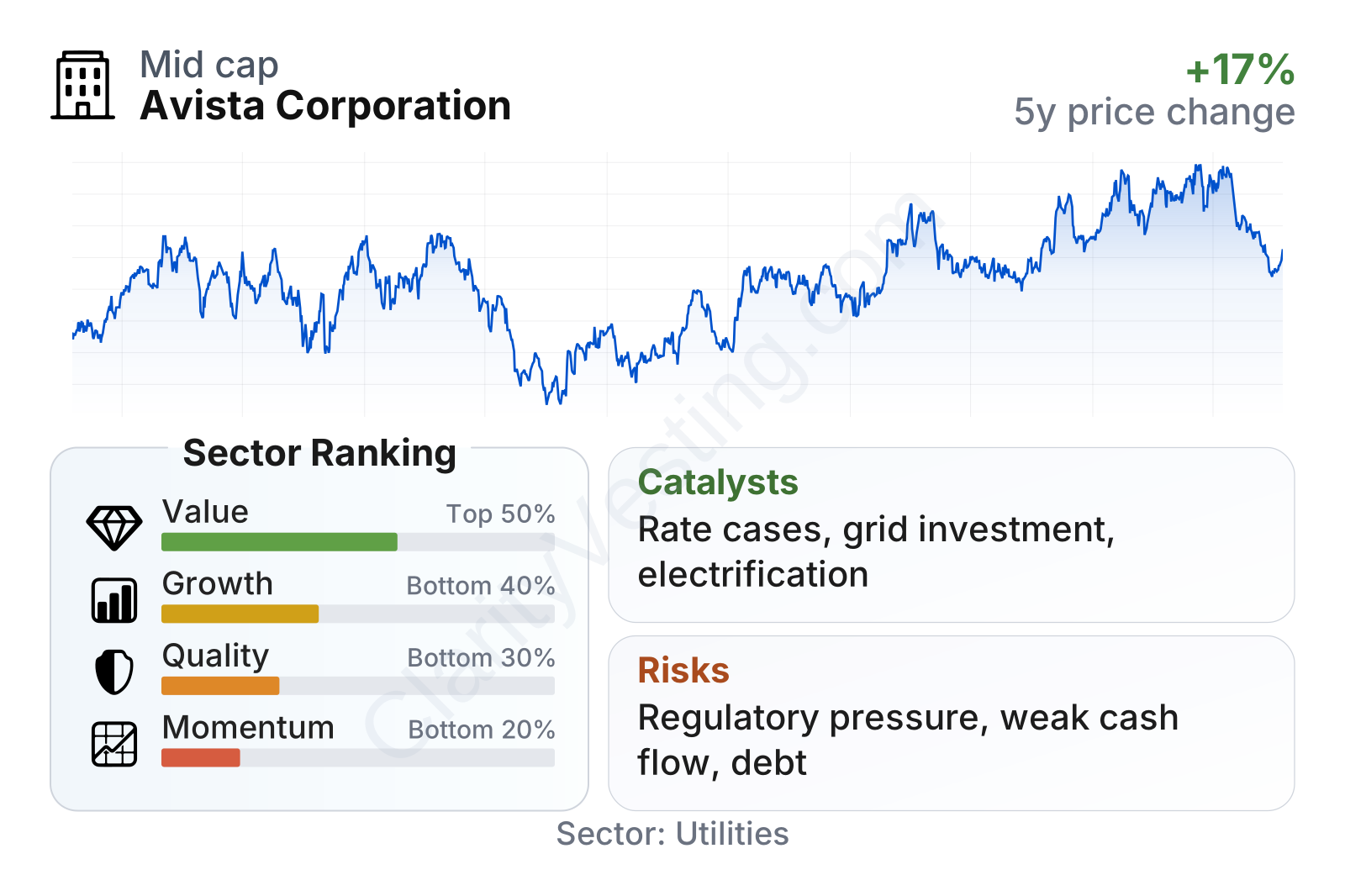
Avista is a mid-sized utility with a low-beta profile, which is common for defensive businesses that provide essential services. On valuation, it screens below the sector median on both earnings and book value multiples, while its dividend yield stands above the sector median. That combination makes the shares look inexpensive relative to many utilities, but the lower price also reflects weaker growth, softer quality metrics, and recent share price underperformance.
Growth and momentum rank in the lower part of the sector. Revenue growth has been limited recently, long-term earnings growth has been challenged, and free cash flow remains inconsistent. Profitability is acceptable for a regulated utility, but debt-related measures and returns on assets are not standout strengths. In short, the table points to a stable but not especially dynamic company: income-oriented characteristics are visible, while operating quality and growth remain more average to below average within the utility group.
Growth
The utility sector is not a high-growth area in the way software or semiconductors can be, but it benefits from durable demand. Electricity and gas distribution remain essential services, and the long-term backdrop is supported by population trends, grid modernization, resilience spending, wildfire prevention work, and the broader electrification of homes, transport, and parts of industry. For a company like Avista, growth usually comes less from market share gains and more from expanding the regulated asset base and securing authorized returns on that investment.
That is why Avista’s strategy matters. The company continues to invest in transmission, distribution, reliability, and generation resources. For regulated utilities, this spending can become a future earnings driver if regulators allow recovery through customer rates. In that sense, the business model is built around patient capital deployment rather than rapid volume expansion.
Revenue per share has trended upward over the past five years, although the path has not been perfectly smooth. That pattern fits a utility that is growing through gradual rate increases and infrastructure investment rather than through aggressive customer expansion. It is a constructive sign, but not one that changes the basic reality that Avista remains a slower-growing company.
A useful near- to medium-term catalyst is the company’s ability to convert its capital plan into approved rate increases and steadier earnings. Another is continued demand for grid upgrades and cleaner, more resilient energy systems in its service territory. If electricity demand rises from data centers, electrification, or regional economic activity, regulated utilities can benefit over time through higher system usage and more investment opportunities.
Free cash flow has been volatile and recently negative again, which is common in periods of elevated capital spending. For Avista, that makes the next phase important: long-term growth depends not just on building assets, but on earning regulated returns on them efficiently enough to improve cash generation after the spending cycle.
Risks
This article is for informational purposes only and does not constitute financial advice. Some content is AI-generated. See Disclaimer


