Stock Analysis · AutoStore Holdings Ltd (AUTSF)
Overview
AutoStore Holdings is a warehouse automation company best known for its cube-based storage and retrieval system. Its technology helps retailers, grocery operators, industrial distributors, and logistics providers store goods in dense grids and use robots to pick and move bins. In simple terms, AutoStore sells a system that allows warehouses to fit more inventory into less space and process orders with less manual work.
The company mainly earns money from selling complete automated warehouse systems and from related software and services. Based on company reporting and business descriptions, revenue is primarily tied to customer installations delivered through a network of integration partners. The mix can vary meaningfully from year to year depending on project timing, but the business can be understood broadly as follows:
- System sales: approximately 85% to 90% of revenue in a typical year. This includes robots, aluminum grid infrastructure, bins, ports where workers or machines access inventory, controllers, and software needed to run the installation.
- After-sales, service, and software-related revenue: approximately 10% to 15% of revenue. This includes support, spare parts, upgrades, and recurring elements tied to installed systems.
AutoStore does not usually sell directly as a traditional warehouse contractor. Instead, it works with partners that design and deploy broader automation solutions around its core platform. That model gives the company global reach without needing to build a full local installation workforce in every market, although it also means partner relationships are central to revenue generation.
The business is geographically diversified, with activity across Europe, North America, and Asia-Pacific. Demand is driven by e-commerce fulfillment, labor shortages in warehouses, pressure to use space more efficiently, and the need for faster order processing in industries such as apparel, grocery, industrial parts, and healthcare.
The financial flow over the last several years shows a business with unusually strong gross profitability for an industrial equipment company, but also one that has experienced swings in operating profit. Revenue has moved in a relatively narrow band recently, while profitability dropped sharply in 2023 and then recovered in 2024 before softening again in 2025. That pattern suggests the core economics are attractive, but project timing, legal costs, mix, and operating expense discipline can have a large effect on bottom-line results.
Key Figures
| Metric | Value | Sector ⓘ |
|---|---|---|
| Date | Oct 24, 2026 | |
| Context | ||
| Sector | Industrials | |
| Industry | Specialty Industrial Machinery | |
| Market Cap ⓘ | $5.46B | |
| Beta ⓘ | 1.98 | |
Value (Cheapness) | ||
| P/E Ratio ⓘ | 32.60 | 22.29 |
| P/B Ratio ⓘ | 3.28 | 1.98 |
| FCF Yield ⓘ | 1.64% | 6.26% |
| Dividend Yield ⓘ | N/A | 1.92% |
| EBIT / EV ⓘ | 3.59% | 4.83% |
| PEG ⓘ | N/A | |
Growth (Business expansion) | ||
| Revenue Growth ⓘ | 43.50% | 9.30% |
| RPS Growth (5Y CAGR) ⓘ | -2.80% | 7.76% |
| EPS Growth (5Y CAGR) ⓘ | N/A | -13.17% |
| BVPS Growth (5Y CAGR) ⓘ | 4.12% | 6.13% |
| Margin Growth (5Y Trend) ⓘ | -0.53% | 0.74% |
| FCF Growth (5Y CAGR) ⓘ | -12.84% | 10.79% |
| DPS Growth (5Y CAGR) ⓘ | N/A | 9.41% |
Quality (Business durability) | ||
| ROIC (Latest) ⓘ | 8.91% | 10.75% |
| ROA (Latest) ⓘ | 6.73% | 5.41% |
| ROIC (5Y Median) ⓘ | N/A | 9.37% |
| ROA (5Y Median) ⓘ | 4.06% | 4.95% |
| Net Debt / EBIT (Latest) ⓘ | 0.18 | 2.04 |
| Net Debt / EBIT (5Y Median) ⓘ | 0.94 | 2.27 |
| Net Debt / EBITDA (Latest) ⓘ | 0.14 | 1.39 |
| Net Debt / Assets ⓘ | 1.78% | 19.27% |
| EBITDA / Interest ⓘ | 11.41 | 9.58 |
| Operating Margin (Latest) ⓘ | 30.69% | 10.49% |
| Operating Margin (5Y Median) ⓘ | 25.05% | 10.30% |
| Debt to Equity (Latest) ⓘ | N/A | 64.82% |
| Profit Margin (Latest) ⓘ | 24.29% | 6.67% |
| Free Cash Flow (Latest) ⓘ | $89.60M | |
Momentum (Price trend) | ||
| 3Y Return ⓘ | N/A | +67.77% |
| 12M Return (excl. last month) ⓘ | N/A | +12.05% |
| 6M Return ⓘ | N/A | 0.00% |
| Price vs. 200-Day MA ⓘ | N/A | +0.67% |
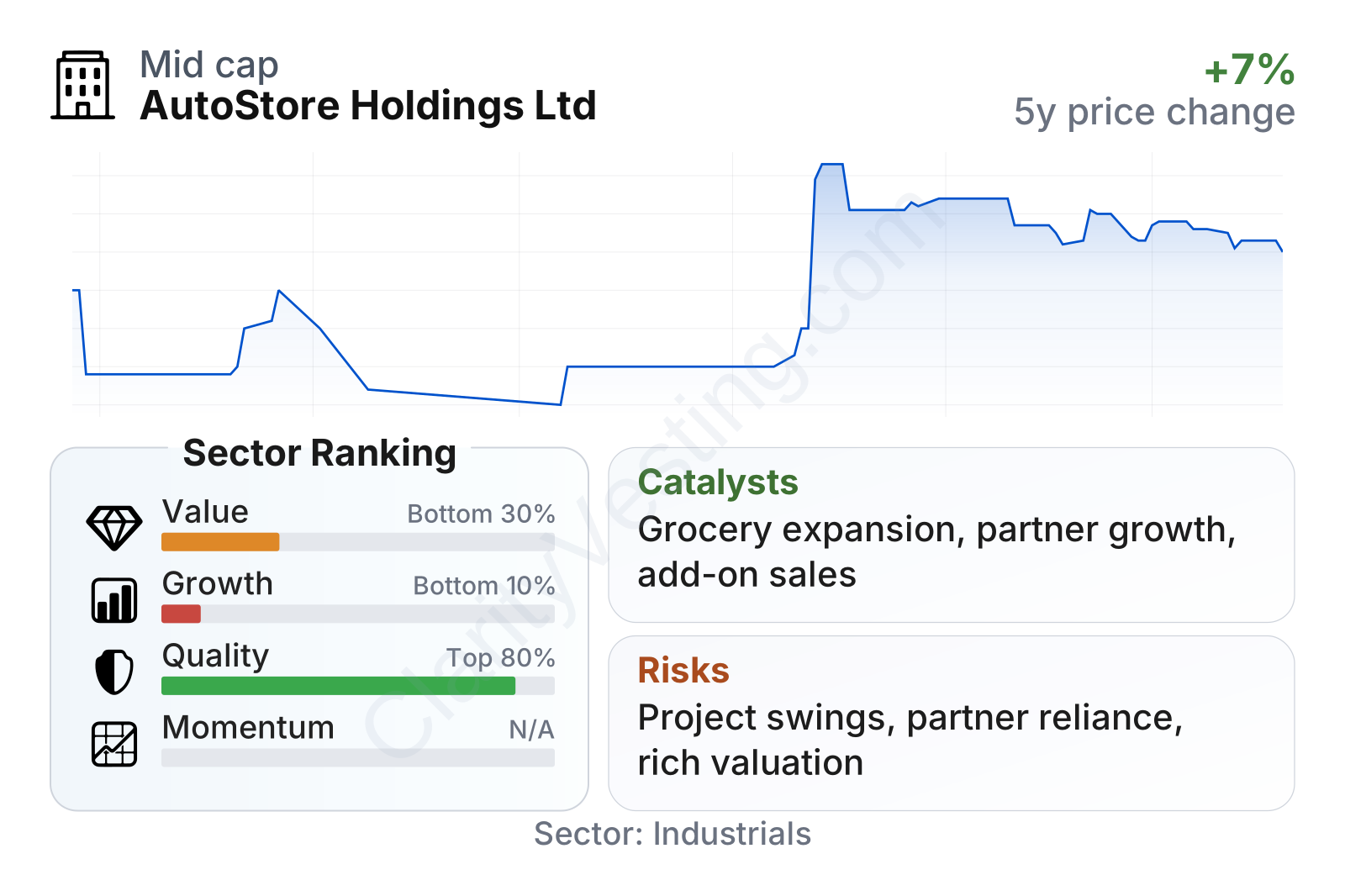
AutoStore stands out more for profitability and balance-sheet strength than for traditional value or long-term growth consistency. Operating margin is far above the sector median, profit margin is also well ahead of peers, and leverage is very low, with net debt close to negligible relative to earnings. Interest coverage is healthy, which reduces financial strain if demand becomes uneven.
At the same time, the valuation appears demanding on several common measures. The earnings multiple and book-value multiple are above sector medians, while free-cash-flow yield is relatively low. That combination usually means the market is assigning a premium to the company’s technology, margins, and long-term automation opportunity rather than to near-term cash generation alone.
The growth picture is mixed. Recent year-over-year revenue growth has been strong, but the longer five-year record is less impressive, with revenue per share and free cash flow showing pressure over that period. This helps explain why the company can rank well on quality metrics while still screening poorly on broader growth and value factors.
The share price has also shown above-average volatility, reflected in a beta close to 2.0. For a long-term reader, that means the stock has tended to move more sharply than the market, which can amplify both optimism and disappointment around orders, litigation developments, and margin changes.
Growth
AutoStore operates in a sector with durable structural support. Warehouse automation has been expanding as companies try to reduce labor dependence, improve space utilization, and shorten delivery times. These needs are not limited to e-commerce. Grocery, pharmacy, spare parts, micro-fulfillment, and industrial distribution all increasingly require compact automation that can fit into existing buildings rather than only giant greenfield facilities.
The company’s strategy is logical for that environment. Its system is modular, meaning customers can begin with a smaller installation and expand capacity later by adding robots, bins, and ports. That lowers the barrier to initial adoption and can create follow-on sales from the installed base. The partner-led model also helps AutoStore access more markets and customer types than it likely could on its own.
A meaningful catalyst is the continued expansion of applications beyond traditional e-commerce fulfillment. The company has been pushing further into grocery and into solutions linked with robotic picking and automated workflows around the grid. If customers increasingly want complete high-density systems that can be installed within existing urban facilities, AutoStore’s footprint and compact design remain relevant.
Another important opening comes from litigation resolution and commercial normalization. The company has spent the last few years operating under the cloud of intellectual property disputes in the automation industry. As uncertainty around those disputes eases, some customers and integrators may be more willing to commit to long-term projects, especially where AutoStore is already a proven solution.
Recent company updates in 2026 have also pointed to continued order activity, product development, and partner expansion, all of which matter because this is a platform business. Growth does not depend only on selling more robots; it also depends on more integrators, more software capability, and more end uses for the same underlying storage architecture.
Risks
This article is for informational purposes only and does not constitute financial advice. Some content is AI-generated. See Disclaimer


