Stock Analysis · Aurinia Pharmaceuticals Inc (AUPH)
Overview
Aurinia Pharmaceuticals is a biotechnology company focused on autoimmune diseases. Its commercial foundation today is centered on LUPKYNIS (voclosporin), an oral therapy approved for adults with active lupus nephritis, a serious kidney complication of systemic lupus erythematosus. In simple terms, Aurinia is no longer an early-stage biotech living mainly on research hopes: it now has a marketed product, recurring sales, and a business model built around expanding the reach of that product while developing additional uses and geographic opportunities.
The company’s revenue is highly concentrated. Based on recent annual results and company disclosures, the business is driven overwhelmingly by product-related revenue tied to LUPKYNIS, with a much smaller contribution from collaboration or other revenue items when they occur.
- LUPKYNIS net product sales: approximately 95% to 100% of revenue in the current business mix. This includes U.S. commercial sales of the company’s flagship lupus nephritis treatment.
- Other revenue: generally a low-single-share portion when present. This can include partnership-related items, service revenue, or accounting adjustments rather than a large independent business line.
A notable improvement in the business model is visible over the last several years: revenue has climbed sharply since launch, while selling and administrative costs have become much more efficient relative to sales. The company has moved from sizable losses to profitability, which is an important change for a biotech of Aurinia’s size.
The progression is clear: revenue has expanded severalfold since 2021, gross profit has remained strong, and operating expenses have become much better controlled. By 2025, Aurinia was generating meaningful operating income and net income, a major shift from the heavy losses seen earlier in commercialization.
Key Figures
| Metric | Value | Sector ⓘ |
|---|---|---|
| Date | Oct 03, 2026 | |
| Context | ||
| Sector | Healthcare | |
| Industry | Biotechnology | |
| Market Cap ⓘ | $2.15B | |
| Beta ⓘ | 1.41 | |
Value (Cheapness) | ||
| P/E Ratio ⓘ | 7.10 | 24.06 |
| P/B Ratio ⓘ | 3.46 | 3.08 |
| FCF Yield ⓘ | 8.06% | 3.07% |
| Dividend Yield ⓘ | N/A | 2.05% |
| EBIT / EV ⓘ | 9.18% | 0.63% |
| PEG ⓘ | N/A | |
Growth (Business expansion) | ||
| Revenue Growth ⓘ | 18.90% | 7.50% |
| RPS Growth (5Y CAGR) ⓘ | 55.11% | 8.70% |
| EPS Growth (5Y CAGR) ⓘ | N/A | -18.20% |
| BVPS Growth (5Y CAGR) ⓘ | 3.14% | 3.95% |
| Margin Growth (5Y Trend) ⓘ | N/A | -0.58% |
| FCF Growth (5Y CAGR) ⓘ | N/A | 0.88% |
| DPS Growth (5Y CAGR) ⓘ | N/A | 6.80% |
Quality (Business durability) | ||
| ROIC (Latest) ⓘ | 66.51% | 3.29% |
| ROA (Latest) ⓘ | 47.60% | 3.02% |
| ROIC (5Y Median) ⓘ | -14.87% | 4.75% |
| ROA (5Y Median) ⓘ | -15.31% | 1.93% |
| Net Debt / EBIT (Latest) ⓘ | -0.71 | 1.33 |
| Net Debt / EBIT (5Y Median) ⓘ | N/A | 1.83 |
| Net Debt / EBITDA (Latest) ⓘ | -0.63 | 0.99 |
| Net Debt / Assets ⓘ | -15.07% | 5.33% |
| EBITDA / Interest ⓘ | 19.66 | 9.63 |
| Operating Margin (Latest) ⓘ | 54.20% | 9.25% |
| Operating Margin (5Y Median) ⓘ | -42.56% | 7.80% |
| Debt to Equity (Latest) ⓘ | 9.83% | 28.99% |
| Profit Margin (Latest) ⓘ | 100.84% | 3.60% |
| Free Cash Flow (Latest) ⓘ | $173.58M | |
Momentum (Price trend) | ||
| 3Y Return ⓘ | +114.38% | +37.48% |
| 12M Return (excl. last month) ⓘ | +33.86% | +20.85% |
| 6M Return ⓘ | +3.10% | +9.73% |
| Price vs. 200-Day MA ⓘ | +2.53% | +4.69% |
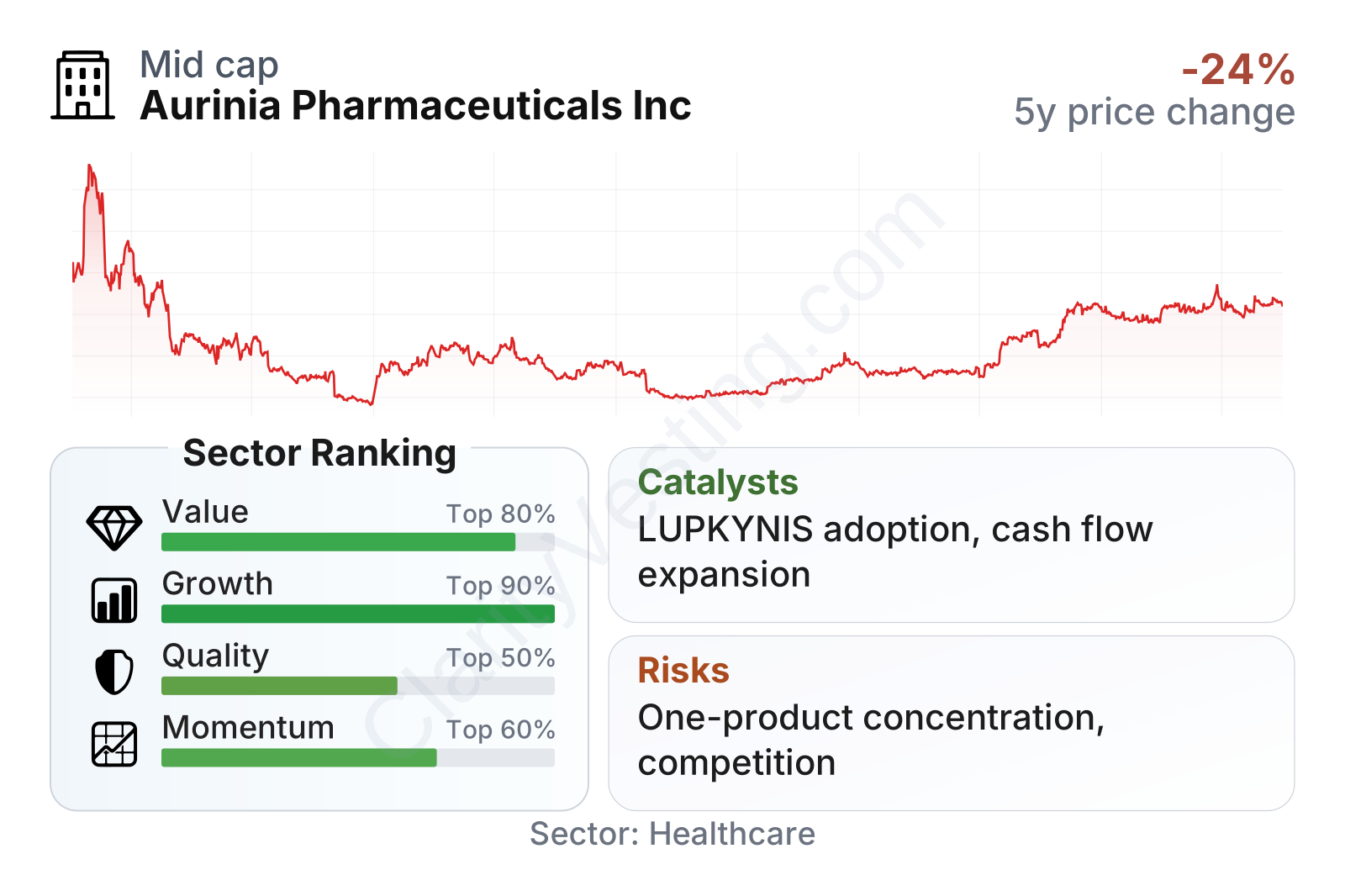
The market is treating Aurinia as a smaller healthcare company with above-average share price volatility, which is common in biotech. What stands out in the latest metrics is the combination of strong growth, high current profitability, and a low earnings multiple relative to the sector. The company also ranks well on free cash flow generation and balance sheet strength, while momentum is positive but not extreme. That mix is unusual in biotechnology, where many companies still operate at a loss.
The share price history also shows why the stock attracts attention but requires patience. It has been highly volatile over the past several years, falling hard after earlier highs and then recovering strongly as the company moved into sustained profitability. That pattern reflects how closely sentiment is tied to execution, reimbursement progress, and expectations for future product growth.
Growth
Aurinia operates in a healthcare niche that remains attractive for long-term expansion. Lupus nephritis is a severe condition with meaningful unmet need, and treatment is specialized, long-term, and supported by physician education and payer access efforts. That creates a market where a successful therapy can build durable commercial value if adoption keeps improving.
The company’s strategy is straightforward and sensible: deepen adoption of LUPKYNIS in the U.S., support physician awareness, improve persistence and access, and extend the product opportunity through new regions or lifecycle development. For a company of this size, focusing resources on one approved medicine rather than spreading itself across too many programs can be a rational way to protect cash generation.
Revenue growth remains healthy, though naturally slower than in the earliest launch phase. Recent year-over-year growth has still been running around the high teens to mid-20% range, which is comfortably above the broader healthcare sector median. The bigger point is not just top-line growth by itself, but the fact that sales growth has continued even after the initial launch period, suggesting the product still has room to penetrate its target market.
Cash generation has improved even more dramatically than sales. Aurinia moved from clearly negative free cash flow a few years ago to strongly positive free cash flow more recently, showing that the commercial platform is now producing excess cash rather than consuming it. That gives management more flexibility for business development, further clinical work, or capital allocation decisions without relying heavily on external financing.
A strong recent catalyst has been the company’s transition into profitability and sustained commercial execution. Another important opportunity is any evidence that the addressable market for lupus nephritis remains underpenetrated, since that would support continued prescription growth without needing a brand-new product launch. In addition, strategic transactions, licensing activity, or pipeline expansion using the cash-generating base business could materially change the growth outlook over time.
Risks
This article is for informational purposes only and does not constitute financial advice. Some content is AI-generated. See Disclaimer